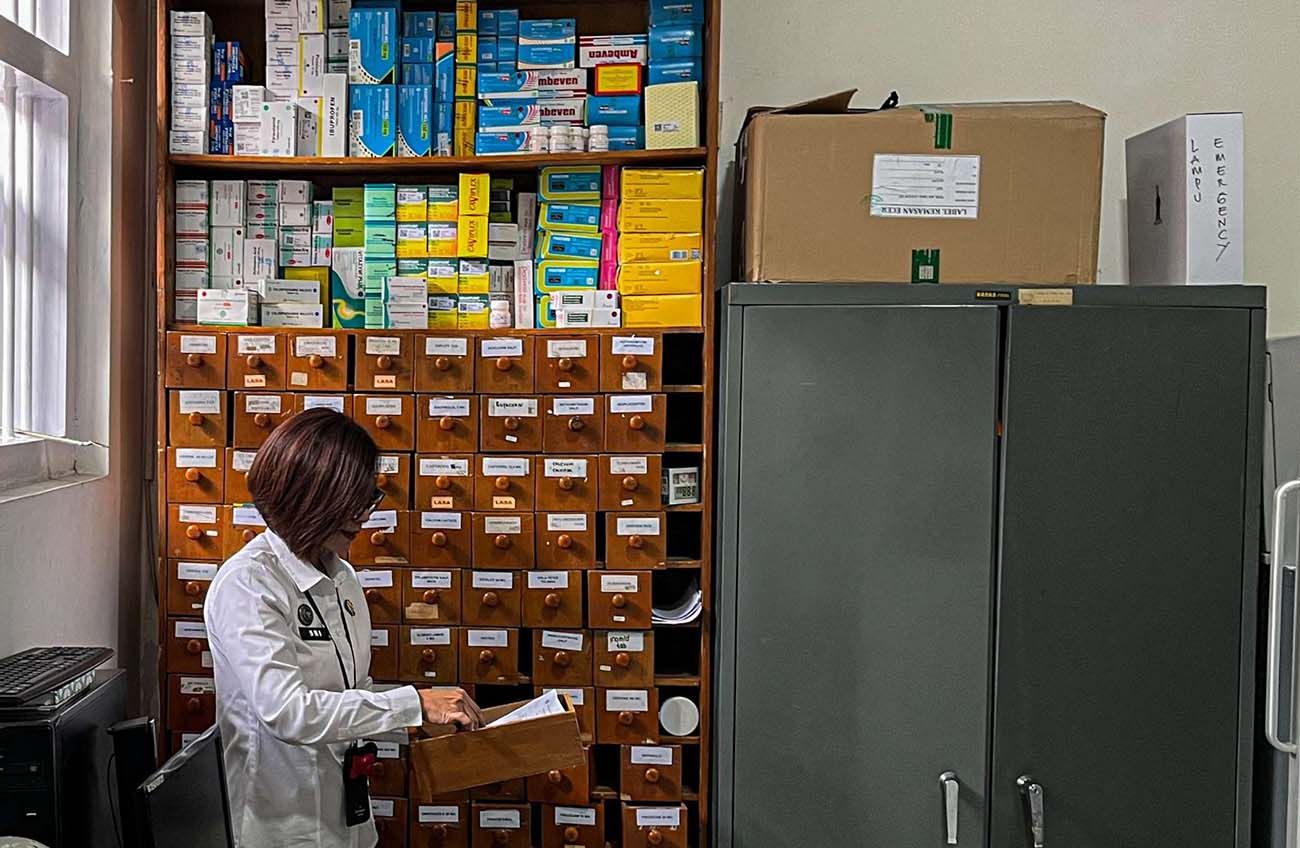
Minister of Health Budi Gunadi Sadikin stated that the prices of medicines are likely to
rise due to the fluctuations in the rupiah’s exchange rate against the US dollar and the
increase in oil prices. However, these increases are expected not to soar sharply,
remaining within reasonable limits.
“In fact, prices for medicines under the National Health Insurance (JKN) program are
guaranteed not to rise and will remain stable,” the Minister said in a statement in
Jakarta, Sunday, June 14, 2026.
The Ministry of Health, he said, has made efforts to ensure that medicines used by BPJS
Kesehatan do not experience price hikes. “We have reviewed which medicine prices
have risen reasonably and which have not. But for BPJS medicines, we have managed to
maintain them,” Budi said.
He explained that an increase in the dollar exchange rate does not automatically mean
that medicine prices will follow with the same percentage. This is because a large portion
of the components for domestic medicine production still utilizes the rupiah.
Therefore, the government has calculated a reasonable threshold for price increases.
Increases in the range of 10-20% are considered reasonable. Meanwhile, anything above
that figure is deemed an attempt to take one-sided profit.
Director General of Pharmaceutical and Medical Devices at the Ministry of Health, Rizka
Andalusia, revealed that her office has coordinated with the pharmaceutical industry
regarding these price calculations. She confirmed that the maximum price adjustment is
capped at 20%. “At most 20%. It depends on the type of medicine; some might only
increase by 5% or 10%. But it cannot be more than 20%,” she said.
Amidst price adjustments for commercial or non-BPJS medicines, the government
guarantees that the prices of medicines included in the JKN scheme will not be affected.
The Potential for Declining Service
Meanwhile, BPJS Watch Advocacy Coordinator, Timboel Siregar, stated that a decline in
hospital services has the potential to occur. This is because the increase in medicine
prices is not followed by adjustments to capitation prices and claim package tariffs,
which refer to the INA-CBG’s.
“Hospitals are squeezed here, but they need to operate. As a result, JKN patients will
certainly experience limited service. If they are general patients, they will definitely be
charged higher costs. This was not anticipated by policymakers. In the end, it is the
community that suffers again,” said Timboel.
Chairman of the Indonesian Empowered Consumer Forum (FKBI), Tulus Abadi, said that
the skyrocketing prices of medicines and vitamins are an inevitability, as 85-90% of raw
materials for medicines in Indonesia come from imports.
He mentioned that the rise in medicine prices will further reduce the consumption ratio
of medicines in Indonesia, which is already considered low. “The collapse of the rupiah
exchange rate will cause the medicine consumption ratio of the Indonesian people to
decline even further, because medicines are becoming more expensive,” he said.
Another impact of the skyrocketing medicine prices is the bloating of the BPJS Kesehatan
budget. According to Tulus, health facilities will submit larger claims, thereby further
pressuring the financial condition of BPJS Kesehatan.
Tulus also assessed that the weakening exchange rate could cause lower-middle-class
pharmaceutical industries to face the threat of bankruptcy. This is because if they cannot
afford to buy raw materials for medicines, production activities will stop. “The threat of
bankruptcy and layoffs becomes inevitable,” he said.