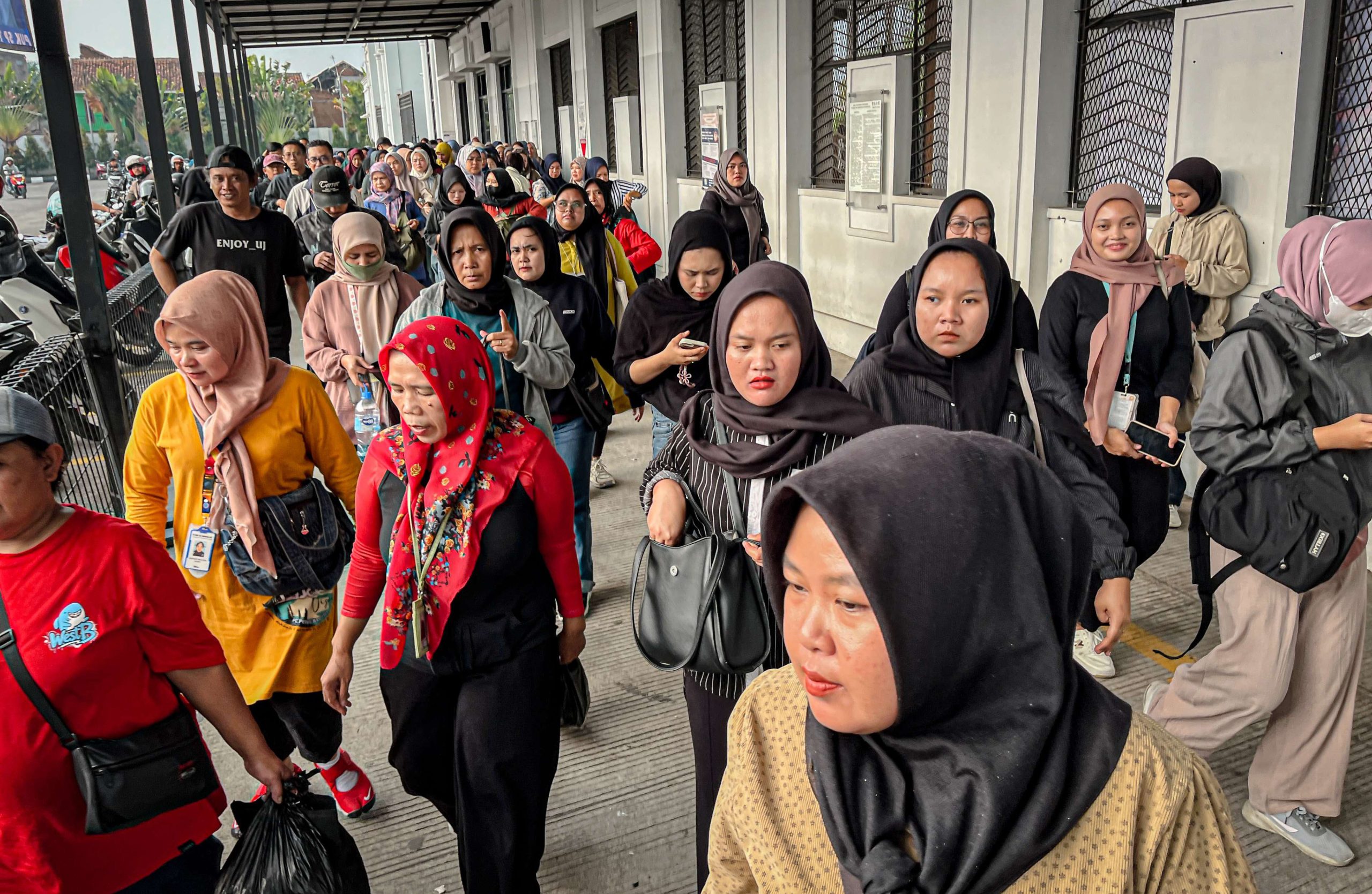
BPJS Watch Advocacy Coordinator Timboel Siregar believes that the continuing wave of layoffs across various sectors could further worsen Indonesia’s employment situation.
“The growing number of workers losing their jobs not only increases the open unemployment rate but also weakens people’s purchasing power, accelerates the shrinking of the middle class, and triggers various social problems,” Timboel said in a statement in Jakarta on Thursday, June 25, 2026.
Previously, President of the Confederation of All Indonesian Trade Unions (KSPSI), Andi Gani Nena Wea, revealed that as many as 55,000 workers could face layoffs in the near future due to issues related to industrial gas supplies.
Andi stated that soaring industrial gas prices have become one of the major burdens on businesses. He urged the government to find a solution as quickly as possible.
If the issue remains unresolved, he warned that layoffs could spread further into the textile industry.
“Gas prices have risen from US$6 to US$23 per MMBTU (Million British Thermal Units). This is extremely alarming. The textile industry could be next. Any sector that relies on industrial gas will face serious difficulties,” Andi said.
Presidential Special Advisor for Employment and Workers’ Welfare Said Iqbal also highlighted another potential source of layoffs. According to him, the planned relocation of two automotive component factories from East Java to Vietnam could result in mass layoffs affecting around 7,000 workers.
Said explained that the two factories, identified as PT J and PT S, are subsidiaries of Japanese parent companies. PT J currently employs approximately 7,000 workers, of whom at least 4,000 could be affected by layoffs.
According to Timboel, the government has yet to demonstrate concrete measures to fulfill the mandate of Law No. 6 of 2023, which requires efforts to prevent layoffs.
“So far, the government has not developed a clear strategy to curb layoffs amid economic weakness and increasing pressure on businesses. Economic conditions continue to deteriorate, and one of the consequences is the ongoing occurrence of layoffs for various reasons,” he said.
The government, he added, should implement Article 151 Paragraph (1) of Law No. 6 of 2023, which mandates efforts to prevent layoffs. However, there has been no visible strategy or concrete action to prevent job cuts, including the unrealized establishment of the Layoff Task Force that had previously been promised.
Contributing Factors
Timboel highlighted several factors accelerating layoffs, including the weakening rupiah exchange rate, which increases production costs for industries dependent on imported raw materials, high interest rates that raise borrowing costs for businesses, and electricity supply issues that could disrupt industrial operations.
In addition, government policies related to the regulation of forest and plantation areas could place additional pressure on labor-intensive sectors such as the palm oil industry.
“Businesses are currently facing pressure from both international geopolitical issues and domestic policies. The weakening rupiah, high borrowing costs due to elevated interest rates, uncertainty in industrial electricity supplies, and policies regulating forest and plantation areas are all factors that could accelerate layoffs,” he said.
For that reason, Timboel urged the government to exercise greater caution when formulating policies so as not to impose additional burdens on businesses that could ultimately affect workers, particularly in labor-intensive sectors.
He added that the situation is becoming increasingly concerning because the creation of new jobs has not been able to keep pace with annual labor force growth, which reaches around two to three million people each year.
Therefore, the government needs to focus more on preserving existing formal employment while accelerating the creation of new job opportunities.
“The government must be serious about maintaining existing formal jobs because the creation of new employment opportunities has not yet been able to match the annual growth of the labor force,” he said.
Timboel stressed that the public currently needs policies focused on safeguarding businesses, creating formal employment opportunities, and preventing layoffs so that labor conditions do not deteriorate further.
“The promise to create 19 million jobs and the commitment to prevent layoffs must be realized through concrete and measurable actions, not merely promises,” he said.
Meanwhile, Indonesian Employers Association (Apindo) Employment Affairs Chair Bob Azam said the organization is preparing 12 mitigation measures to help companies avoid layoffs amid ongoing economic pressures.
The measures are being designed as an early warning system to assess corporate conditions before businesses are forced to resort to layoffs.
Apindo has coordinated with the government, including the Ministry of Manpower, to develop the guidelines.***