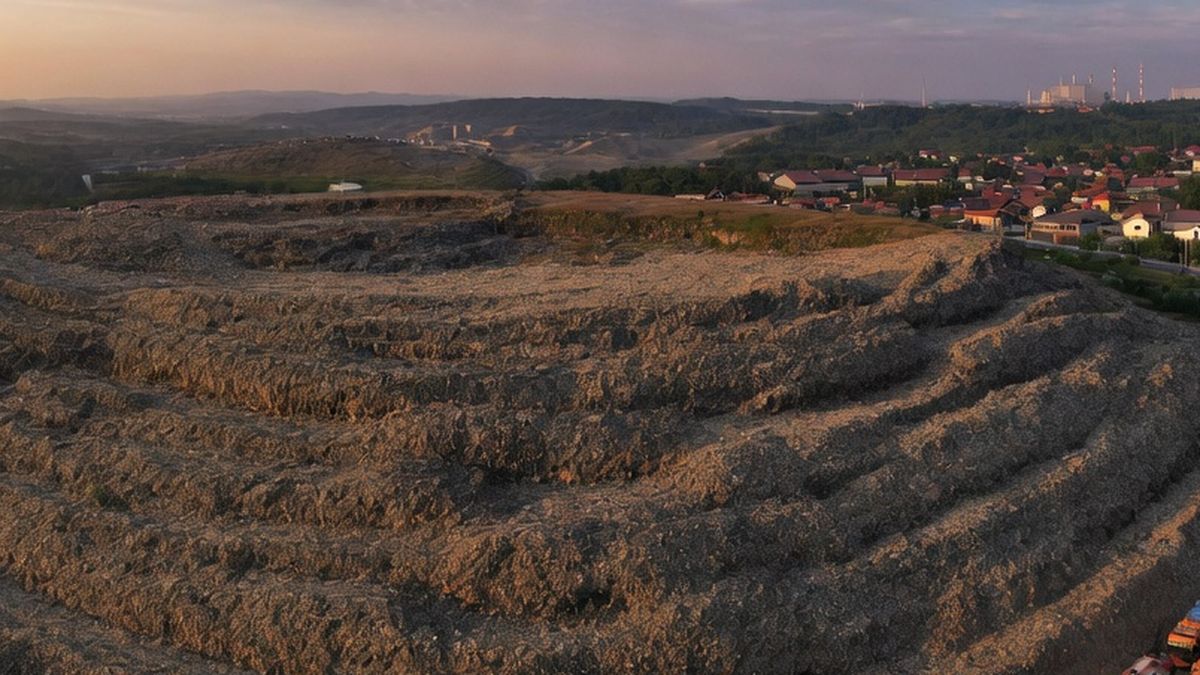
DEPOK RUBLIC — Bantargebang TPST in Bekasi, West Java, is listed as a waste disposal location with the second largest methane gas eruption in the world. This finding refers to a report by the Emmett Institute research team at the University of California Los Angeles (UCLA) which used satellite-based Carbon Mapper data from Planet Labs and the NASA space station.
In the report, the Bantargebang TPST was detected producing around 6.3 metric tons of methane gas per hour throughout 2025. This amount places Bantargebang just below Campo de Mayo in Buenos Aires, Argentina, which was recorded as producing 7.6 metric tons of methane per hour.
The magnitude of these emissions places Bantargebang as one of the most significant contributors to methane emissions from the waste sector globally. Methane gas itself is known to come from the process of decomposing organic waste which accumulates in large volumes and is not managed optimally.
According to a UCLA report quoted by Katadata on April 28 2026, a landfill with emissions of five tons of methane per hour has a global warming impact equivalent to one million SUVs or a 500 megawatt coal-fired power plant.
This shows that the emissions released by Bantargebang have a very large scale climate impact, even exceeding the comparison threshold used in the study.
Equivalent to a Large Capacity Power Plant
Katadata wrote that the volume of methane gas from Bantargebang is said to be equivalent to energy emissions from a large capacity power plant. This comparison shows the large energy potential and environmental threats contained in these waste piles.
As a comparison, the Babelan PLTU operated by PT Cikarang Listrindo in West Bekasi has a capacity of 280 megawatts. Meanwhile, PT Bekasi Power’s PLTGU in the Jababeka industrial area has a total capacity of 755 megawatts.
With this scale, the methane gas produced by Bantargebang is considered to be no less large than conventional energy generation capacity in the surrounding area. This reinforces the picture that the landfill in Bantargebang is not only a sanitation problem, but also an energy and environmental problem.
In that context, the large methane emissions are an indicator that the volume of organic waste at that location is very dominant and has not been handled optimally.
Environmental Threats And Safety Risks
Apart from contributing to global warming, the accumulation of methane gas in landfills also poses serious safety risks. This gas is flammable and can trigger fires or explosions if it accumulates in large quantities without an adequate control system.
Katadata explains that the release of large amounts of methane into the atmosphere is exacerbating the climate crisis because this gas has a much higher global warming potential than carbon dioxide in the short term.
On the other hand, the large methane emissions also indicate that organic waste management in Bantargebang is still not optimal. Organic waste that rots openly produces large amounts of gas if it is not processed or captured through a landfill gas utilization system.
This condition shows that the waste problem in Bantargebang has developed into a strategic environmental issue that has a broad impact, both on the safety of the surrounding area and on the national emissions reduction agenda.
The Energy Potential of Waste Gas is Not Optimal
Behind these large emissions, the report also highlights that methane gas actually has the potential to be used as an energy source if captured and processed using the right system.
The gas resulting from the decomposition of organic waste can be used to produce electricity, while the organic material itself has the potential to be processed into compost if it is separated from the start. However, this potential has not been utilized optimally in the current waste management system.
According to the report quoted, the dominance of methane emissions on a large scale shows that organic waste management in Bantargebang still relies on open piling, not on an integrated processing approach.
This finding also highlights the big challenges of national waste management, especially in reducing emissions from the waste sector, which has so far often escaped public attention compared to the energy and transportation sectors.