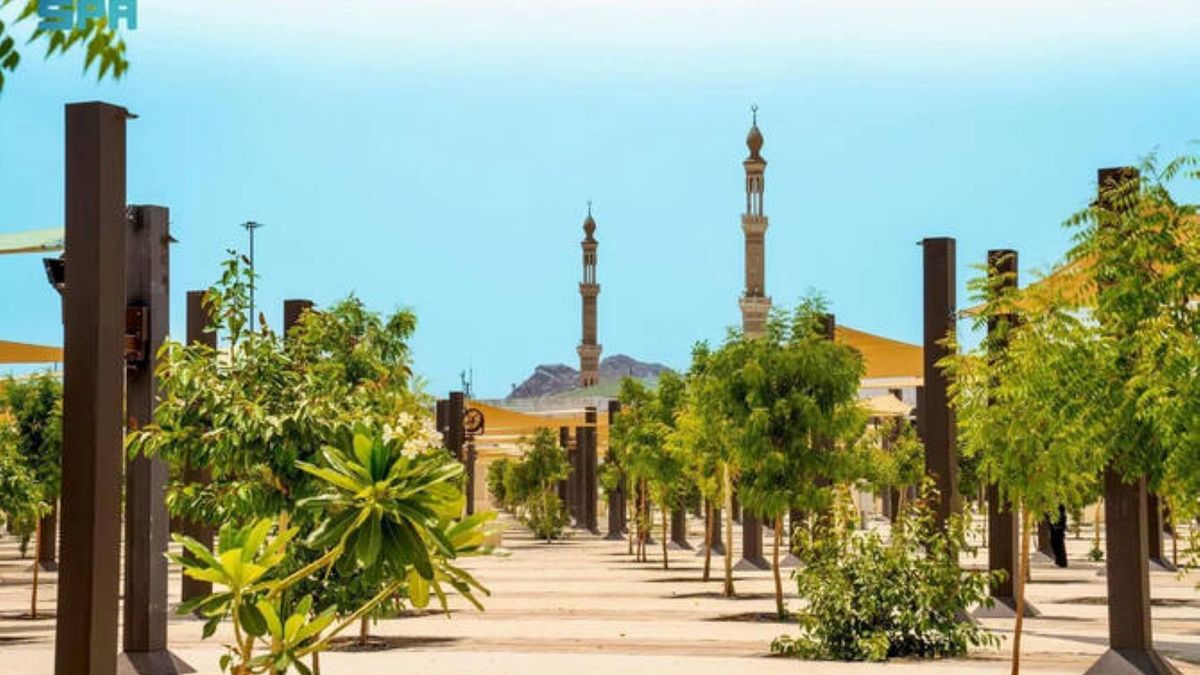
JOGJA PORTAL – Saudi Arabia is showing real and measurable steps in changing the face of the holy city of Mecca to become greener, cooler and more sustainable. In recent times, more than 60,000 trees have been planted in holy sites—a major achievement that is not only symbolic, but also has a direct impact on the comfort of millions of Hajj and Umrah pilgrims.
The Saudi Press Agency recently reported that this greening movement was driven systematically by Kidana Development Co., a subsidiary of the Royal Commission for Makkah City and Holy Sites. Through a gradual and planned approach, this company planted tens of thousands of trees at various strategic points, from congregation movement routes to open areas around worship locations. The latest planting of 40,000 trees complements the previous phase which had reached more than 20,000 trees, creating a significant spike in green space.
The results are very noticeable. Compared to last year’s Hajj season, the green area in Makkah has increased threefold. In the midst of desert temperatures that can reach extreme levels, the presence of these trees plays an important role in lowering environmental temperatures, providing shade and improving air quality. For the congregation, this change provides a worship experience that is much more comfortable, humane and environmentally friendly.
Also read: Three Indonesian citizens arrested in Mecca, illegal Hajj advertisement demolished
However, this success did not come instantly. This greening program is part of a grand strategy integrated in Saudi Vision 2030 and the Saudi Green Initiative. These two initiatives are the foundation for Saudi Arabia’s transformation towards a country that is not only economically advanced, but also committed to environmental conservation. In the context of Makkah, the challenge is much more complex because it must maintain a balance between large-scale infrastructure development and the sanctity and sustainability of the area.
Not only focusing on planting trees, Saudi Arabia also strengthens its ecosystem-based approach by developing natural areas such as the Al-Mughmas Valley. This area is now starting to be known as one of the promising ecotourism destinations in Makkah. With its distinctive landscape—a mix of desert and semi-desert vegetation—Al-Mughmas is home to various species of flora and fauna that are able to survive in extreme conditions. The presence of birds, insects and reptiles in this area indicates a healthy and functioning ecosystem.
The development of Al-Mughmas will not only enrich the natural landscape, but also open up new opportunities in the sustainable tourism sector. Visitors, both local residents and international pilgrims, now have an alternative way to enjoy natural beauty while understanding the importance of biodiversity conservation. This is proof that development does not always have to sacrifice the environment, but can go hand in hand.
Also Read: A Unique Way to Build Self-Confidence, Students Become Hosts at Student Led Conferences
Furthermore, this major step reflects a paradigm shift in the management of the holy city. If previously the main focus was on the capacity and smoothness of worship, now aspects of sustainability and environmental quality have become an inseparable part. Makkah is no longer only seen as a spiritual center, but also as an example of how a city with very high visitation pressure can still be transformed into a greener and more resilient one.
The success of this reforestation also carries a global message. In the midst of increasing world attention to climate change and environmental degradation, what Saudi Arabia is doing in Mecca is an inspiring model—that even in areas with harsh natural conditions, large-scale reforestation efforts are still possible with commitment, technology and careful planning.
With a combination of large-scale tree planting and development of natural areas, Saudi Arabia has now not only succeeded in beautifying the face of Mecca, but also strengthening the quality of the spiritual experience of pilgrims. Fresher air, friendlier temperatures and greener landscapes provide a more solemn and comfortable atmosphere of worship.
This transformation marks a new chapter for Mecca—a holy city that is not only the center of Muslim worship, but also a symbol of harmony between humans, nature and sustainable development. ***