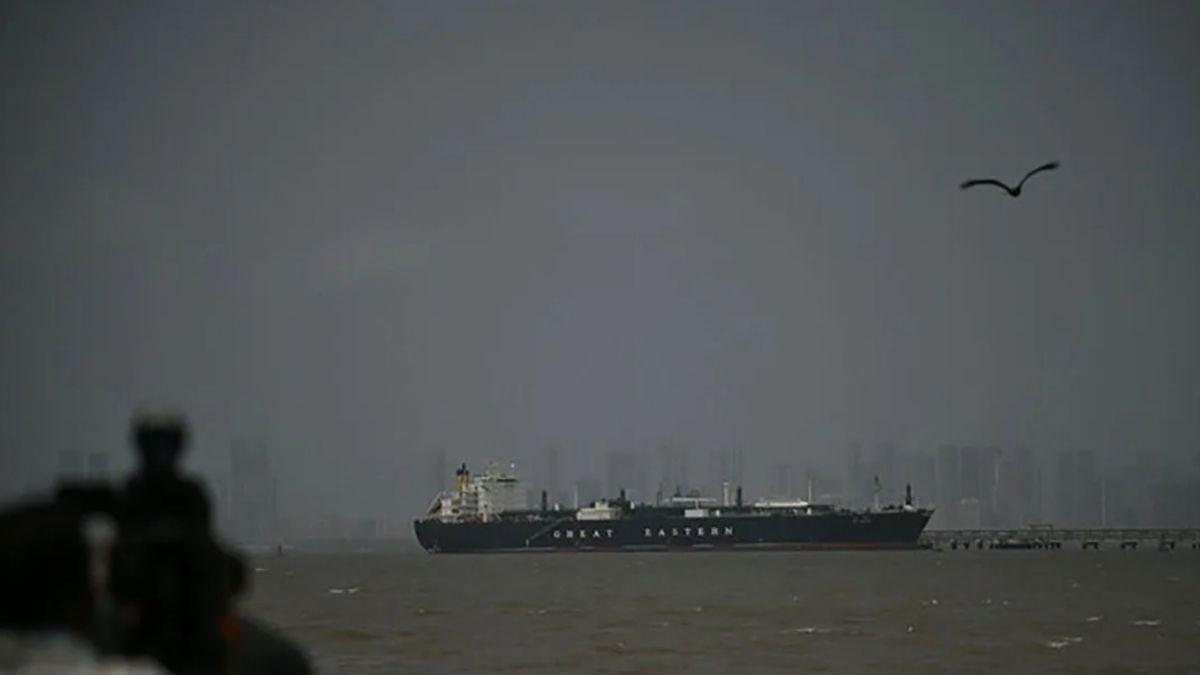
Bulukumba News – The Persian Gulf sky was still dark when the first booming sound broke the silence. In the distance, flashes of light danced over the surface of the sea—not lightning, but an air defense system working without pause. Beneath him, large ships cruised by slowly, like giant creatures lost in a region that was no longer safe.
On the deck of the escort ship, the radar was spinning non-stop. Every point of light on the screen could mean a threat. Drones, missiles, or speedboats—they all come almost at once. Within minutes, a decision had to be made: shoot or be hit.
And that morning, the world was reminded again that the Strait of Hormuz is not just a trade route—it is a vein that could turn into a battlefield for Iran and the United States at any time.
Also read: It’s not about winning, this is Iran’s strategy to face the US and Israel.
When the truce breaks in the middle of the sea
Monday, May 4 2026, marked another turning point in a conflict that has not yet completely died out. According to a Bloomberg News report, an escalation of violence broke out again in the Persian Gulf, involving the militaries of the United States, Iran and the United Arab Emirates (UAE).
Commander of US Central Command, Admiral Brad Cooper, confirmed that the US military succeeded in thwarting a combined attack from Iran—from drones, missiles, to fast boats—while escorting two American-flagged ships across the Strait of Hormuz.
In Washington, Donald Trump immediately announced the results of the operation in his trademark style.
“We shot down seven small boats, or what they call ‘fast boats,'” he wrote in Truth Social.
The statement was not just a military report. It was a political message—that America would not back down from the world’s most strategic path.
However, on the other hand, this statement also emphasizes one thing: the ceasefire that has only been running for four weeks is now at stake.
Also Read: Failure of Nuclear Negotiations in Islamabad: Trump Cancels Meeting and Challenges Tehran
The fires in Fujairah and the fear that spreads
The tension doesn’t stop at sea. On the UAE mainland, a port in Fujairah caught fire after being attacked by Iranian drones. Flames rose high, bouncing off the walls of the container, while ambulance sirens wailed amidst the panic.
Three people were reportedly rushed to hospital. For the first time since the ceasefire took effect, UAE authorities issued a missile warning to its citizens.
Another attack also hit a tanker belonging to Abu Dhabi National Oil Co (ADNOC), broadening the spectrum of conflict from military to energy infrastructure.
In an instant, the conflict that had subsided spread again—from sea to port, from military to civilian.
Like a domino effect, the explosion in Hormuz immediately rocked world markets. The price of Brent crude oil jumped around 6% and reached US$106 per barrel—around Rp. 1.8 million. Meanwhile, US crude oil rose more than 4% to close to US$114 per barrel or around Rp. 1.9 million.
These numbers are not just statistics. They are crisis signals. The Strait of Hormuz currently carries around 20% of the world’s oil supply. When that pathway is disrupted, the world loses not only oil—but also certainty.
Defense analyst Bloomberg EconomicsBecca Wasser, called this situation a bad sign.
“All of this confirms that the US-Iran ceasefire is very fragile. The most likely outcome is a protracted conflict with ongoing tensions and sporadic fighting that keeps oil prices high.”
The sentence felt like a prediction—or perhaps a warning.
Also read: Cracked ceasefire: Netanyahu vs Hezbollah accuse each other, Lebanon threatens to explode
“Project Freedom” and the liberation narrative
In the midst of the chaos, Trump launched an operation called Project Freedom. The aim is to escort trapped commercial ships out of the Persian Gulf.
Trump called the ships “held hostage by a pretty evil place.” He emphasized that many countries had asked America for help to free their fleets.
However, behind the “liberation” narrative, there is a more complex reality.
Iran, on the other hand, views the US military presence as a violation. Tehran even emphasized that it would only reopen the Strait of Hormuz if the blockade on its ports was lifted.
At this point, the conflict is no longer about who attacks whom—but rather who has the right to control the most vital route in the world.
Also read: Struck by a serious illness, is it true that the Zionist Prime Minister of Israel has officially resigned?
Between diplomacy and the threat of a new war
Interestingly, in the midst of the escalation, Iranian Foreign Minister Abbas Araghchi actually stated that talks with the US were “making progress”.
However, he gave a sharp warning: the US and UAE must be careful not to be trapped again in a deadlock caused by parties who do not want peace.
This statement reflects the paradox of modern conflict: diplomacy goes hand in hand with war. On the one hand, negotiations are continuing. On the other hand, missiles are still launched.
Political pressure also comes from within the US. Senator Lindsey Graham urged a “big, strong and short” military response. Meanwhile, former Israeli PM Naftali Bennett called the attack on the UAE a “declaration of the resumption of war”.
The war narrative has strengthened again.
Also Read: Sea Drama Peaks! Iran Shoots and Seizes Ships, World Oil Routes Threatened to Be Paralyzed
The Strait of Hormuz: Small point, global impact
On the world map, the Strait of Hormuz is just a narrow line connecting the Persian Gulf with the Arabian Sea. But in the real world, it is a geopolitical center of gravity.
About 130 ships usually pass through every day. Now, that number has shrunk drastically. Many ships chose to wait, or even turned around.
Iran has reportedly blocked almost all shipping traffic. Meanwhile, the US claims to be able to open the route with advanced technology, including underwater drones with low detection capabilities.
This is where technology meets tension, and military strategy meets global economics.
The conflict that began on February 28, 2026 has killed more than 5,500 people, mostly in Iran and Lebanon.
That number continues to increase, even though the world had hoped that a ceasefire would be the end point.
Now, that hope is shaky again. The Strait of Hormuz is not just a battlefield—it is a symbol. A symbol that the modern world is still fragile in the face of ancient conflicts: power, energy and domination.
In the midst of the boom and bustle of oil prices continuing to climb, one question hangs in the air: how long can the world survive this kind of tension?
Because in the Strait of Hormuz, every shot is not just about war—it’s about the future of energy, global stability, and the fate of millions of people who have never even seen the sea.***