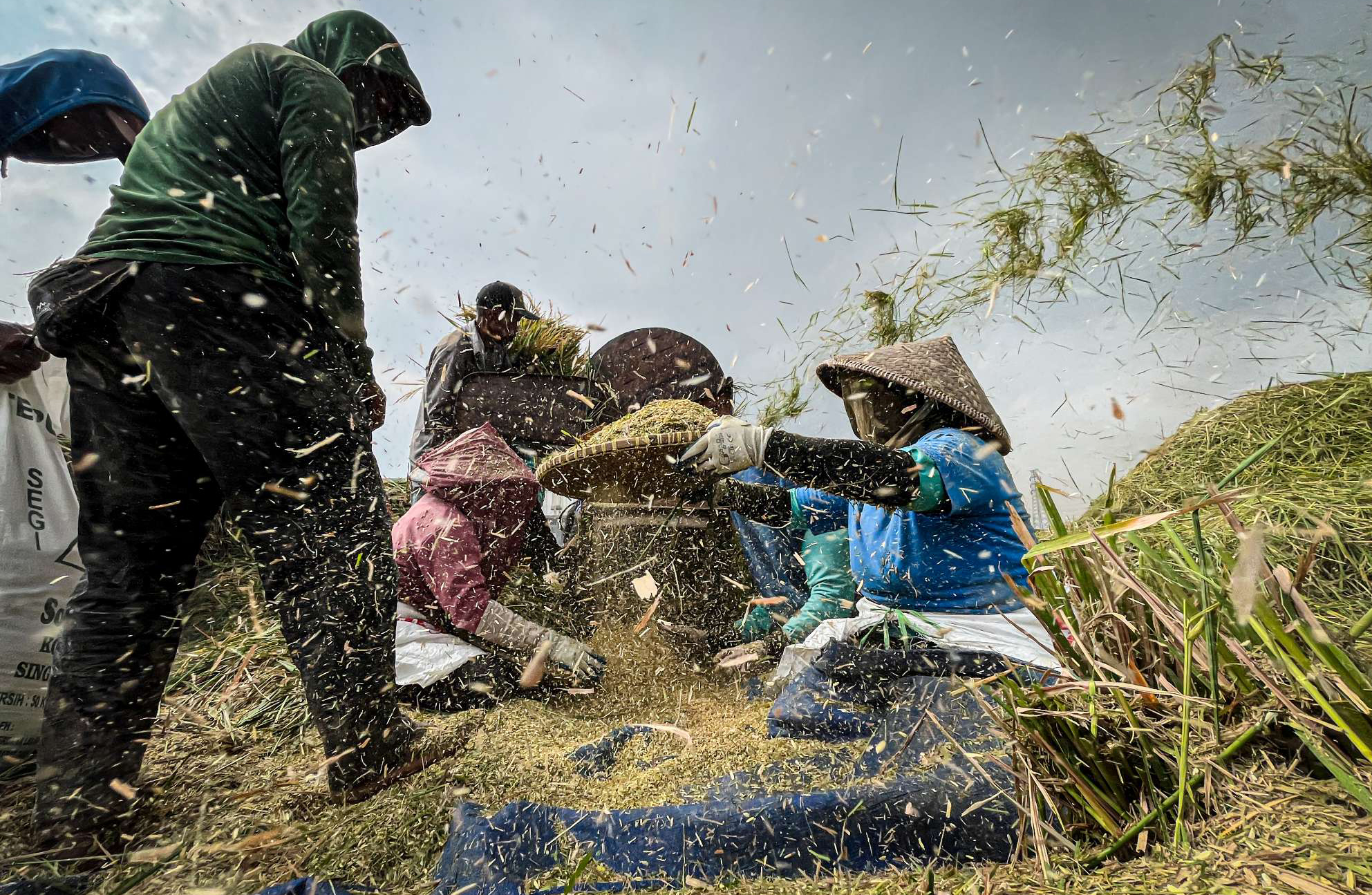
Agricultural analyst Khudori from the Indonesian Association of Political Economy (AEPI) said that rice prices continue to show an upward trend even though the government currently holds the largest rice reserves in the country’s history.
He believes this situation reflects strong pressure from the domestic market, particularly due to high paddy prices and the fact that government rice distribution to the market has not yet been fully optimized.
“The increase in rice prices has actually been occurring since the beginning of the year and has consistently been seen at various levels of trade, from rice mills and wholesalers to retailers. This phenomenon is interesting because it is happening during the main harvest season and amid a significant increase in national rice stocks,” he said in a statement in Jakarta on Wednesday, June 24, 2026.
Khudori added that the public narrative claiming rice prices are stable is not entirely incorrect, but only partially true.
“The accurate statement is that rice prices are stably high and continue to rise,” he added.
Data from Indonesia’s Central Statistics Agency (BPS) show that the national average price of medium-grade rice in the third week of June 2026 reached Rp14,402 per kilogram, an increase of 0.38 percent compared with May 2026. Meanwhile, premium rice reached Rp16,230 per kilogram, up 0.46 percent month-on-month.
These prices have exceeded the government’s Highest Retail Price (HET) for Zone I, which is set at Rp13,500 per kilogram for medium rice and Rp14,900 per kilogram for premium rice.
Khudori said the main factor driving rice price increases is the high price of unhusked rice at the farmer level. Based on BPS data, the national paddy price on June 20, 2026, reached Rp6,993 per kilogram, exceeding the Government Purchasing Price (HPP) of Rp6,500 per kilogram.
In several major production centers such as Lampung and East Java, paddy prices have reportedly reached between Rp7,500 and Rp8,000 per kilogram.
According to him, rising paddy prices directly increase rice production costs because paddy is the primary raw material used in rice milling.
“Rice is produced from paddy. When paddy prices become more expensive and exceed the HPP, milled rice will naturally become more expensive as well,” he said.
At the same time, paddy production has begun to decline following the end of the main harvest season. BPS estimates that dry unhusked paddy production in June 2026 will reach 4.05 million tons, down approximately 18 percent from May 2026, which recorded 4.94 million tons.
Although production is projected to increase again in July, the volume will remain far below the peak harvest level recorded in March 2026, which reached 8.71 million tons.
Khudori noted that this condition has intensified competition for paddy supplies. The competition involves not only rice mills but also Perum Bulog, which continues to procure paddy and rice to meet its Government Rice Reserve (CBP) targets.
As of mid-June 2026, Bulog had procured approximately 3.14 million tons of rice out of its 4 million-ton target.
Limited Impact
In addition to high paddy prices, Khudori believes that rice distribution through the Food Supply and Price Stabilization (SPHP) program has not been large enough to significantly influence market prices.
Bulog data show that SPHP rice distribution from March through June 20, 2026, totaled only 361,667 tons, equivalent to around 3,229 tons per day.
According to Khudori, this volume remains relatively small compared to overall market demand, limiting its stabilizing effect.
This is despite the fact that Bulog currently manages approximately 5.2 million tons of rice stocks—the highest level ever recorded.
Therefore, he urged the government to accelerate the release of government rice reserves into the market to strengthen price stabilization while reducing the risk of declining rice quality caused by prolonged storage.
He stressed that such a measure is important so that the abundance of national rice reserves can genuinely benefit the public through more affordable prices rather than simply remaining stored in warehouses.
Meanwhile, Minister of Agriculture Amran Sulaiman responded to concerns over high rice prices in Indonesia. He said that whether rice is considered expensive must be viewed from a broader perspective.
“We first need to agree on the definition of expensive. We must strike a balance. We have to protect farmers as producers—115 million people—while also ensuring consumers are satisfied,” he said.
Amran emphasized that farmers’ welfare must remain a priority because farmers are the final line of defense for national food security.
If farmers’ welfare is not protected and continues to decline, it will affect national food production. In the worst-case scenario, it could trigger a national food crisis that would directly affect between one and two million Indonesians.***