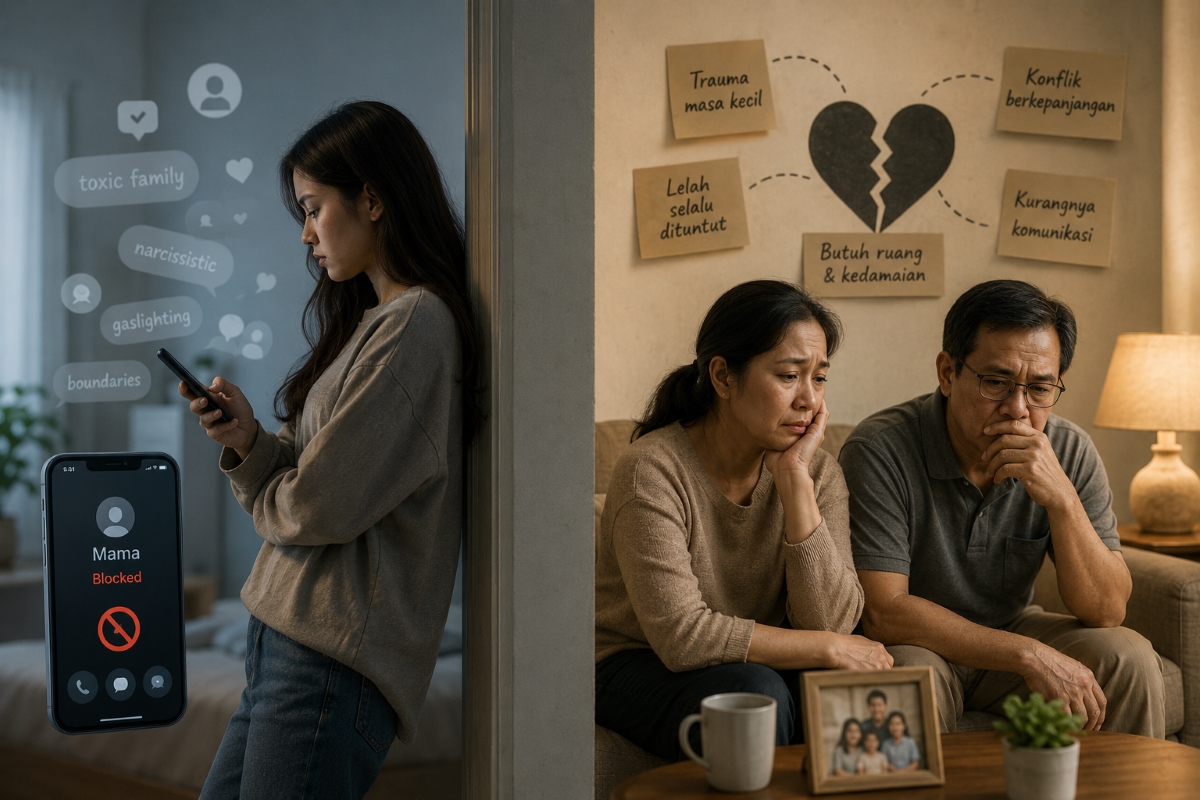
A brief message appears on a phone without warning. Its contents are short but emotionally chilling: an adult child announces that, from that day forward, they have chosen to cut ties with their family. Their parents are blocked on every communication platform, phone numbers are no longer reachable, and all avenues for contact are closed.
This scenario is no longer merely the plot of a family drama. It has become an increasingly visible social reality in modern society. The phenomenon of “going no contact”—where adult children completely sever relationships with their parents—is now drawing widespread attention around the world.
Many people assume that family conflicts can always be resolved around the dinner table during the holidays. In reality, however, the situation is often far more complicated.
A panel discussion featured in the podcast “Oprah Explores the Rising Trend of Going No Contact with Your Family” on Oprah’s official channel has shed new light on the issue. Hosted by Oprah Winfrey, the podcast highlighted findings from a Cornell University study showing that nearly one-third—or approximately 30%—of Americans are currently experiencing estrangement from an immediate family member.
One of the primary drivers behind this growing trend is a shift in cultural values. According to psychologist Dr. Joshua Coleman, speaking in the podcast, younger generations have fundamentally changed the way they view family relationships.
Traditional expectations that children should obey and respect their parents unconditionally are gradually fading. Today’s adults are more likely to prioritize personal happiness, mental health, self-identity, and healthy personal boundaries. Protecting psychological well-being has become one of the strongest reasons behind the decision to distance themselves from family members.
The rise of social media has further amplified the phenomenon. Millions of videos discussing “toxic families” have created online spaces where people feel validated in sharing their experiences.
However, Dr. Coleman also criticized the widespread misuse of psychological terminology on the internet. Labels such as “narcissistic,” “gaslighting,” and “boundary violations” are often applied too casually to justify cutting off family relationships. As a result, some loving and hardworking parents may be unfairly judged and excluded without ever being given the opportunity to address or repair the relationship.
For adult children who choose to leave, the decision rarely stems from a single incident.
During Oprah’s discussion, an audience member named Bristol explained that her decision was rooted in childhood trauma. She said she grew tired of constantly being expected to be the “perfect child” while simultaneously serving as the family’s emotional punching bag. Bristol shared that she only felt her nervous system leave its constant state of survival mode after creating distance from her family.
A similar story came from Chris, who chose to end contact in order to protect his young daughter from rejection and the emotionally distant treatment she experienced from grandparents who demanded unquestioning obedience.
On the other side of the relationship, many parents are left overwhelmed by confusion and heartbreak.
Chrissy, a mother who participated in the discussion, described feeling completely shocked. After what seemed to be a positive family vacation together, the relationship with her child suddenly collapsed for more than three years following what she considered a relatively minor disagreement in which her child did not get what they wanted.
She also lamented what she sees as a social media culture that too often portrays parents as villains without allowing opportunities for open dialogue or reconciliation.
The Path Toward Healing
Bridging the growing divide requires a deeper understanding of how family relationships have evolved.
Best-selling author Dr. Lindsay Gibson emphasized an important principle during the discussion: the era in which simply holding the title of “mother” or “father” automatically guaranteed authority has come to an end.
Parental relationships with adult children can no longer rely solely on status. Instead, they must be nurtured through effective communication, empathy, and emotional validation. Young adults facing the pressures of modern life often lack the emotional energy to maintain relationships they perceive as consistently draining.
Despite the pain of estrangement, reconciliation is not impossible.
The key, according to the discussion, lies in humility, self-reflection, and a willingness to acknowledge one’s own shortcomings. This was illustrated by Aaron, a father who successfully repaired his fractured relationship with his daughter. He set aside his pride, sought counseling with a psychologist, and learned to respect his adult daughter’s privacy instead of trying to control her as though she were still a teenager.
For parents hoping to reopen communication, Dr. Coleman recommends beginning with a statement that validates their child’s perspective:
“I know you wouldn’t have made this decision unless you truly believed it was the healthiest thing for you right now.”
The next step, he says, is to sincerely look for the truth within the child’s grievances.
As Oprah concluded at the end of the discussion, forgiveness in family conflict means letting go of the hope that the past could have been different. It is an act of accepting reality—not for someone else’s sake, but to find one’s own inner peace.***