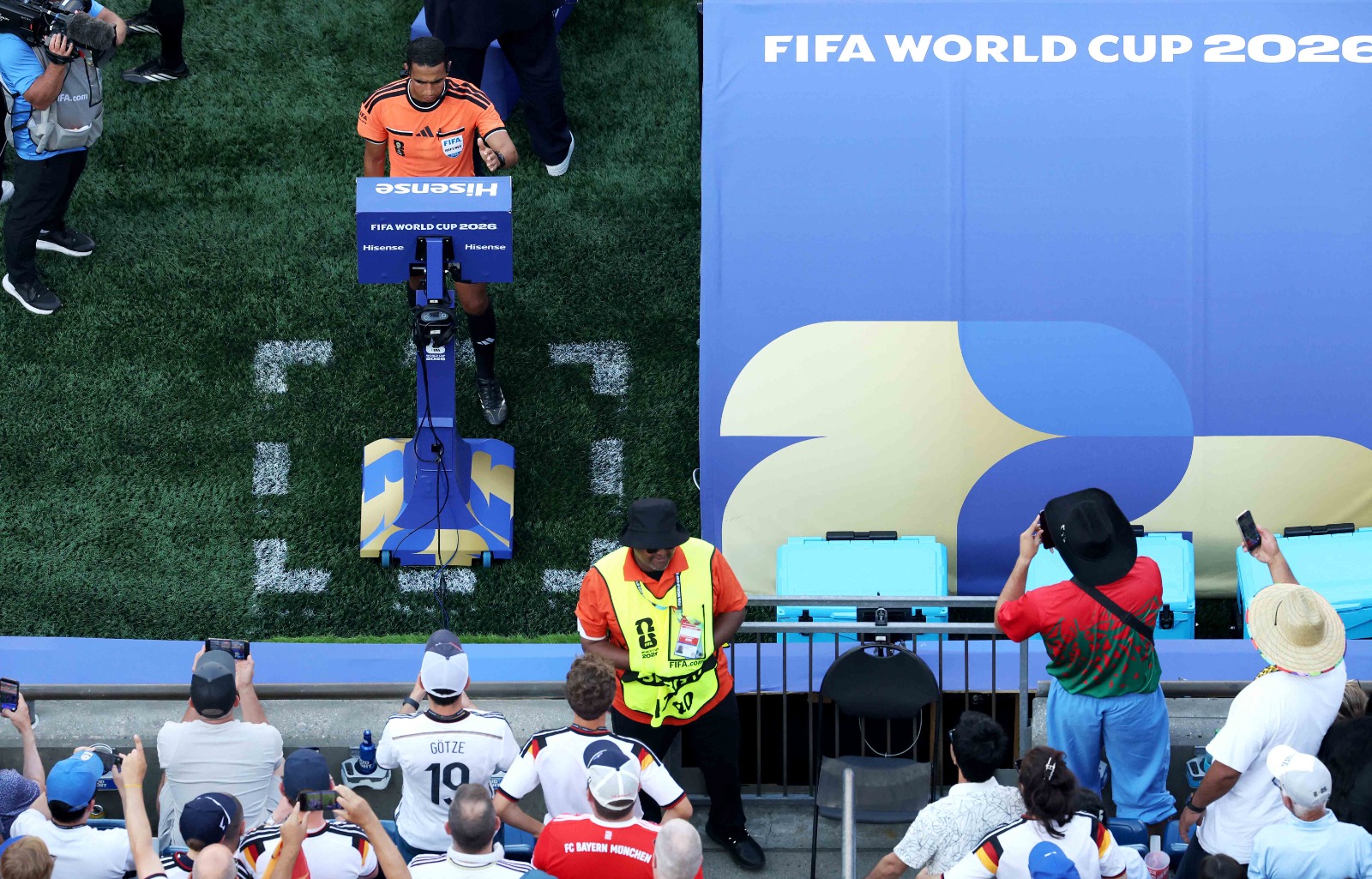
Not only the players and coaches, the FIFA 2026 World Cup held in the United States, Canada, and Mexico has become a showcase for the development of modern football technology. Notably, every match involves digital devices and artificial intelligence (AI) to assist referee decision-making as well as enhance the spectator experience.
However, behind this sophistication, controversy remains an inseparable part of football. A number of decisions generated by technology have instead triggered lengthy debates. This fact proves that no matter how sophisticated the devices used are, human interpretation still has a large space in determining the course of a match.
One of the most prominent technologies is the semi-automated offside technology (SAOT). This device is a development of the technology first used at the 2022 World Cup in Qatar. The system utilizes a network of high-speed cameras mounted on the stadium roof to track the position of every player as well as the ball in real time. Combined with a sensor inside the match ball, the system is capable of determining an offside position in just a matter of seconds. The advantage of this technology is that it speeds up the decision-making process compared to conventional VAR, so the match is not halted for too long.
The official 2026 World Cup ball is also equipped with an inertial measurement unit (IMU) capable of sending data up to hundreds of times per second to the VAR room. This technology, which serves as the main partner of SAOT, helps determine a player’s first touch, the exact time the ball is played, the direction of the ball’s movement, and assists in offside analysis. Although becoming more sophisticated, VAR remains the technology that most frequently sparks controversy. Throughout the knockout stage of the 2026 World Cup, several VAR decisions triggered strong protests.
Controversial
One of the most controversial cases occurred in the Round of 16 during the match between Argentina and Egypt. VAR disallowed Mostafa Ziko’s goal because a foul was previously deemed to have occurred against Lisandro Martinez in the buildup to the attack. Conversely, the Egyptian camp also felt they should have been awarded a penalty when Mohamed Salah was brought down in the restricted area moments before Argentina scored the 3-2 winning goal. Egyptian coach Hossam Hassan even stated that the referee’s decisions disadvantaged his team, while The Pharaohs’ players questioned the consistency of VAR usage.
Controversy emerged again in the quarterfinal round, which also involved Argentina. Referee Joao Pinheiro issued a second yellow card to Breel Embolo after a VAR review, judging that the Swiss forward committed a diving violation. The decision forced Switzerland to play with ten men during their best momentum. Swiss coach Murat Yakin criticized the decision. “There was no reason for that yellow card. The situation was not dangerous at all. This rule actually ruins the match,” Yakin said.
In contrast to the technologies supporting VAR, goal line technology (GLT) once again demonstrated its role in a number of matches. This technology confirms whether the ball has fully crossed the goal line before the referee makes a decision. Unlike VAR, which still requires interpretation, GLT provides an automatic decision in less than a second.
The 2026 World Cup also introduced various innovations to tackle extreme weather, particularly in the United States where several of its stadiums recorded temperatures above 35 degrees Celsius. FIFA also implemented cooling breaks more consistently, player body temperature monitoring, GPS-based physical workload analysis, to real-time heart rate monitoring.
In the 2026 World Cup, nearly all participants utilize artificial intelligence to assist in match analysis. The collected data includes the average positioning of players, sprint speed, pressing effectiveness, quality of chances (expected goals/xG), to the opponent’s attacking patterns. Coaches can receive analytical reports a few minutes after the match concludes to prepare for the next game.
Aside from the pitch, technology has also changed the way spectators enjoy the match. Some innovations used include augmented reality-based replays, real-time statistics on the broadcast screen, ball trajectory visualization, shot speed graphics, to AI-based goal probability predictions. All of this data allows spectators to understand the course of the match more deeply.