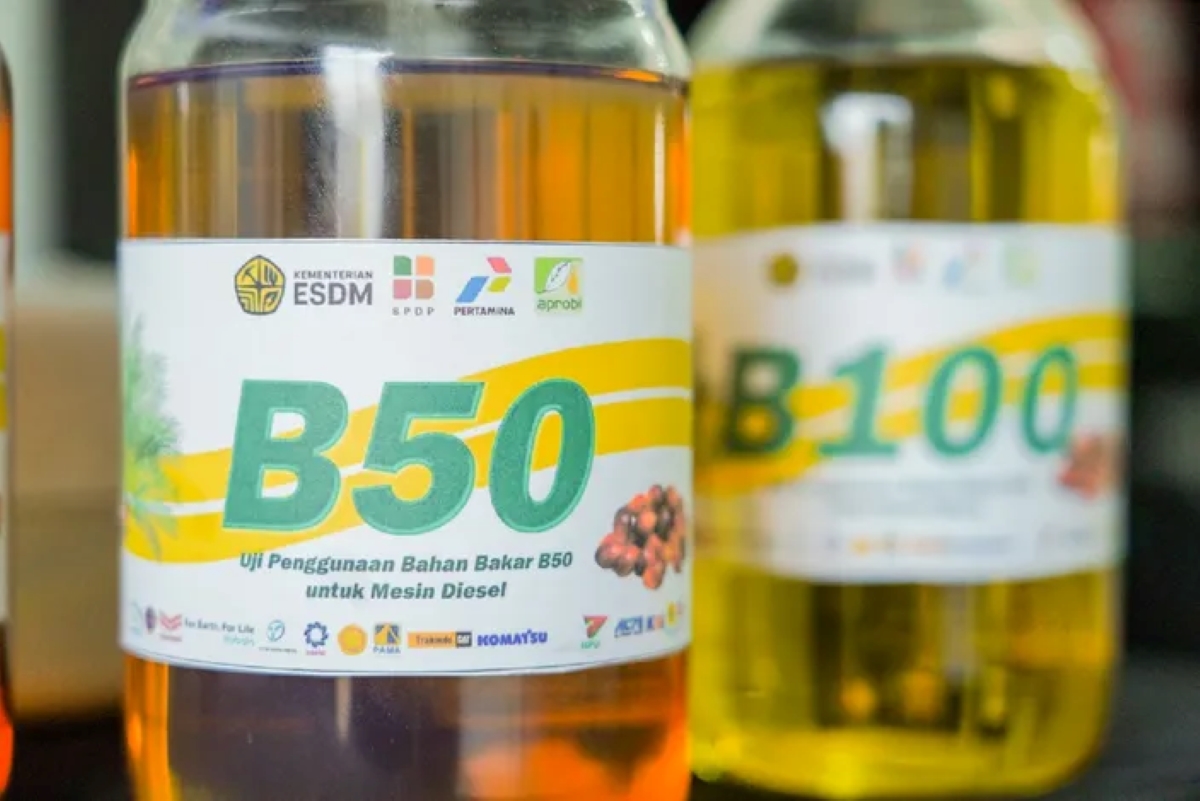
The government’s B50 biodiesel policy has begun to deliver tangible results in strengthening Indonesia’s energy security. The implementation of diesel fuel blended with 50 percent palm oil-based biodiesel has successfully reduced Indonesia’s oil imports by 250,000 to 300,000 barrels per day.
As a result, Indonesia’s daily oil import requirement has fallen from approximately 1 million barrels to around 700,000–750,000 barrels per day.
Minister of Energy and Mineral Resources (ESDM) Bahlil Lahadalia said the reduction in oil imports is a direct result of the government’s implementation of the B50 program.
“With the implementation of B50, we have been able to reduce our oil imports by nearly 250,000 to 300,000 barrels per day,” Bahlil said while opening the Global Hydrogen Ecosystem Summit & Exhibition 2026 in Jakarta on Tuesday.
B50’s Impact on Indonesia’s Oil Imports
Several indicators highlight the significant impact of the B50 policy on Indonesia’s energy needs:
- Oil imports have declined by approximately 250,000–300,000 barrels per day.
- Daily import requirements have decreased from around 1 million barrels to 700,000–750,000 barrels.
- Indonesia’s national fuel consumption stands at approximately 1.6 million barrels per day.
- Domestic crude oil production (lifting) remains at only around 600,000–615,000 barrels per day.
- Indonesia’s annual diesel fuel consumption reaches approximately 39 million kiloliters (KL).
Domestic Oil Production Still Falls Short of National Demand
Bahlil explained that Indonesia continues to face a significant gap between oil consumption and domestic production.
National fuel demand currently reaches around 1.6 million barrels per day, while domestic oil lifting remains at only 600,000–615,000 barrels per day.
The shortfall has traditionally been covered through oil imports totaling approximately 1 million barrels per day.
However, since the wider implementation of B50, Indonesia’s dependence on imported oil has begun to decline.
“At present, total oil imports are now around 700,000 to 750,000 barrels per day, down from the previous gap of approximately 1 million barrels,” Bahlil said.
Why Does B50 Reduce Oil Imports?
B50 is a diesel fuel blend consisting of 50 percent palm oil-based biodiesel and 50 percent conventional diesel fuel.
The higher the biodiesel content, the lower the demand for petroleum-based diesel.
This means Indonesia no longer relies entirely on imported crude oil to meet its diesel fuel requirements.
The program also provides several additional benefits, including:
- Reducing dependence on imported oil.
- Increasing the utilization of domestically produced palm oil.
- Saving foreign exchange reserves that were previously used to purchase imported oil.
- Supporting the country’s transition toward more environmentally friendly energy sources.
Prabowo: Indonesia Has Begun Ending Diesel Imports
Earlier, President Prabowo Subianto stated that Indonesia had begun phasing out diesel fuel imports starting in July 2026, following the government’s success in developing the B50 program.
According to the President, Indonesia has also become the first country in the world to successfully produce biodiesel containing a 50 percent palm oil blend.
Prabowo said the policy not only strengthens the country’s energy independence but also delivers substantial economic benefits.
Funds that were previously spent on importing diesel fuel can now circulate within the domestic economy, creating added value for national industries, the palm oil plantation sector, and local communities.
Government Preparing the Next Phase: E10 to E20
The government is not stopping with the implementation of B50.
Preparations are currently underway for the development of E10 gasoline, a fuel blend containing 10 percent ethanol, as the first step toward broader bioethanol utilization.
In the future, the government aims to increase the blend to E20.
To support this target, the government plans to accelerate the construction of new bioethanol production plants.
Indonesia currently has only one bioethanol plant, meaning production capacity must be expanded to meet future domestic demand.
The implementation of B50 has become one of the government’s key strategies to reduce oil imports while strengthening national energy security.
If the planned expansion of bioethanol through the E10 and E20 programs proceeds as scheduled, Indonesia’s dependence on imported fossil fuels is expected to continue declining.
In addition to conserving the country’s foreign exchange reserves, the policy is also expected to stimulate the growth of domestic resource-based energy industries and accelerate Indonesia’s transition toward a more sustainable energy future.***