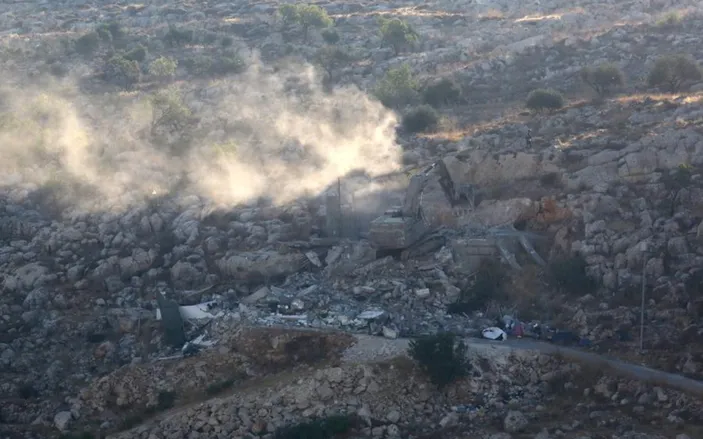
Tensions in the West Bank escalated once again after a group of Israeli settlers attacked several Palestinian villages in the early hours of Sunday, July 26, 2026.
During the attacks, two mosques were targeted in arson incidents, while several civilian buildings were vandalized with Hebrew graffiti bearing messages of revenge.
According to Reuters, the attacks came in the aftermath of deadly clashes two days earlier that left six people dead, including four Palestinians and two Israeli soldiers.
Abdel Azim Wadi, head of the Qusra Village Council in southeastern Nablus, said the settlers set fire to a newly completed mosque that was ready to be opened to worshippers.
“The mosque was in its final stage and ready to receive worshippers. It had already been fitted with carpets and furnishings. They burned it and sprayed Hebrew slogans on its walls,” Wadi said.
Graffiti found at the scene read “Jewish revenge” and included the name of an Israeli citizen who was killed near Tal Village.
A similar attack also took place in Kour Village, near Tulkarm.
According to village council member Farid Jiyousi, three settlers attempted to set the village mosque on fire during dawn prayers.
Fortunately, worshippers who were already at the mosque managed to extinguish the flames before they spread to the main prayer hall.
Jiyousi said the attackers also left Hebrew graffiti on the mosque’s walls.
He added that it was the first attack on a place of worship in the village.
Israeli Military Investigating the Attackers
In addition to targeting places of worship, Palestinian officials reported that settlers also attacked Palestinian workers at a stone-cutting facility in the town of Kafr Malik, near Ramallah.
The Israeli military said troops deployed to Qusra Village found evidence of arson and graffiti at the scene.
Security forces subsequently launched a search for those responsible.
“The security forces strongly condemn incidents of this kind, including damage to religious sites, and will continue to act decisively to maintain security and public order in the area,” the Israeli military said.
The attacks early Sunday were reportedly linked to clashes that occurred on Friday, July 24, 2026, near Tal Village, southwest of Nablus.
According to reports, the confrontation began when a group of Israeli settlers, some of whom were armed, entered an area near the village.
Palestinian residents confronted the group, and the situation escalated into violent clashes.
Video footage circulating online showed a Palestinian man seizing a weapon from one of the settlers.
The Palestinian Authority said the settlers had initiated the violence, while the Israeli military stated that both sides exchanged gunfire.
Security Operations Intensified
Following the incident, Israeli Prime Minister Benjamin Netanyahu ordered a large-scale security operation across the West Bank.
The move was taken in response to the deaths of Israeli citizens during the earlier clashes.
The Israeli government increased its military presence throughout the West Bank and canceled leave for security personnel.
Meanwhile, according to the Palestinian Prisoners Club, around 60 Palestinians have been arrested since Saturday night during operations carried out by Israeli authorities.
The latest wave of violence adds to the long-running conflict between Israeli settlers and Palestinians in the West Bank.
According to data from the United Nations (UN) and the Palestinian Authority, dozens of Palestinians have been killed and hundreds more injured this year.
The Palestinian Ministry of Awqaf also recorded at least 45 mosques in the West Bank being targeted in attacks throughout 2025.
Most countries and UN bodies continue to regard Israeli settlements in the West Bank as violations of international law, a position rejected by the Israeli government.
Amid the escalating tensions, Pope Leo also expressed concern over the deteriorating situation.
In a statement issued on Sunday, he called for negotiations to begin in pursuit of “a just political solution” and emphasized the importance of protecting all holy sites while preserving the status quo for every religion.***