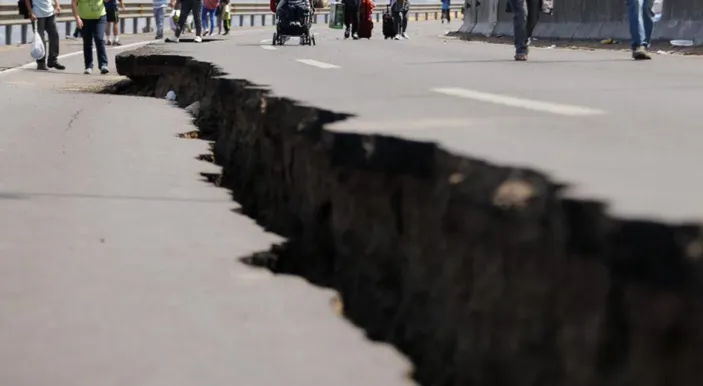
A magnitude 7.1 earthquake struck Kumamoto Prefecture in southern Japan on Tuesday, July 28, 2026.
According to Reuters, The Japan Times, and Nikkei Asia, the earthquake reached Shindo 7, Japan’s highest seismic intensity level. The powerful tremor cut electricity to tens of thousands of households, halted railway services, and prompted tsunami and aftershock warnings.
The Japan Meteorological Agency (JMA) reported that a magnitude 4.5 aftershock occurred four minutes after the main earthquake.
Emergency earthquake warnings were issued for seven prefectures on Kyushu Island: Kumamoto, Nagasaki, Kagoshima, Fukuoka, Saga, Oita, and Miyazaki.
A tsunami warning for waves of up to one meter was issued for coastal areas along the Ariake Sea and the Yatsushiro Sea following the earthquake. The first waves were expected to arrive shortly after the quake, with additional waves forecast to follow.
A strong Shindo 6 intensity was recorded in the cities of Yatsushiro and Uto, the towns of Mashiki and Misato, as well as Minami Ward in Kumamoto City. Neighboring prefectures also experienced strong shaking of Shindo 5 or higher.
Kyushu Electric Power reported that approximately 45,600 households lost electricity as a result of the earthquake.
Meanwhile, JR Kyushu announced the suspension of all train services, including the Shinkansen bullet train, as a safety precaution.
Kyushu Electric Power also confirmed that no abnormalities were detected at the Sendai and Genkai nuclear power plants following the quake.
The affected region is a major hub for semiconductor manufacturing.
TSMC, the world’s largest contract chip manufacturer, operates one of its main production facilities in Kyushu. A TSMC spokesperson told Kyodo News that the company was assessing the situation.
Sony also operates manufacturing facilities in the region. A company spokesperson said Sony was inspecting its facilities following the earthquake.
History of Kumamoto Earthquakes and Japan’s Seismic Vulnerability
Kumamoto was previously struck by a series of devastating earthquakes in April 2016, which claimed 278 lives and injured 2,800 people.
The 2016 disaster also severely damaged Kumamoto Castle, a historic cultural landmark, with restoration work expected to continue until 2052.
Exactly 137 years earlier, on July 28, 1889, Kumamoto was hit by a magnitude 6.3 earthquake that killed 20 people.
The recurrence of a major earthquake on the same date serves as another reminder of the region’s vulnerability to seismic activity.
Japan is one of the most earthquake-prone countries in the world.
Located along the Pacific Ring of Fire, the country experiences an earthquake approximately every five minutes.
The island nation accounts for roughly 20 percent of all earthquakes worldwide with a magnitude of 6.0 or greater.***