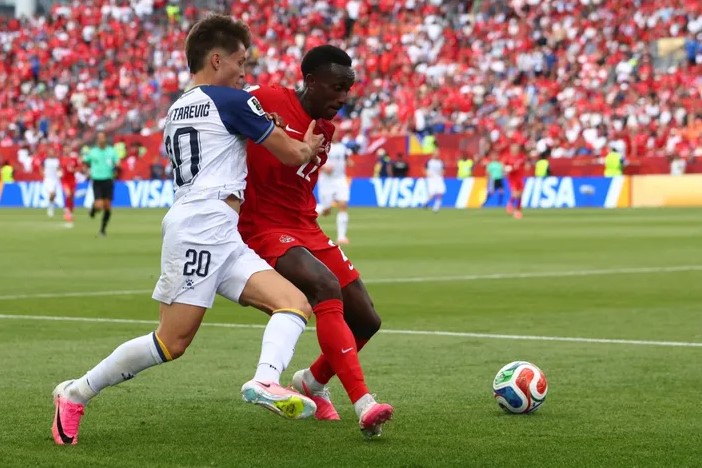
When people think of sports in Canada, images of hockey pucks, sticks, and vast ice rinks immediately come to mind. The country’s reputation as a dominant force in ice hockey is unquestionable. During the 2025–2026 NHL season, Canada once again supplied the largest number of players, continuing to dominate the world’s premier hockey league. Canadian superstars such as Connor McDavid, Sidney Crosby, Cale Makar, and Nathan MacKinnon have maintained their supremacy across North America.
A total of 304 Canadian players were listed on the NHL’s official website out of the 726 players who appeared on Opening Day last season. Canada has also dominated international hockey, winning nine Olympic gold medals in men’s ice hockey since 1920, most recently at the 2014 Winter Olympics.
Yet few could have imagined that a nation once regarded as little more than an underdog in football is now writing its own remarkable fairytale on the grand stage of the 2026 FIFA World Cup.
Canada’s football evolution becomes even more extraordinary when viewed through the lens of its history. The Canadian men’s national team made its first-ever FIFA World Cup appearance in 1986 in Mexico under head coach Tony Waiters.
Led by captain Bruce Wilson, Canada faced traditional powerhouses France, the Soviet Union, and Hungary during the group stage. Merely qualifying for the tournament was already considered a miracle, as the North American Soccer League (NASL) had collapsed in 1985. The crisis forced many national team players to turn to indoor soccer or take part-time jobs to make ends meet.
Following that tournament, Canadian football experienced a dramatic decline. The 2009 edition of Soccernomics bluntly described Canada as one of the world’s most disappointing football nations. A humiliating 8-1 defeat to Honduras in 2012 shattered the team’s morale. By April 2017, Canada had fallen to 109th in the FIFA World Rankings, trailing nations such as Eswatini and Kazakhstan.
The turning point came with the arrival of John Herdman, who now coaches the Indonesia national team. Herdman did more than introduce a new tactical philosophy—he completely transformed the players’ mentality, aided by the emergence of generational talent Alphonso Davies. Reflecting on Canada’s remarkable transformation, Herdman acknowledged the difficult road his players had traveled.
“Many of our players understood just how difficult it was to earn respect in the past. Holding a Canadian passport often meant they had virtually no chance of being taken seriously at the elite level,” Herdman said in an interview with The Athletic in 2021.
He added that Davies had fundamentally changed that perception.
“He is a trailblazer, a successful immigrant, and a true reflection of our nation’s diversity. Alphonso has restored the credibility of Canadian football in the eyes of the world. From this point forward, our destiny is in our own hands to create something truly special.”
The Canucks’ growing strength became evident when they unexpectedly topped the CONCACAF qualifying standings for the 2022 FIFA World Cup, finishing ahead of traditional regional powers the United States and Mexico. Although Canada was eliminated in the group stage after being drawn into a “group of death,” its aggressive style of play earned widespread praise.
That positive momentum continued as Canada reached the semi-finals of the 2024 Copa América, helping the nation establish itself consistently among the world’s top 30-ranked teams.
Now competing at the 2026 FIFA World Cup under head coach Jesse Marsch, Canada has emerged as a far more mature and confident side.
Their impressive campaign began with a crucial late goal from Cyle Larin to secure a 1-1 draw against Bosnia and Herzegovina. Their breakthrough performance came when they crushed Qatar 6-0. The emphatic victory featured a stunning hat-trick from Jonathan David, marking the first World Cup hat-trick by a CONCACAF player in the modern era of the tournament.
Although Canada suffered a 2-1 defeat to Switzerland in its final group match, finishing as Group B runners-up was enough to book a place in the Round of 32 against South Africa in Los Angeles.
In that tense knockout clash, captain Stephen Eustáquio emerged as the hero by scoring the winning goal deep into injury time. The dramatic 1-0 victory secured Canada’s place in the Round of 16 for the first time in the nation’s history.
Today, Saturday, July 4, 2026, Jesse Marsch’s squad is preparing to stake everything against Morocco in Houston as they bid to secure a place in the quarter-finals.
Canada’s national team has now proven to the world that it is no longer just the undisputed king of the ice—it has also become a formidable new predator on football’s biggest stage. ***