The 2026 FIFA World Cup appears set to go down as the most spectacular and grandest football tournament in history. The tournament’s lavish opening ceremony at the iconic Azteca Stadium in Mexico City on Friday, June 12, 2026, was immediately marked by the creation of several new records both on and off the pitch.
The largest World Cup ever staged wasted no time in making history. From its unprecedented multi-country opening ceremony concept and performances by globally renowned music stars to dramatic red-card incidents on the field, the tournament delivered memorable moments from its very first day.
Azteca Stadium was honored as the venue for the opening match. The legendary stadium, which witnessed the brilliance of Pelé during the 1970 World Cup and Diego Maradona in 1986, added another historic milestone by becoming the first stadium in the world to host a World Cup opening match on three separate occasions.
Thousands of supporters packed the stadium and were treated to a vibrant display of Mexican culture, traditional dances, and large-scale visual performances involving hundreds of drones.
The entertainment program gained additional star power with the return of Colombian superstar Shakira. After a 12-year absence from the World Cup stage, the 49-year-old singer delivered a stunning performance of “Dai Dai,” one of the tournament’s official songs, alongside Nigerian artist Burna Boy.
The multicultural celebration in Mexico City also featured performances by J Balvin, Danny Ocean, the rock band Maná, and a multilingual indigenous ritual led by Lila Downs. One of the evening’s most memorable collaborations saw South Korean singer EJAE join legendary Italian tenor Andrea Bocelli and French DJ David Guetta to perform FIFA’s official anthem, “DNA.”
Similar festivities are expected to continue in the tournament’s other co-host nations. In Toronto, Canada, fans were welcomed by performances from Alanis Morissette and Michael Bublé, while SoFi Stadium in Los Angeles, United States, was set to host stars including Katy Perry and Lisa of BLACKPINK.
Behind the massive production stands Italian creative producer Marco Balich. According to Balich, the greatest challenge was creating a unified narrative across three countries separated by vast geographical distances. Between 260 and 300 production crew members were deployed in each host city to maintain visual consistency, with a giant World Cup trophy formed by drone formations serving as the unifying symbol.
Red Cards Take Center Stage
Once the opening ceremony concluded, the drama quickly shifted to the football field.
Host nation Mexico secured its first three points of the tournament with a 2-0 victory over South Africa. The win was powered by goals from Julián Quiñones and Raúl Jiménez, giving El Tri a dream start in front of their home supporters.
Quiñones opened the scoring in the ninth minute, registering the fastest goal ever scored in a World Cup opening match since Philipp Lahm achieved the feat for Germany in 2006.
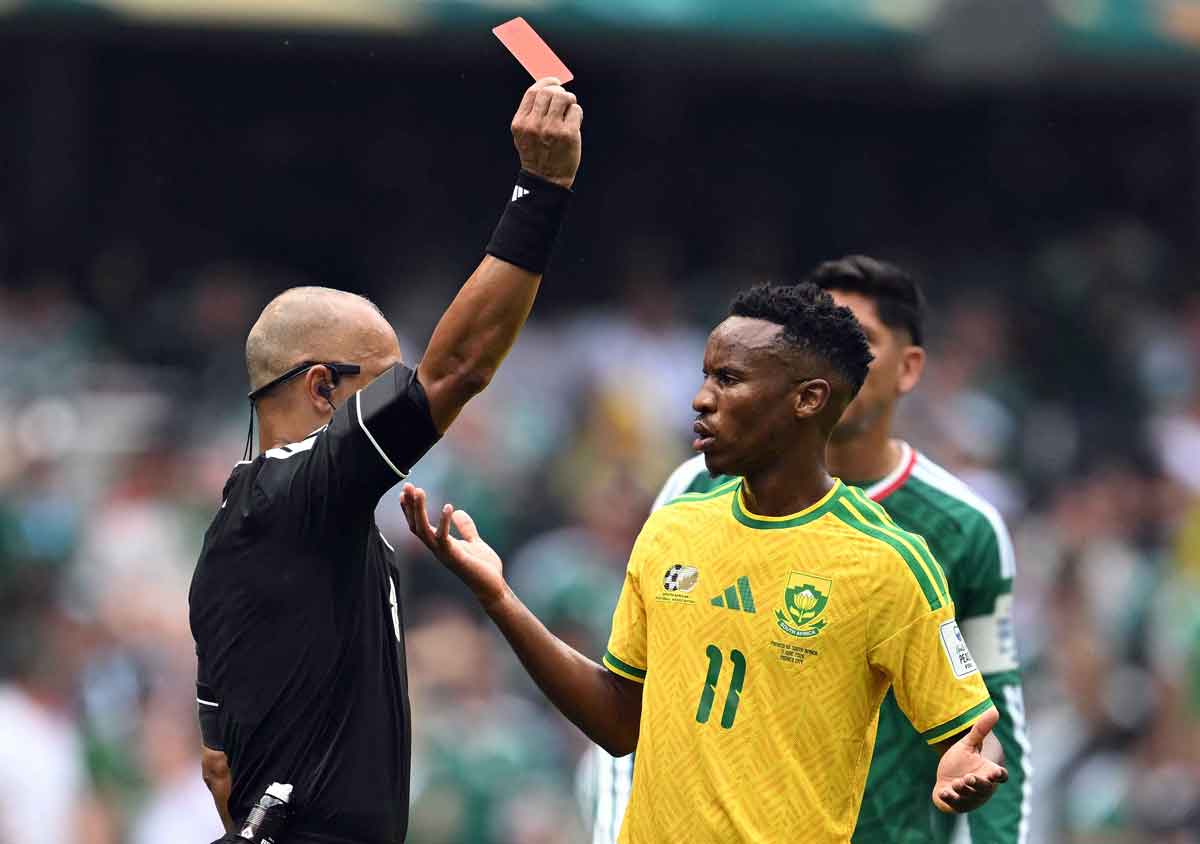
The match, officiated by Brazilian referee Wilton Sampaio, was played at a high intensity and produced a record-setting number of red cards. Sampaio sent off three players—two from South Africa, Sphephelo Sithole in the 50th minute and Themba Zwane in the 84th minute, as well as Mexico defender César Montes in second-half stoppage time. The three dismissals established a new record for the most red cards ever shown in a World Cup opening match.
South Africa head coach Hugo Broos expressed disappointment with the officiating decisions that forced his side to finish the match with only nine players.
“It is unfortunate that we had to finish the match with nine players,” said the Belgian coach, as quoted by the BBC.
Broos refrained from criticizing the first red card but questioned the referee’s decision regarding the second dismissal.
“Regarding the first red card, there is not much to discuss. However, for the second one, I believe the Mexican player blocked our player. Situations like that can happen, but the referee saw it differently,” he said.
Despite the defeat, Broos praised his players for competing strongly against a Mexican side backed by tens of thousands of supporters at Estadio Azteca. He noted that the hosts struggled at times to break down South Africa’s defensive organization.
Meanwhile, Mexico head coach Javier Aguirre described his team’s performance as outstanding and believed they had accomplished their objective.
“It could have ended 4-0, but people are happy. It is the start of the World Cup, we have left our nerves behind, and we are going home with three points. Now we are thinking about what comes next,” Aguirre said, as quoted by Reuters.
Historic Records Continue to Fall
Another individual milestone was achieved by Mexico’s veteran goalkeeper Guillermo Ochoa.
His inclusion in the starting lineup made him the first player in football history to appear in six different FIFA World Cup tournaments, an extraordinary achievement that reflects remarkable longevity since his World Cup debut in 2006.
The meeting between Mexico and South Africa also broke a 50-year FIFA tradition. Since the modern opening-match format was introduced in 1974, every World Cup opener had featured a different pairing of teams.
This year, however, history repeated itself as Mexico and South Africa once again faced each other in an opening match, just as they did at the 2010 FIFA World Cup in South Africa. For Mexico, it marked the eighth World Cup opening match in the nation’s history—more than any other country.
Elsewhere, South Korea secured a dramatic 2-1 victory over the Czech Republic, ending a run of three consecutive World Cup editions without winning an opening match. Meanwhile, Japan suffered a setback after captain and midfield leader Wataru Endo was forced to withdraw from the squad and leave training camp due to an injury that had failed to heal properly.
Clashes and Protests
World Cup fever was also evident in Canada.
Ahead of Canada’s match against Bosnia and Herzegovina at BMO Field in Toronto, approximately 30,000 Bosnian supporters were reported to have gathered around the 45,000-seat stadium. The massive turnout demonstrated how football can transport the atmosphere of one nation to another part of the world.
However, the tournament’s opening day was not entirely free from controversy.
Just hours before kickoff at Azteca Stadium, clashes reportedly erupted between security forces and demonstrators. Protesters used the global spotlight of the World Cup to raise domestic issues ranging from teachers’ welfare to demands for justice for victims of drug cartel violence. Fortunately, the unrest outside the stadium did not disrupt the match itself.
With a total of 104 matches involving 48 nations, the 2026 FIFA World Cup has opened in spectacular fashion, reinforcing expectations that this edition could become one of the most memorable tournaments in the history of modern football.