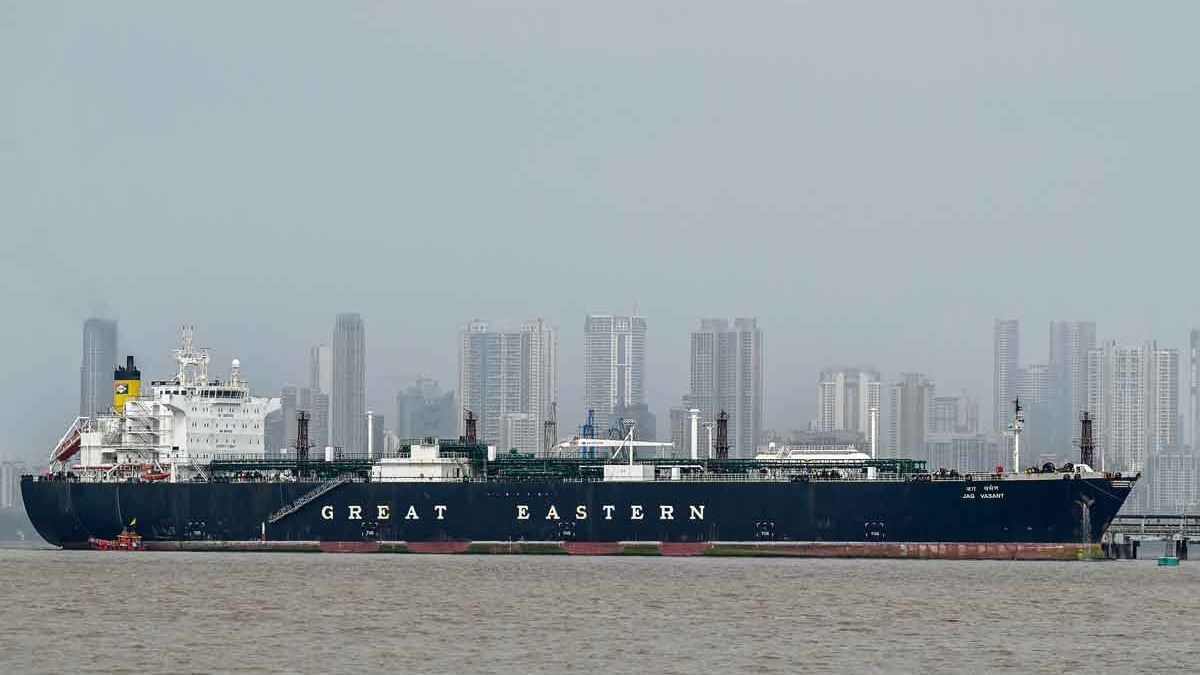
Bulukumba News – The world is moving fast—tankers pass through the Strait of Hormuz with a shadow of risk, energy prices fluctuate, and diplomacy teeters on fragile tensions.
But for Singapore, one thing is clear: there are non-negotiable principles.
“This is not a duty that must be paid,” said Balakrishnan, his voice flat but full of meaning. “This is a right.”
The Strait of Hormuz is more than a narrow body of water between Iran and Oman. It is one of the most strategic points in the world trading system. According to data from the US Energy Information Administration (EIA), around 20 percent of global oil supplies pass through this route every day.
Also Read: US Sends Elite Navy SEALs and Rangers: Threat of Seizure of Iranian Oil and Major Escalation
In normal situations, traffic there moves without much attention. However, when conflict escalates in the Middle East region, this route turns into a vulnerable point that can affect the global economy in a matter of days.
Report The Straits Times stated that several countries and ship operators chose a pragmatic path: negotiating with Iran, even paying up to around US$2 million or the equivalent of more than IDR 31 billion to ensure safe passage.
In that context, Singapore’s attitude becomes a contrast.
Also read: Not the Strait of Hormuz, this is the determining factor in the duration of the Iran vs Israel war
UNCLOS Principles as the “Constitution of the Sea”
In a parliamentary session on Monday, April 7 2026, Balakrishnan emphasized that his country would not be involved in such negotiations.
He referred to the United Nations Convention on the Law of the Sea (UNCLOS), an international legal framework that regulates the rights and obligations of states at sea.
“There is a right of transit passage. It is not a privilege granted by neighboring countries,” he said.
This statement was not just diplomatic rhetoric. In UNCLOS, the right of transit passage allows ships from all countries to pass through international straits without hindrance, as long as they do not threaten security.
For Singapore, this principle is not just about Hormuz. The city-state itself is on the vital Malacca Strait—one of the busiest shipping routes in the world.
If the “pay to pass” concept becomes the norm, the implications could spread to many other strategic points, including the Southeast Asian region.
“Do you now understand why we must take the categorical position that international law is the constitution of the oceans?” Balakrishnan said.
Also read: Iran chooses to respond to ‘tube water’ with ‘milk’? Four Indonesian Ships Allowed to Pass through the Strait of Hormuz
Between reality and risk
Although firm in principle, Singapore remains aware of the realities on the ground. The government, through the Singapore Maritime and Port Authority, continues to coordinate with Singapore-flagged ship operators transiting the Persian Gulf region.
This step is important, considering that the safety of the ship’s crew and the smooth distribution of energy are the main stakes.
At the same time, diplomatic communications are maintained. Balakrishnan revealed that he had interacted with Iran’s Foreign Minister, Abbas Araghchi, before the conflict escalated, and opened the possibility of further communication.
Also Read: Iran’s Cheap Drones Paralyze Billion Dollar System: US Sophisticated Defense Questioned, Is Russia Involved?
But he emphasized the limits: communication does not mean negotiating tariffs or passage permits.
The Hormuz issue also opens up a wider discussion: energy security. Singapore’s Minister of Energy and Science & Technology, Tan See Leng, revealed that the government is expanding regional cooperation to reduce dependence on high-risk routes.
Singapore has given conditional approval to import up to 8.35 gigawatts of renewable energy from projects in the region, including Indonesia, Australia and Vietnam. This figure exceeds the initial target of 6 gigawatts.***