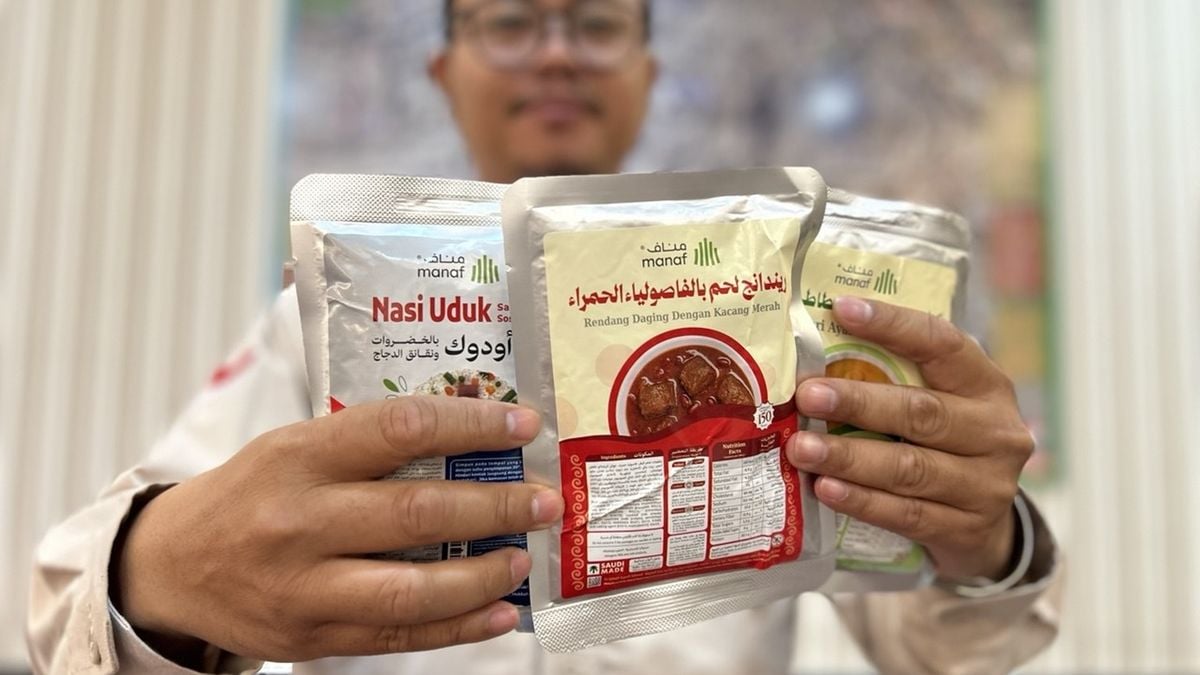
Media Purwodadi – The Indonesian Ministry of Haj ensures that the food packages needed during the Hajj Armuzna 1447 Hijriah phase are safe for all Indonesian pilgrims in the Holy Land.
The government has prepared certainty about the distribution of food packages to support the smooth running of congregational worship during the peak phase of the Hajj in Arafah, Muzdalifah, and Mina or Armuzna.
The Indonesian Ministry of Hajj calculates the total need for Haj Armuzna food packages to reach around 3,082,200 ready-to-eat packages to maintain the stamina and mobility of Indonesian pilgrims.
Also read: Myth of the Afterlife Vehicle: Gus Baha corrects the misconceptions regarding the cow sacrificial joint venture
The Director General of Hajj Economic Ecosystem Development at the Indonesian Ministry of Hajj, Jaenal Effendi, said that all the congregation’s consumption needs had been prepared in detail from the start of the Hajj pilgrimage.
The preparation of food logistics was carried out so that the congregation remained comfortable in worship when entering the crucial phase of Armuzna which is known to have dense activity and high mobility.
Jaenal Effendi conveyed this information to the Hajj Media Center team in Makkah, regarding consumption preparations, on Tuesday, May 19 2026.
According to Jaenal, the millions of food packages were divided into two main categories to meet the congregation’s consumption needs during several stages of Armuzna implementation.
The first category was prepared specifically for Armuzna’s main needs on 8 to 12 Dzulhijjah with a total of around 1,849,680 ready-to-eat food packages.
Procurement of the first category of packages involves cooperation between Saudi Arabian sharia and PT Halalan Thayyiban and Family Food to strengthen the congregation’s logistics supply.
Meanwhile, in the second category, 1,232,520 packages were prepared to meet the consumption needs of the congregation on 7, 8 and 13 Zulhijah during the Hajj pilgrimage.
The second category of food packages is produced directly by the Indonesian food industry in collaboration with local companies in Saudi Arabia to speed up distribution.
Indonesian Ministry of Haj Anticipates Global Geopolitical Impact
The Indonesian Ministry of Haj said that steps to accelerate food production were taken as a mitigation strategy to face uncertainty in the global supply chain due to the international geopolitical situation.
Jaenal explained that the increase in raw material prices had become a concern for the government before the Armuzna phase began in order to ensure that the congregation’s consumption needs remained safe.
He said that food logistics distribution continued to run smoothly even though global conditions affected the supply of raw materials for a number of Indonesian congregations’ consumption needs.
“Due to geopolitics and the increase in raw materials, we ensure that the implementation of Armuzna from the 7th to the 13th remains safe,” said Jaenal Effendi.
Most of the ready-to-eat food packages are said to be available in the food provider’s kitchen and immediately distributed to the hotel where the Indonesian congregation is staying.
Early distribution is carried out so that the congregation’s consumption needs do not experience delays when entering the peak phase of the Hajj pilgrimage in the Armuzna area.
The Indonesian Ministry of Haj considers logistical readiness to be an important factor in maintaining the physical condition of the congregation during a series of religious services with very busy activities in the Holy Land.
Apart from ensuring the supply is safe, the government is also adjusting the food menu to suit the tastes of the majority of Indonesian pilgrims during the Hajj pilgrimage.
The menu prepared includes chicken carrot potato curry, red bean chicken stew, red bean beef rendang, potato chicken curry and uduk rice.
Apart from that, there is also white basmati rice combined with various typical Indonesian side dishes to maintain the comfort of the congregation when consuming this ready-to-eat food.
Also Read: Gaspol, Grobogan Traffic Police Put Up Banners on Jalan A Yani Purwodadi which is prone to accidents
Jaenal said that Haji Armuzna’s food packages are designed to be practical so that they can be consumed immediately without the need for heating or other additional treatment.
“Well, we have adapted this to Indonesian tastes. This can be opened and eaten straight away,” said Jaenal when explaining the concept of ready-to-eat food.
The government hopes that this taste adjustment can reduce the boredom of pilgrims while in the Holy Land when consuming food in practical packaging.
Apart from being practical, the food safety aspect is also the main concern of the Indonesian Ministry of Haj in preparing millions of food packages for Indonesian pilgrims during the Armuzna phase.
Jaenal ensures that all ready-to-eat food packages have a shelf life of up to 18 months so they remain safe to consume during the Hajj pilgrimage.
The Indonesian Ministry of Haj also conducted repeated laboratory tests to ensure the quality of the food remained suitable for consumption before being distributed to all Indonesian congregations.
Field officers are asked to actively provide education to the congregation regarding how to use food packages so that consumption can be done easily and practically.
The government hopes that the distribution of Hajj Armuzna food packages will be able to help pilgrims maintain stamina so they can focus more on carrying out the entire Hajj pilgrimage.
Haji Armuzna’s logistical readiness is an important part of the Indonesian Ministry of Haj’s services to Indonesian pilgrims during the peak of worship in the Holy Land.
With the supply of food packages that are guaranteed to be safe, the Indonesian Ministry of Haj hopes that all Indonesian pilgrims can undergo the Armuzna phase comfortably, safely and smoothly.***