THE THOUGHTS OF THE PEOPLE OF SULTENG – In the past, global construction experts have issued an absolute verdict on the extreme landscape in Guizhou Province, China, There will never be any infrastructure that can be built over this chasm. For centuries, Guizhou was the epitome of extreme isolation. Millions of its inhabitants live cut off from the outside world because they are surrounded by a series of vertical limestone cliffs and terrifying giant canyons.
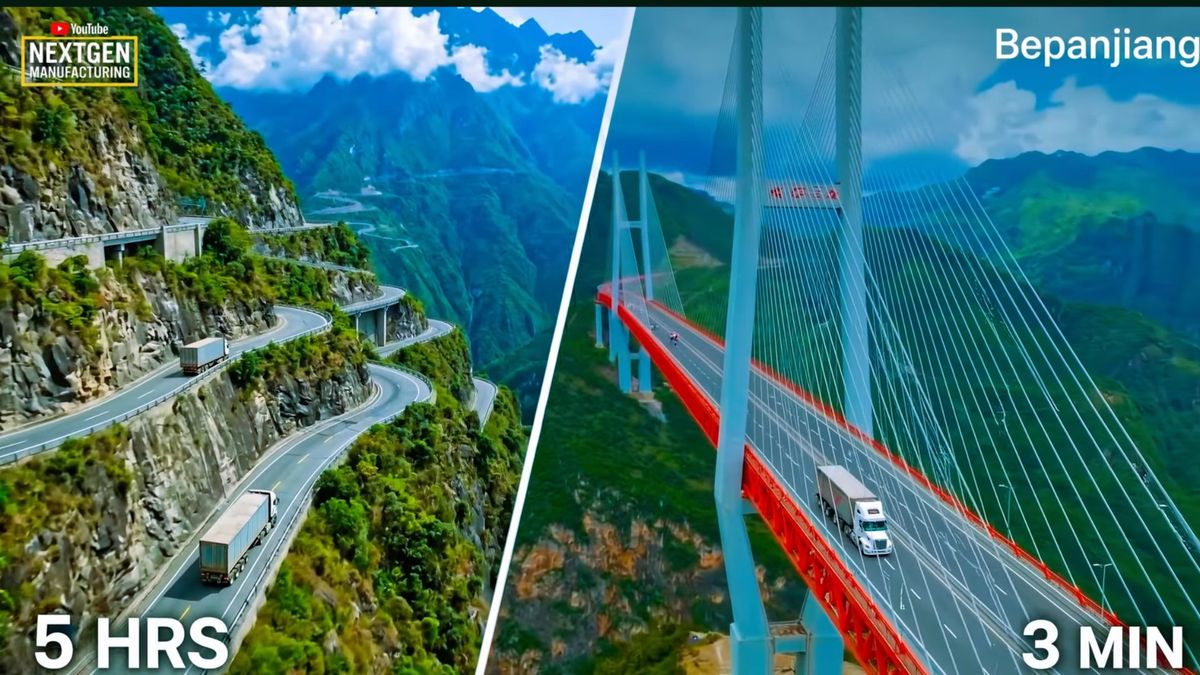
Until 2000, this province had no toll road network at all. To cross just one gap in the deepest canyon, residents have to take a brutal five-hour journey down a steep cliff that risks their lives.
However, history changed when the local government made a bold decision, connecting Guizhou with a modern transportation network regardless of the costs and natural risks involved. The crucial point that anchored the entire plan was the Beipanjiang River Gorge, a giant trough with terrifying gusts of wind that could reach speeds of 140 kilometers per hour.
Also Read: New Geopolitical Front, China’s Silent Ambition and Putin’s Strategic Alliance on the Arctic Ice Sheet
For 13 years, every proposed conventional bridge design ended up as a pile of waste paper on the drawing table. Nature is too wild to be conquered by ordinary methods.
Until 2011, a genius engineer proposed a radical blueprint that would turn the impossible into a historical reality. The plan is to build a cable-stayed bridge (cable-stayed bridge) with the main support tower built not on flat ground, but attached directly to the protrusion of a steep vertical rock cliff. This mammoth project officially began in November 2011, marking the beginning of one of the most dramatic civil engineering battles in human history.
Due to space limitations and the extreme location, modern heavy machinery cannot be lowered to the bottom of the cliff. This is where the workers’ mentality is tested. Each foundation anchor point had to be manually drilled using human hands directly into the solid rock. To allow logistics to move across canyon gaps hundreds of meters away, engineers designed a special cross-canyon overhead cable system. A total of 200 controlled explosions were detonated with super-strict mathematical accuracy to carve out the cliff walls, followed by millimeter-by-millimeter geological examinations to ensure there were no micro-cracks in the remaining supporting rock.
Also read: Failure of the Peace Order in Gaza and the Critical Response of the European Council
Millimeter Precision in the Middle of a Storm and Real Proof
Two great construction teams started building simultaneously from two different sides of the cliff, creeping towards each other in the empty air. Their main foundation was drilled 15 meters deep into the core rock base of the cliff, then filled with a casting of 15,000 cubic meters of concrete which had to be poured continuously without stopping for a second; one small crack means complete failure of the entire project. Using an automatic climbing concrete mold system (self-climbing formwork), the bridge’s twin towers grow as high as 4 meters every day amid storm winds capable of blowing people away. For safety reasons, the entire work area must be tightly enclosed by a special steel safety net.
When the extreme winter of 2012 hit with temperatures below zero degrees, work never stopped. In 18 AD, the twin towers as high as 392 meters stood firmly on the edge of the cliff, ready to support the weight of thousands of tons. The next stage is the most complicated part: installing the 112 giant steel cables supporting the bridge. To stretch the first guideline across the 720-meter gap in the canyon, engineers used helicopters flown by exceptionally skilled pilots, who had to hover steadily in the midst of cross-canyon winds of 80 kilometers per hour.
Also read: Escalation in the Strait of Hormuz and Donald Trump’s pressure strategy
Each cable attached is like tuning the strings on a giant guitar, each pull changes the overall tension of the other cables. When the giant cables were pulled close to the target tension with an accuracy of below 1%, the bridge span began to sing and vibrate violently due to wind resonance. Danger of material fatigue (fatigue) lurking. However, in a short time, engineers found an elegant solution by installing giant hydraulic shock absorbers (viscous dampers) at the base of each cable, which instantly tames those wild vibrations.
The most exciting moments occur when the steel deck weighing a total of 10,000 tonnes built from two sides finally meets in the middle of a cliff at a height of 565 meters. When measured, there was a deviation or misalignment of the end of the bridge of 3 centimeters. Through micro-adjusting the tension on 12 specific cables over a full 18 hours, the giant span shifted slowly until it was perfectly aligned with a tolerance of just 2 millimeters! The 120-ton cover section was dropped precisely into the fissure, uniting the two hemispheres of Guizhou that were separated for millions of years. The engineers and workers could not hold back their tears, they hugged each other to celebrate the moment they called The day the canyon disappeared forever.
On December 29, 2016, the Beipanjiang Bridge was officially opened to the public after undergoing extreme load tests by 80 fully loaded trucks simultaneously. The brutal route that previously took 5 hours is now cut down in just 4 minutes. Logistics efficiency soared by 97%, changing the economic fate of the entire region. This masterpiece is valid proof to the world, that when natural limitations are in the way, the creativity, courage and knowledge of great engineers will always find a way to conquer them.***