ABOUT CIBUBUR – Carrying out mission work in Africa is not just about preaching the Gospel or providing catechesis to the people. For Father Lawrence Lelo SVD, from Atambua, NTT, missionary work means entering into community life, understanding local culture, facing educational limitations, and struggling with traditional thought patterns that have been rooted for centuries.
Father Lawrence shared this long experience during a meeting with the Indonesian Catholic Journalists Association (PWKI) which took place at Dapur Solo Restaurant, Jalan Matraman Raya, Jakarta, Monday, May 25 2026.
During his 16 years of work as a missionary for the SVD Congregation in Kenya and Tanzania, Father Lawrence witnessed firsthand the dynamics of local community life, including the Maasai community, which is known to be strong in maintaining the customs and traditions of its ancestors.
According to Father Lawrence, one of the biggest challenges of mission work is not only about preaching the faith, but also how to accompany people who still live with low levels of education and very strong cultural patterns.
Also Read: KWI Appreciates PWKI’s Risk-Full Mission to Meet Pope Leo XIV at the Vatican
“Sometimes just introducing a new perspective on education, health or managing life is a big challenge. It’s not easy to talk about change in a society that holds traditions very strongly,” he said.
Polygamy, Cows, and Social Status

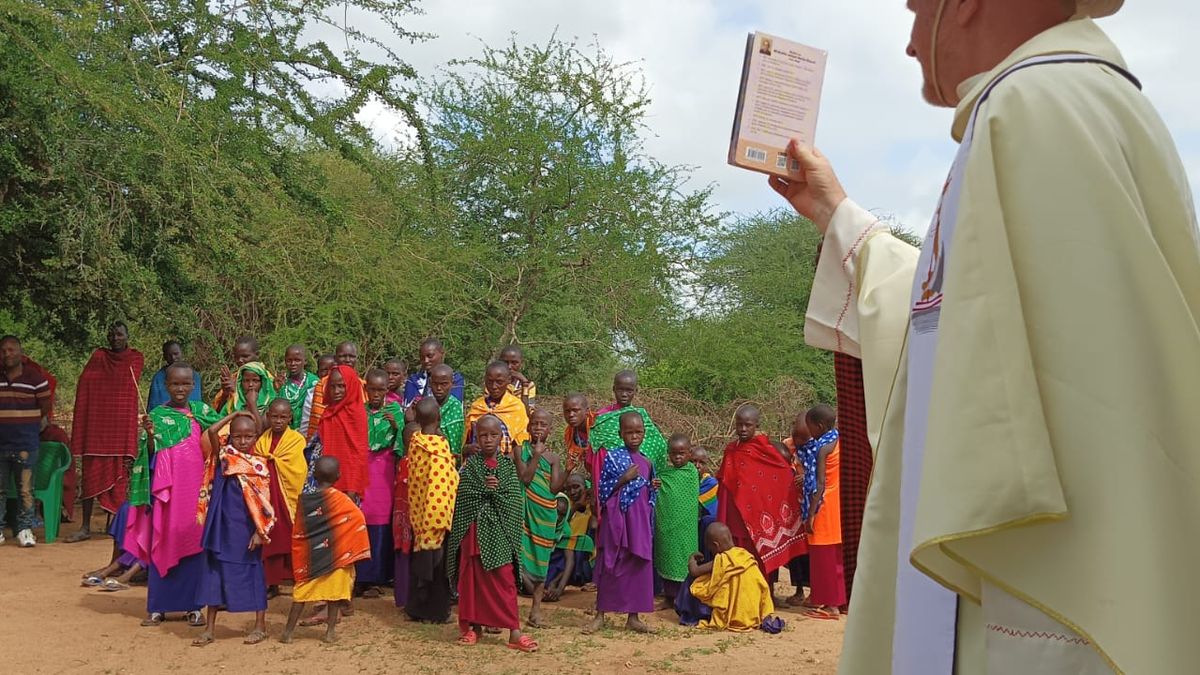
Mass at Saint Augustine Orkesumet Parish, with the majority of the congregation coming from the Maasai tribe. Photo: doc. Father Lawrence
In his story, Father Lawrence touches on the lives of the Maasai people in Kenya and Tanzania who still maintain traditional lifestyles.
The practice of polygamy is still part of the social structure in some Maasai communities. A man can have five to seven wives as a symbol of social status and economic ability.
Apart from that, the size of a community’s wealth is largely determined by the number of livestock, especially cows, they own. “The more cows a person has, the higher his dignity or social position in society,” he explained.
Also read: Opening the year together, PWKI raises the theme of food for all
However, according to Father Lawrence, the problem faced is not just the amount of livestock ownership, but rather the way we view wealth itself.
In the midst of modern economic logic, cows can be a productive asset to finance education, health, investment, or build a family’s future. However, in certain cultures, cows are still seen primarily as symbols of honor, wealth, and social identity.
“Many cows do not automatically follow the modern economic mindset. Cows are seen more as a symbol of wealth and social caste, not something to be sold to pay for education or improve life,” he said.
Missions that Touch Real Life

The majority of the Maasai tribe celebrate the Eucharist in the middle of the African savanna. Photo: doc. Father Lawrence
For Father Lawrence, mission work in Africa cannot be separated from everyday humanitarian problems. Missionaries not only talk about the faith and teachings of the Church, but must also be present in matters of education, health, community empowerment, and building social awareness.
Also Read: Rice Cooker Story at Opening the New Year with PWKI
The low level of education in a number of rural areas makes the process of social change progress slowly. Not a few people live with limited access to schools, health facilities, and basic information about world developments.
In such conditions, missionaries are required to have extra patience. “Mission work requires a long process. You cannot come and immediately change society. There must be a cultural approach, assistance and a willingness to live with them,” he said.
Cultivating Change

Father Lawrence Lelo SVD taking a group photo in front of the church. Photo: doc. Father Lawrence
Despite facing many challenges, Father Lawrence emphasized that African people also have strong life values, such as community solidarity, togetherness, respect for family, and closeness to nature.
Therefore, mission work is not about erasing local culture, but rather building dialogue between cultural values and the need for social change.
“What is needed is assistance so that people maintain their cultural values, but also have the opportunity to develop through education, health and a better lifestyle,” he said.
Also Read: Language Agency Expects Indonesian Missionaries to Become Language Ambassadors

Father Lawrence Lelo SVD (third from left) photo with PWKI administrators. Source: LGK (selfie)
The meeting with PWKI became a space to share experiences about other faces of the Catholic Church’s mission work in Africa, a long journey that not only talks about the proclamation of faith, but also the struggle to build human dignity amidst cultural challenges, poverty and limited access to development.
According to Father Lawrence Lelo SVD, mission work is ultimately not just about teaching something to society, but also learning to understand people, culture, and the meaning of perseverance in building change.
Learn Swahili, Integrate with Local Culture

Father Lawrence Lelo SVD taking a group photo in front of the church. Photo: doc. Father Lawrence
Ordained a priest on October 1 2009, Fr Lawrence Lewo SVD had barely enjoyed his early days in the priesthood when the call to mission took him far from his homeland to East Africa.
Early 2010 was the starting point for this big journey. After undergoing a short English course at Ledalero, he was asked to immediately say goodbye to his family. In early February 2010, he left for Jakarta before continuing the long journey to Nairobi, Kenya. On February 25, 2010, Father Lawrence finally set foot in Africa, turning over a new chapter as a missionary.
Also read: This is the story of a missionary in Italy who misses his homeland
However, being a missionary in Africa is not enough to just have a passion for service. Apart from having to master English, Father Lawrence is also required to understand the local language which is the main means of communication for the local community.
“Swahili is the official language in Kenya, Tanzania and Uganda, apart from English. I need a two-month Swahili language course and continue it there. But because Swahili takes many loanwords from Arabic, there are quite a lot of words that feel familiar to Indonesians,” said Father Lawrence.
The Swahili or Kiswahili language is indeed an important key for service work in East Africa. Interestingly, a number of Swahili vocabulary is similar to Indonesian. Father Lawrence gave examples of some of them: meza (table), book (book/book), habari (news), total (amount), my judge (judge), salamu (greeting), believe (faith), up to tajiri which means rich.
Mastery of language is an important part of the cultural adaptation process that a missionary must undergo. From March 2010 to March 2011, Father Lawrence attended an intensive English course in Nairobi. After that, he underwent ministry practice at a parish in Kenya while simultaneously deepening his language skills.
In early October 2011, he traveled to Arusha, Tanzania, to take a Kiswahili language course in Morogoro. Within two months, he successfully completed the course as preparation for entering the real field of service.
In January 2012, Father Lawrence accepted the assignment as associate pastor at Simanjiro Good Shepherd Parish, Tanzania, an area predominantly inhabited by the Maasai community. Life in a pastoral community with strong customs and culture is a new experience full of challenges and learning.
In August 2014, he was trusted to become the head priest at the St. Augustine Orkesumet Parish, where the majority of its congregation comes from the Maasai tribe. In the midst of the African savanna, Father Lawrence not only preached the Gospel, but also learned to understand the way of life, traditions and values of the local community.
The Covid-19 pandemic in 2020 brought a new chapter to his mission. He was assigned as an economist at the SVD formation house in Nairobi, Kenya, a service he continues to this day.
Briefly, from 2012 to 2020, Father Lawrence devoted his mission work in Tanzania with the Maasai people. From 2021 until now, he has continued his service at the SVD formation house in Nairobi, Kenya, accompanying the formation process for prospective missionaries.
For Father Lawrence, mission work is not just a cross-country move. Mission is a learning journey to learn language, culture, way of life, and especially learning to present God’s love in communities with different languages, traditions and backgrounds.