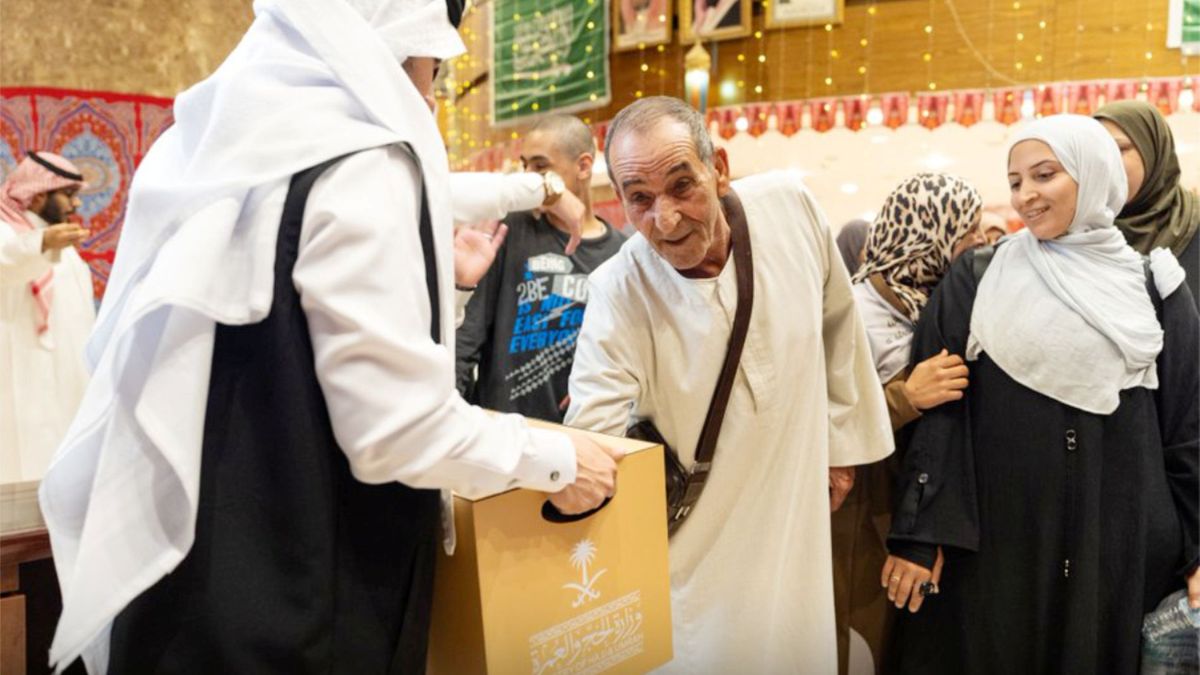
JOGJA PORTAL – The Saudi Arabian government ensures that the health condition of more than 1.7 million Hajj pilgrims this year is stable and safe, with no significant public health threats found.
Quoted from Arab News, Thursday (28/5/2026), mentioned in a press conference regarding the safety and health of the Hajj, the spokesperson for the Ministry of Health, Abdulaziz Abdulbaqi, said that this condition was the result of a health service system that was sophisticated and working efficiently. This is supported by national professional staff, careful planning, and the use of modern technology for monitoring and fast handling.
Also present on this occasion were the spokesperson for the Ministry of Home Affairs, Brigadier General Talal bin Abdulmohsen Al-Shalhoub, spokesperson for the Ministry of Hajj and Umrah, Ghassan Al-Nuaimi, and spokesperson for the transportation and logistics sector for the Hajj season, Abdulaziz Al-Otaibi.
Abdulbaqi revealed that as of May 27 2026, the health services provided to the congregation had reached more than 1.2 million services in the integrated health system.
“This service includes more than 41 thousand visits to emergency departments, more than 4,900 patients treated in hospitals, and around 50 thousand congregants served in primary health centers and emergency services,” he explained. He added that outpatient consultations were recorded at more than 14 thousand, while around 83 thousand emergency cases had been handled.
Also Read: Number of Hajj Pilgrims Increases by 2 Percent, Holy Land Crowded with 1.7 Million Muslims
In addition, 29 open heart operations, 251 cardiac catheterization procedures, and 337 other surgical operations have been carried out.
In the aspect of health consultation services, more than 1 million incoming calls were received through the Ministry of Health’s 397 service center in various languages. A total of 466 cases of heat exhaustion were also successfully treated according to medical procedures, so that the congregation could continue their series of services.
In the security sector, Al-Shalhoub emphasized that the Hajj security system runs with the latest technology and real-time monitoring based on artificial intelligence, supported by cross-agency coordination and wide deployment of personnel.
“Current Hajj security does not only rely on officers in the field, but is also supported by an integrated intelligent control room between the Ministry of Home Affairs, the Allah Guest Services Program, the Ministry of Hajj and the Ministry of Health,” he said.
He also highlighted strategic cooperation with state security forces in managing the stoning procession, with all agencies working in an organized and high-precision system to monitor mass movements directly.
“We have carried out thorough planning, implementation and supervision. If an emergency situation occurs, a quick response will be carried out with the support of artificial intelligence technology,” he added.
Also Read: White Sea in Mina, 1.7 Million Hajj Pilgrims Perform Jumrah Throwing Ritual
Meanwhile, Al-Nuaimi explained that after sunset on Arafah Day, around 60 percent of the congregation spent the night in Muzdalifah, while the other 40 percent moved according to the schedule set in the crowd management scheme.
He also mentioned that the Nusuk card had been used for more than 4 million scans, which helped speed up verification of congregation data in the field.
For the implementation of sacrificial services, through the Adahi program, congregations can carry out hadyu according to sharia and health standards, with a capacity of more than 800 thousand animals during sacrificial days and Tasyrik, and digital purchasing services are available.
In the field of transportation, Al-Otaibi said that more than 2.4 million pilgrims took advantage of the “Passengers Without Baggage” program, with a total of more than 3.8 million pieces of baggage that had been handled.
He also revealed that the project connecting Al-Sail Al-Kabir Road with the Riyadh–Taif route will be completed before the next Hajj season, and Terminal 4 will be opened at King Abdulaziz International Airport.
Mashaer metro trains have served more than 961 thousand pilgrims, while station capacity continues to be increased to accommodate the surge in passengers.
Also read: Saudi Arabia issues first permit for drones for drug distribution during Hajj
In addition, more than 2,500 buses are used to transport pilgrims from various entrances, with 24 parking areas capable of accommodating up to 2,000 buses. Around 600 thousand vehicles were also recorded as passing towards the holy area.
The Haramain Fast Train also remains a mainstay, with more than 830 thousand pilgrims having been transported via more than 5,300 journeys until 8 Dzulhijjah.
Al-Otaibi added that the punctuality rate for intercity bus trips reached 96 percent, supported by more than 950 automatic monitoring points to ensure operational compliance.
For the return of the congregation, the first flight is scheduled for May 29 and the last on June 30 (Muharram 15), with 870 service counters prepared. In addition, there are 70 smart gates at King Abdulaziz International Airport and 20 similar gates at Madinah Airport to support the biometric identification process. ***