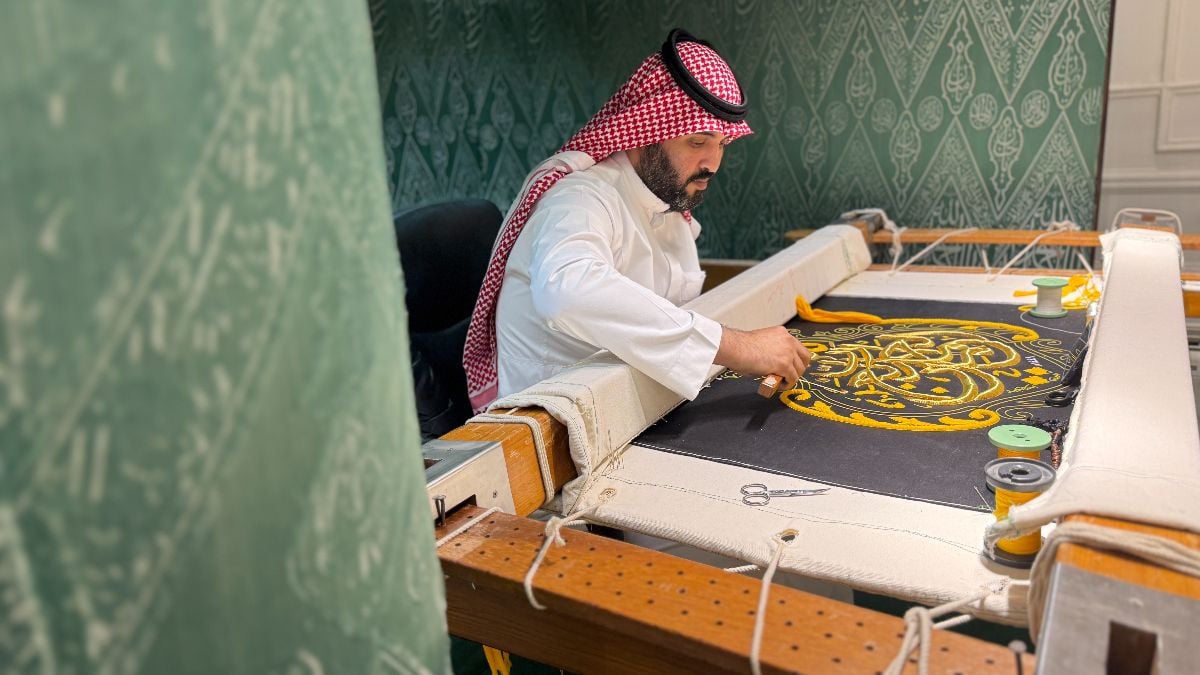
THE MIND OF THE PEOPLE – Jet black cloth with gold embroidered calligraphy covering the Kaaba will be encountered by Hajj and Umrah pilgrims during the tawaf procession. The manufacturing process became one of the greatest artistic and spiritual masterpieces in the Islamic world.
It is Kiswah, which in Arabic means veil. The Kiswah was installed to protect the beauty of the Kaaba.
In 2026, the manufacture of miswah cloth will be centered at the King Abdulaziz Complex for the Holy Kaaba in Makkah, Saudi Arabia. The PPIH Saudi Arabia Hajj Media Center (MCH) team together with representatives of journalists from various countries covering Hajj activities had the opportunity to see the process of making the kiswah cloth.
Behind the soft kiswah cloth and beautiful calligraphy covering the Kaaba, there are hundreds of skilled hands involved. At least 155 skilled craftsmen and calligraphy artists are deployed every day to make kiswah cloth.
- Also Read: Kaaba Replica Will Be Built in Bogor, Kiswah Cloth Installed in Grand Mosque
The production time for a complete set of kiswah takes almost 10-11 months. The longest process is embroidering calligraphy on cloth because it is done manually.
Kiswah uses selected natural pure silk fabric. For the calligraphy ornament as the center of attention, 120 kg of pure 24 carat gold thread and 100 kg of silver thread were used.
For this work of high artistic value, the costs required are not half-hearted, reaching 25 million riyals or the equivalent of more than IDR 100 billion.
The manufacturing process begins with selecting the best silk fabric imported from abroad. Approximately 670 kg of pure, raw natural silk is specially washed to remove the natural protective layer so that the thread becomes very smooth and ready to absorb color, then spun into fine threads with a very high level of precision.
After being spun, the silk thread enters the dyeing stage. The outer part of the Kiswah cloth is colored dark black which symbolizes majesty, steadfastness and simplicity. The dyeing is done repeatedly so that the black color penetrates perfectly into the deepest fibers, and also ensures that the fabric is resistant to exposure to extreme sunlight and weather changes in Mecca.
- Also Read: For the First Time, Women Are Involved in the Kiswah Replacement Process
For the record, there is also silk dyed green for the inside of the Kaaba.
Silk thread fabric that has matured in color is ready to be woven into large sheets.
Nowadays, the basic weaving of black cloth uses modern high-tech machines to ensure the structural strength of the cloth.
There is a special motif on the woven kiswah cloth with words of dhikr such as “Ya Allah Ya Allah”, “La ilaha illallah Muhammadur Rasulullah”, and “Subhanallah wa bihamdihi Subhanallahil ‘Adzim”.
While the cloth is being woven, the calligraphy artist begins to design the calligraphic layout of the verses of the Koran that will be embedded on the Kiswah belt. The verses chosen are adjusted to the position in which they are placed, especially verses about the Hajj or the sanctity of the Baitullah).
The calligraphy pattern is printed on paper, then transferred onto thick canvas as a basic guide for embroidery.
Calligraphy embroidery is the most complicated process and requires high precision. The craftsmen embroider slowly and with full concentration, ensuring that letter by letter matches the basic pattern.
Also Read: Replacement of the Kiswah of the Kaaba on 1 Muharram 1446 H, Attracts the Attention of Hajj Pilgrims
In order to produce a magnificent embossed effect, the calligraphy pattern on the canvas is first filled with thick white cotton thread. The craftsman then begins to embroider the top of the calligraphy with gold and silver plated thread tightly until it covers the white thread.
One kiswah set consists of 47 separate panels with a width of about 95 cm on each side and a height of up to 14 meters. In the final stage, the black panel pieces are stitched and joined together precisely to form a complete covering for the four sides of the Kaaba. The most magnificent separate part, namely the Kaaba door curtain (Al-Burqu’), is also installed at this stage.
Once the entire process is complete, the new Kiswah will be kept until the day it is replaced. The replacement of kiswah cloth has been going on for more than a century, becoming a momentum that has attracted the attention of Muslims throughout the world.
Previously, the kiswah was changed every 9th of Dzulhijjah when the Hajj pilgrims were performing wukuf at Arafah.
Since 1 Muharram 1444 AH coincides with 30 July 2022, on the orders of King Salman the Saudi Arabian government has replaced the Kaaba kiswah as a sacred start to the turn of the Hijriah year.
A special sight will be found by pilgrims entering the Grand Mosque during the month of Hajj. Since the beginning of the year, the Kaaba has been in ‘ihram’, the kiswah is raised approximately 3 meters high and covered with white cotton cloth. This tradition is carried out by the management of the Grand Mosque as a symbol of the start of the Hajj season.
The Kiswah not only beautifies the Qibla of Muslims, but also covers every prayer and hope expressed by millions of people who prostrate around it. ***