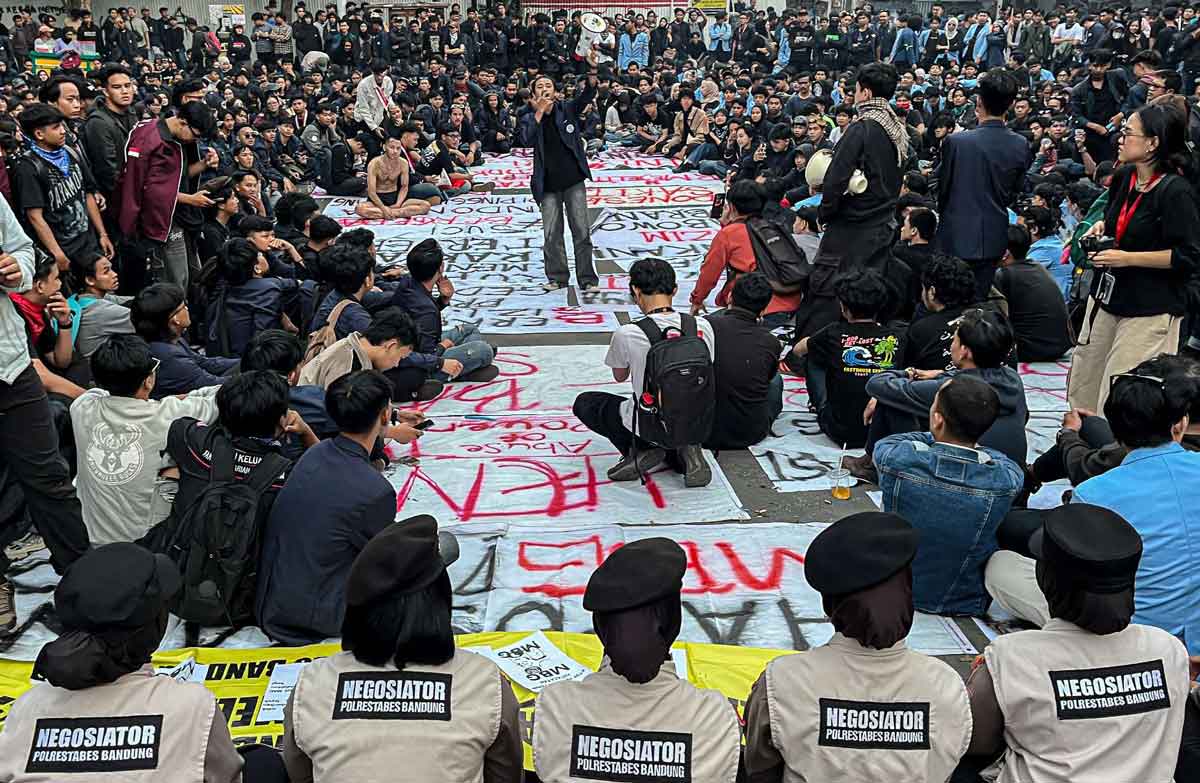
A wave of nationwide demonstrations involving students and civil society groups took place across various cities in Indonesia in mid-June 2026. The protests were driven by concerns over the worsening national economic situation, controversies surrounding government programs, and perceived threats to shrinking civic space.
A major demonstration was held in front of the West Java Regional House of Representatives (DPRD) building in Bandung on Monday, June 15, 2026. Similar protests also took place in Jakarta, Medan at the North Sumatra DPRD building, Makassar, Palembang, Yogyakarta, Semarang, Surabaya, and Solo.
The student demonstration in front of the West Java DPRD office in Bandung turned chaotic. The unrest was allegedly triggered by provocations from a group of individuals who threw mineral water bottles and firecrackers toward police officers.
The protest featured tire burnings, road closures, and a series of speeches sharply criticizing the administration of President Prabowo Subianto and Vice President Gibran Rakabuming Raka.
The demonstrators came from Student Executive Boards (BEM) of several universities, including Pasundan University (Unpas) in Bandung and Jenderal Achmad Yani University (Unjani) in Cimahi.
The demonstration began at approximately 3:00 p.m. on Jalan Diponegoro, a major thoroughfare where the West Java DPRD office is located. To ease traffic congestion, police closed several roads leading to the area.
Ferry Anwar, a student from Bandung Islamic University (Unisba), said the protest was the result of coordination among several student organizations. According to him, they brought three main demands that they considered crucial to the nation’s current condition.
“First, we demand an education revolution. Second, abolish the Free Nutritious Meals (MBG) program. Third, revoke the TNI-Polri Law, which we believe is beginning to encroach upon and threaten civilian space,” Ferry said at the protest site.
In addition to those three central issues, economic challenges linked to global geopolitical tensions, including developments involving Iran and the United States, were also highlighted. The government was criticized for being slow to respond and for failing to provide concrete solutions to protect the people’s economy.
Ferry further emphasized that the demonstrators’ primary objective was not to meet with legislators but to express a vote of no confidence.
“Our main demand is not to meet with the DPRD. We want to push for President Prabowo and Vice President Gibran to step down from office,” he said.
Protests Also Target Bank Indonesia
A similarly large protest disrupted the Braga area in Bandung. Hundreds of students from Pasundan University (Unpas) and Jenderal Achmad Yani University (Unjani) staged a demonstration directly in front of the West Java Representative Office of Bank Indonesia.
As a result, road access in the area was completely closed. Both motorcycles and cars were redirected toward Jalan Merdeka. Protesters briefly burned used tires as a form of protest before police officers extinguished them.
Muamar Baasir, Chairman of the Student Executive Board of the Faculty of Law at Unpas, stated that their presence in front of Bank Indonesia was intended to urge the state to take strategic measures amid the ongoing crisis.
He highlighted several key concerns that required immediate attention, including the weakening of the rupiah. Students called on Bank Indonesia to take concrete action to curb the rise of the U.S. dollar and stabilize the rupiah exchange rate.
The protesters also demanded firm government action to reduce fuel prices and called for a comprehensive evaluation of the management of the Free Nutritious Meals (MBG) program.
“Beyond economic issues, we are also highlighting what we consider repressive actions by security forces against the public. Today, students are asking whether this country still operates as a democracy or merely as a bureaucracy. The current government acts arbitrarily, violating laws and the Constitution,” Muamar said.
Sharp criticism regarding budget allocation was also voiced by Zihan Fitriyani, Deputy Chair of the Student Executive Board of the Faculty of Health Technology Sciences at Unjani.
She argued that the MBG program absorbs too much of the state budget, while the education and healthcare sectors are being neglected.
“The implementation of the MBG program lacks clear direction. At the same time, the rupiah continues to weaken. Even if this is a global issue, the government has not provided sufficient transparency or policy explanations,” Zihan said.
She also strongly criticized proposals that would allow police officers to hold civilian positions and condemned the detention of one of her fellow Unjani students during the protest.
“Free our friend! Free our friend!” she shouted as she concluded her speech.
Demonstrations Spread to Majalengka
Dozens of students and community members from the Majalengka Student and Community Alliance staged a protest at the Majalengka Regency DPRD building on Monday, June 15, 2026.
The demonstration voiced opposition to rising fuel prices and what participants described as the growing prevalence of corruption that continues to burden ordinary citizens.
The protesters marched from the Youth Center (GGM) to the legislative building under heavy police escort.
Along the route, they carried banners and posters featuring messages such as “The Dollar Soars, the People Suffer” and “Corruption Thrives, the People Endure Hardship.”
Calls for National Reform
In Jakarta, protests were centered around the State Palace and the Horse Statue area, carrying the themes of “Second Reform Movement” and “Reorganizing Indonesia.”
The demonstrations were followed by a meeting between student representatives and Vice President Gibran Rakabuming Raka.
The Vice President met representatives of student groups who had participated in demonstrations across several locations in Jakarta and received them at the Vice Presidential Palace on Jalan Medan Merdeka Selatan on Monday afternoon.
A total of 15 representatives left the protest site and arrived at the Vice Presidential Palace at approximately 5:00 p.m.
Acting Vice Presidential Secretary Al Muktabar said the meeting covered various regional and national issues and that the concerns raised would be taken into consideration.
“Of course, everything will be addressed within the limits of authority provided by existing laws and regulations. Because we are a democratic nation governed by the rule of law, the Vice President highly appreciates these kinds of aspirations,” Al Muktabar told reporters at the Vice Presidential Palace.
Meanwhile, protest coordinator and Chairman of the Student Executive Board of the Faculty of Law at UBK, M. Abdi Maludin, said the Vice President had carefully noted the students’ demands.
“The Vice President’s response was very positive. He took note of our demands as part of efforts to improve and evaluate irregularities occurring in the country today,” Abdi said.
According to him, the issues discussed included the MBG program, the weakening rupiah, and rising non-subsidized fuel prices.
The protest in Jakarta involved approximately 122 students from several universities.
BEM Bersatu Rejects Political Manipulation
Meanwhile, the student alliance BEM Bersatu stated that it strongly opposes any student movement that is influenced by practical political interests.
“We, BEM Bersatu, reject all forms of political manipulation of student movements. Student activism must remain the voice of the people, not a tool for elites in their struggle for power,” said BEM Bersatu spokesperson Rahmat Djimbula during a press conference in Jakarta on Tuesday, June 16, 2026.
The statement was issued in response to a number of recent student demonstrations.
BEM Bersatu argued that some protests have begun to lose direction, citing a lack of research, weak arguments, and unclear demands. These conditions, the alliance said, raise questions about the independence of the movements.
The group also questioned the priorities promoted by some protest organizers. According to BEM Bersatu, public attention has been diverted toward issues that are not necessarily the most urgent concerns facing society.
“Meanwhile, the Free Nutritious Meals (MBG) program, which has a direct impact on nutrition and public welfare, has become the target of opposition, even though we agree that improvements in governance are still necessary,” Rahmat said.***