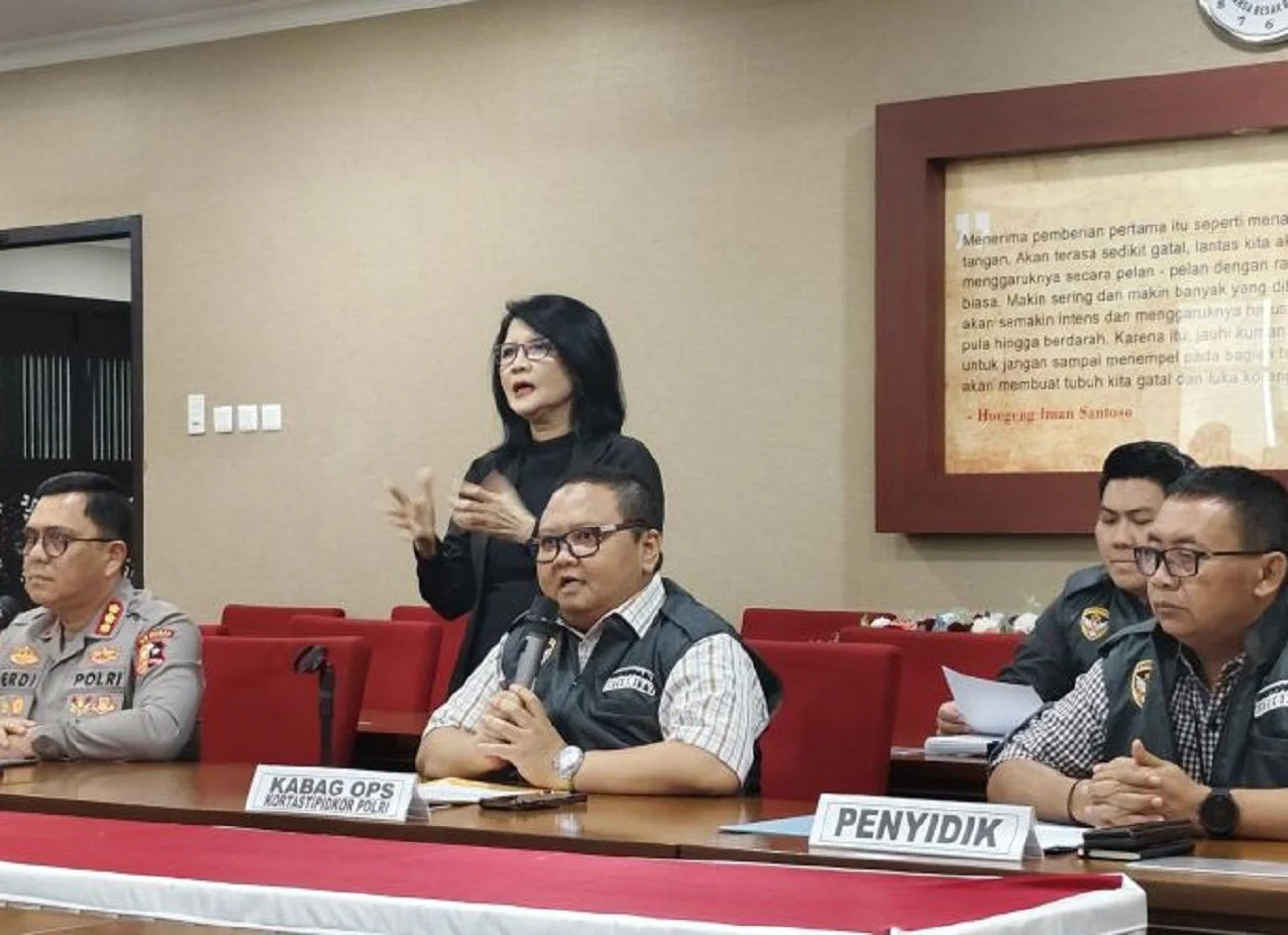
The National Police Corruption Eradication Corps (Kortastipidkor) announced a mega-corruption scandal rocking a national strategic project. Head of Operations at the National Police Kortastipidkor, Police Grand Commissioner Ahmad Yusuf Afandi, explained that the fantastic loss figure was obtained based on an investigative audit report from the Audit Board of the Republic of Indonesia (BPK RI). This structured deviation has been detected from the planning stage, procurement process, to the execution of work on the ground.
“Based on the investigative audit report for calculating state financial losses by the Audit Board of the Republic of Indonesia (BPK RI), there is a state financial loss of around Rp 645.27 billion,” Ahmad Yusuf Afandi said at the National Police Criminal Investigation Department (Bareskrim) Building, Jakarta, Tuesday, July 7, 2026, as quoted by Antara.
This massive state loss arose due to payments to the project executor that were forced through to reach 99.3% of the contract value. Tragically, even though the state money was nearly depleted, the output of the work on the ground completely failed to meet the agreed performance standards.
In this case, Kortastipidkor investigators have named two former high-ranking executives as suspects. The first suspect is DPP, the President Director of PTPN XI for the 2015–2017 period. In this matter, DPP played a role in conditioning the bidding process by passing an unqualified company, directing the formation of the KSO Wika-Barata-Multinas consortium, and unilaterally inflating the owner’s estimate price to benefit a specific group.
The second suspect is TD, the President Director of PT Multinas Indonesia. TD played a role in the illicit agreement to win the project, executing the work carelessly, failing to involve technology providers with specific specifications, and defaulting on the obligation to issue a performance guarantee, which caused the testing phase (commissioning) to fail.