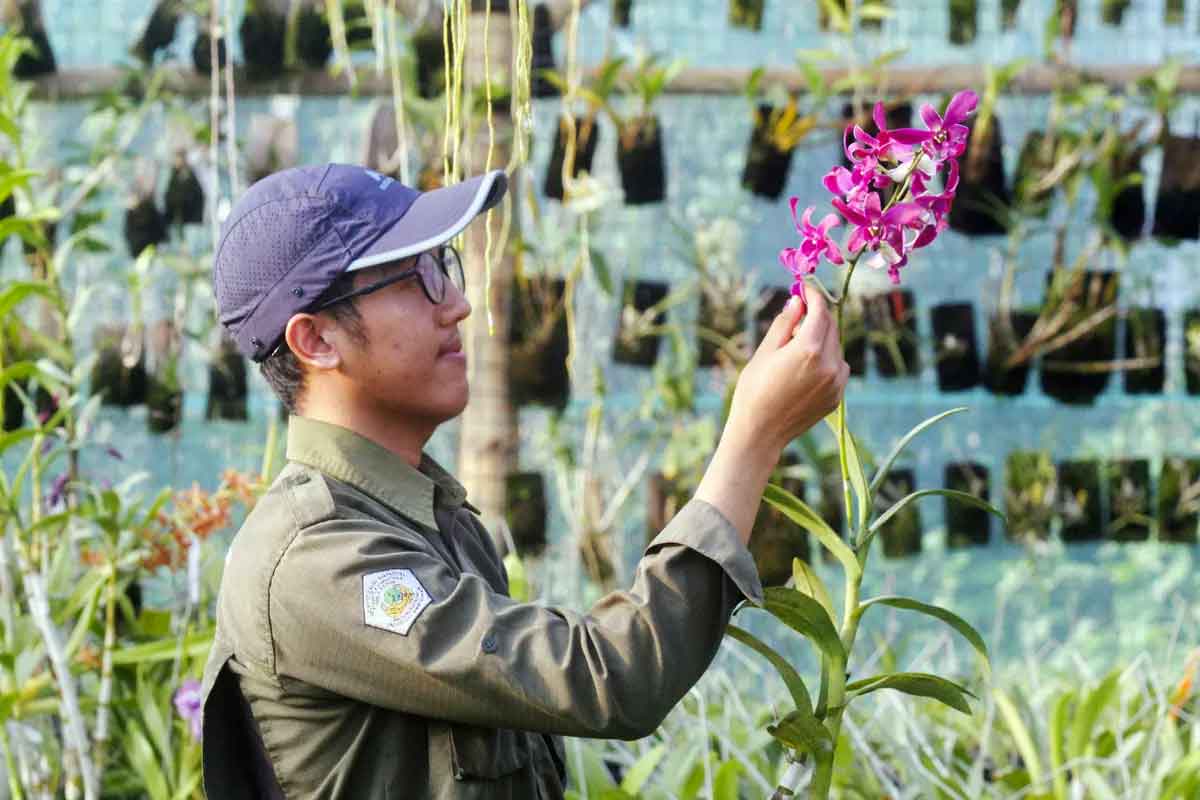
Researchers from Indonesia’s National Research and Innovation Agency (BRIN) have revealed that the pigeon orchid (Dendrobium crumenatum), which grows abundantly across various conservation areas in Indonesia, holds significant potential as a source of bioactive compounds for the development of nutraceuticals and other natural health products. However, its potential remains largely underutilized.
Through a study published in the journal Applied Biochemistry and Biotechnology, the BRIN research team found that the environmental conditions in which the orchid grows influence its metabolite composition. These differences, in turn, affect the plant’s antioxidant and antibacterial activities.
The study employed a metabolomics approach using Ultra High Performance Liquid Chromatography–High Resolution Mass Spectrometry (UHPLC-HRMS). Researchers compared the metabolite profiles of leaves and stems of Dendrobium crumenatum collected from the Bogor Botanical Gardens (KRB) and Ujung Kulon National Park (TNUK).
Salsabila Aqila Putri, a postdoctoral researcher at BRIN’s Research Center for Food Technology and Processing (PRTPP), explained that the study aimed to uncover the relationship between environmental conditions and the plant’s metabolite content while evaluating its biological potential.
She revealed that the geographical location of conservation areas significantly influences the metabolite profile of Dendrobium crumenatum. Environmental factors trigger the production of different secondary metabolites as part of the plant’s adaptive mechanisms.
Metabolomic analysis successfully identified 48 metabolite compounds, consisting of approximately 54 percent secondary metabolites, including phenolic compounds, flavonoids, alkaloids, and terpenoids. The remaining 46 percent were primary metabolites, such as fatty acids, amino acids, and their derivatives.
The analysis showed that samples from the Bogor Botanical Gardens contained higher levels of fatty acids and alkaloids. In contrast, orchids collected from Ujung Kulon National Park were richer in phenolic compounds and flavonoids.
According to Salsabila, these differences represent the plants’ natural responses to the distinct environmental characteristics of each conservation area.
“Plants growing in the Bogor Botanical Gardens tend to experience environmental pressures associated with urbanization. In addition, the higher total nitrogen content in the soil increases the levels of fatty acids and alkaloids in the orchids,” she said on Monday, June 13, 2026.
“Meanwhile, lower rainfall in Ujung Kulon National Park causes the plants to experience greater water stress. This condition stimulates increased production of metabolites that help prevent oxidative stress, such as phenolic compounds and flavonoids, in the pigeon orchids growing there.”
In addition to identifying metabolites, the research team evaluated antioxidant activity using the DPPH, ABTS, and FRAP methods.
The results showed that leaf extracts from orchids collected in Ujung Kulon National Park exhibited the highest antioxidant activity through the ABTS radical scavenging mechanism, with an IC₅₀ value of 99.23 micrograms per milliliter and a FRAP activity of 200.78 milligrams Trolox Equivalent per gram.
Meanwhile, leaf extracts from the Bogor Botanical Gardens demonstrated the strongest activity in inhibiting DPPH radicals, with an IC₅₀ value of 242.5 micrograms per milliliter.
The antibacterial tests also produced promising results. Leaf and stem extracts from the Bogor Botanical Gardens inhibited the growth of Pseudomonas aeruginosa by 70.15 percent and 86.44 percent, respectively. Meanwhile, stem extracts from Ujung Kulon National Park showed the strongest activity against Staphylococcus aureus.
To better understand the underlying mechanism, the researchers performed molecular docking simulations targeting Penicillin-Binding Protein 2 (PBP2), a key protein involved in the formation of the cell wall of Pseudomonas aeruginosa.
Simulations involving several dominant compounds identified through UHPLC-HRMS analysis revealed that certain phenolic compounds possess strong binding affinity to the protein, suggesting their potential to inhibit bacterial growth.
Among the tested compounds, 4′,6-dihydroxy-3′-methoxyaurone demonstrated the highest binding affinity.
Salsabila believes the findings open new opportunities for utilizing pigeon orchids as raw materials for health products derived from Indonesia’s biodiversity.
“Our findings show that the metabolites found in Dendrobium crumenatum are not only influenced by the environment in which the plant grows, but also determine its antioxidant and antibacterial activities,” she said.
“These findings provide a scientific foundation for developing pigeon orchids as potential raw materials for nutraceuticals and other health products based on Indonesia’s rich biological resources.”
The study also underscores the importance of conservation areas as reservoirs of genetic resources and biodiversity with high-value bioactive compounds. This potential could drive innovation in functional foods, healthcare, and biotechnology.***