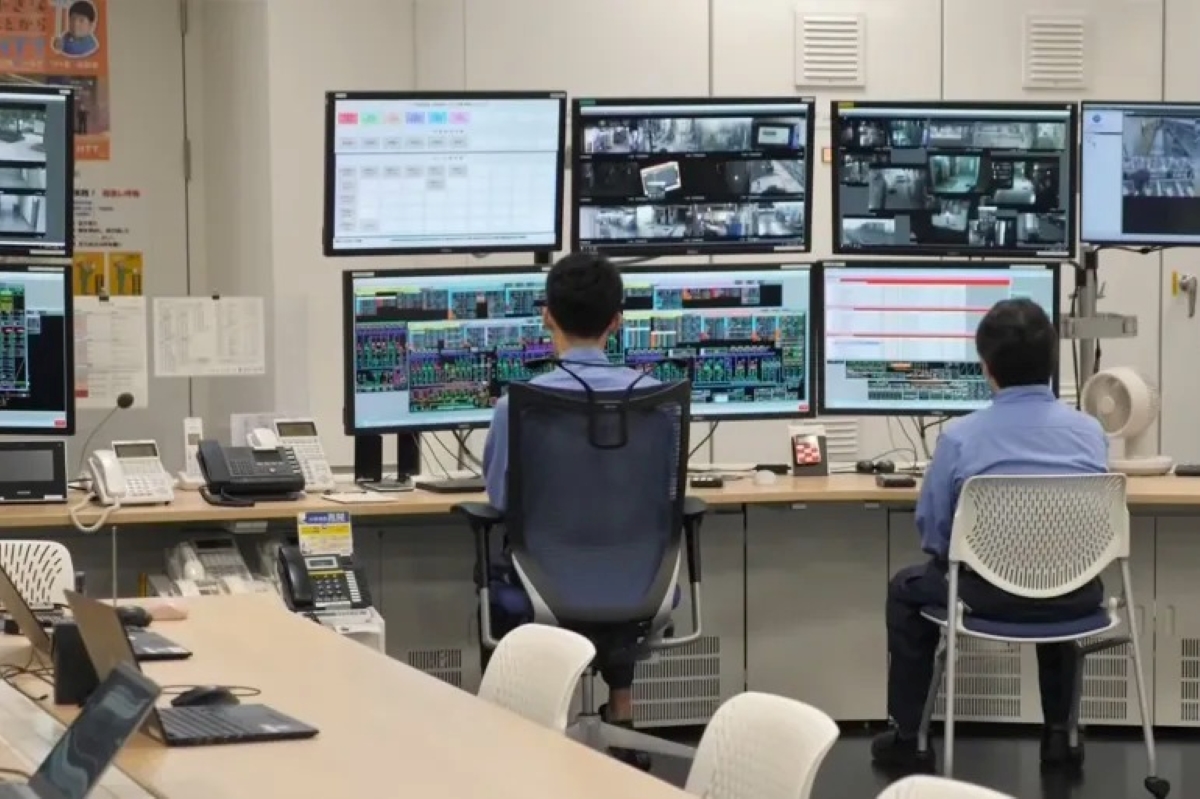
Amid the towering skyscrapers of Otemachi, Tokyo, a significant experiment is underway—one that could shape the future of Japan’s economy. The question at the heart of the initiative is whether artificial intelligence (AI) can help rescue the country from a worsening labor shortage caused by its rapidly aging population.
Beneath the city’s streets, Marunouchi Heat Supply Company operates a 30-kilometer network of heating and cooling pipelines that serves office buildings and transportation facilities throughout Tokyo’s central business district.
The company is now using an AI-powered system called PlantPilot to manage the complex infrastructure, marking a major step toward achieving full digitalization by 2027.
According to Al Jazeera on Thursday, July 23, 2026, the system was developed in collaboration with AI startup Preferred Networks. It was trained using historical operational data as well as decades of expertise accumulated by senior engineers.
By analyzing sensor data, the AI system is designed to predict future operating conditions while preserving and transferring valuable technical knowledge to the next generation of workers.
“Our biggest challenge is securing skilled workers. As experienced employees begin to retire, we face the risk of losing invaluable operational knowledge. AI helps preserve that expertise and pass it on,” said Hidetaka Yagi, Assistant General Manager of the Development and Engineering Department at Marunouchi Heat Supply.
AI as a Workplace Partner
Unlike concerns in several Western countries that automation could replace human workers, Japan is positioning AI as a workplace partner rather than a substitute.
The country’s shrinking population has created growing labor shortages across nearly every industry, including manufacturing, logistics, energy, and healthcare.
Japan’s technology development strategy is therefore increasingly focused on solving real-world problems instead of competing directly with the United States or China in the race to build the world’s largest AI models.
Local companies such as Sakana AI are concentrating on integrating artificial intelligence into Japan’s already well-established industrial sectors.
“If we try to compete with American companies in exactly the same way, we won’t succeed. Japan needs to develop different ideas, attract talented researchers, and create new approaches to innovation. The goal is not to replicate OpenAI in Japan, but to use AI to solve real-world problems,” said Ren Ito, Chairman of Sakana AI.
Massive Investment
Japan’s efforts to address its demographic challenges are being strongly supported by the government.
The Japanese government plans to mobilize 370 trillion yen (approximately US$2.3 trillion) in public and private investment by 2040.
The funding will be directed toward the development of artificial intelligence, the semiconductor industry, and advanced research.
The initiative underscores that AI is no longer viewed merely as a technological trend, but as a critical instrument for Japan’s future.***