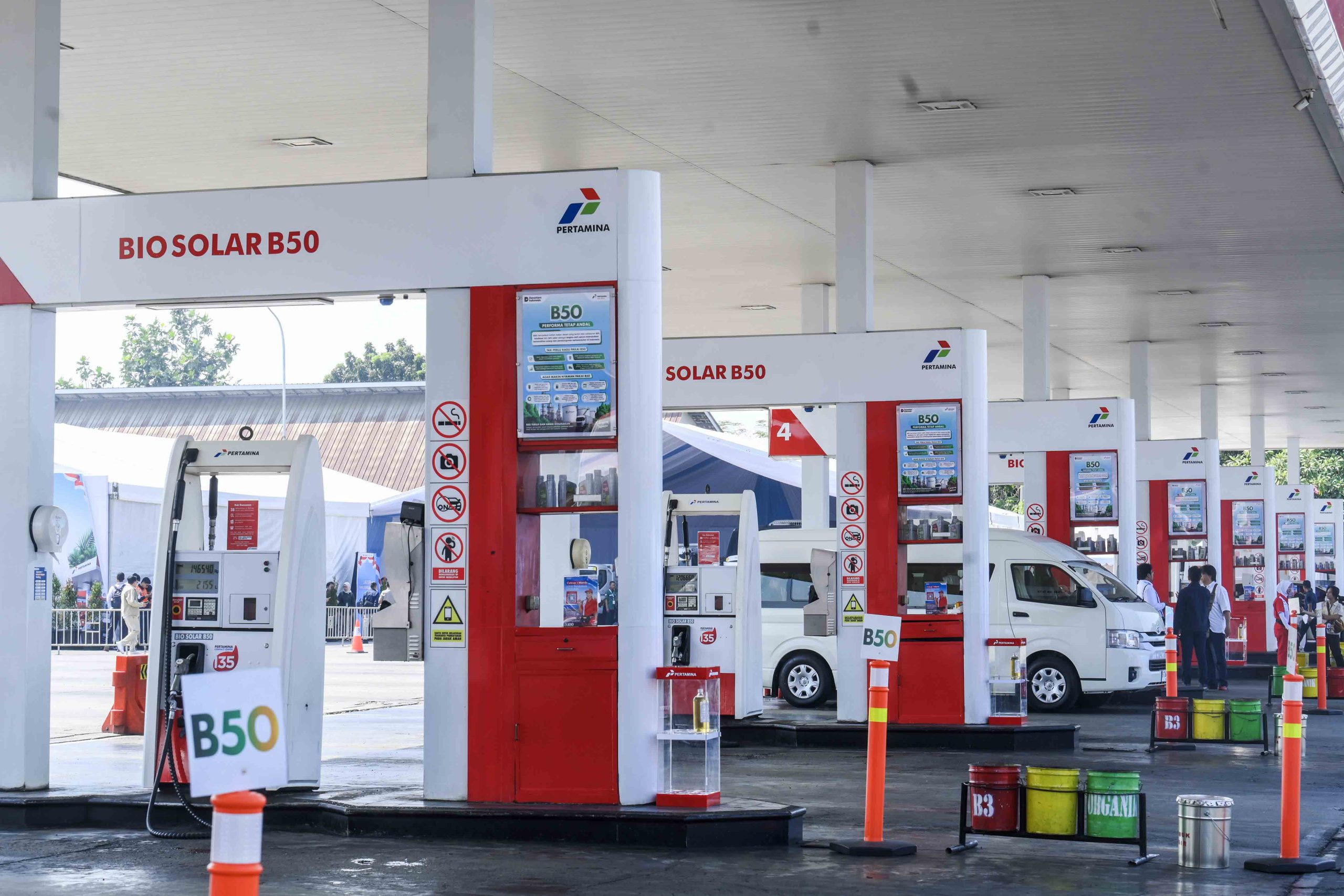
Indonesian President Prabowo Subianto officially launched the Mandatory B50 Biodiesel Program, a diesel fuel blend containing 50% palm oil-based biofuel, marking a major milestone in the country’s energy transition. With the program’s implementation, Indonesia has officially ended its imports of diesel fuel.
“Indonesia has officially become the first country in the world to implement the Mandatory B50 Biodiesel Program. The implementation of this biofuel program is also part of the government’s effort to achieve energy self-sufficiency,” Prabowo said during the launch ceremony at the KM 57 Rest Area in Karawang on Thursday, July 9, 2026.
Prabowo emphasized that the Mandatory B50 Biodiesel Program is not merely a technological achievement, but also a concrete effort to manage Indonesia’s natural resources for the benefit of its people. He described it as a significant milestone toward national energy independence.
According to the President, the survival of any nation depends on three fundamental elements. First, a country must be able to produce its own food. Second, it must have its own energy resources without relying on other nations. Third, it must secure sufficient water resources.
“Food, energy, and water. These are priorities recognized by the United Nations, and nearly all experts on human civilization understand that without these three elements, a nation will struggle to survive, maintain its sovereignty, and achieve prosperity,” Prabowo said.
As previously announced, the implementation of the B50 program is based on Minister of Energy and Mineral Resources Regulation No. 4 of 2025 concerning the Production and Utilization of Biofuels, as well as Ministerial Decree No. 257.K/EK.01/MEM.E/2026, which mandates a 50% biodiesel blend in diesel fuel.
Under these regulations, biofuel producers, fuel suppliers, and fuel distributors are required to comply with quality standards that meet the government’s technical specifications.
The government has also established an enforcement mechanism, and the program will undergo regular evaluations. From a technical standpoint, B50 has been tested across six diesel-powered sectors: automotive, agricultural machinery, mining heavy equipment, maritime transportation, power generation, and railways. The testing involved government ministries and agencies, state-owned enterprises, industry associations, academic institutions, technology providers, and end-user industries.
Eliminating Diesel Imports
Meanwhile, Minister of Energy and Mineral Resources (ESDM) Bahlil Lahadalia stated that ending diesel imports will eliminate the country’s annual diesel import requirement of approximately 3 million to 4 million kiloliters (KL).
Indonesia currently consumes around 38 million to 40 million kiloliters of diesel fuel annually.
“With the implementation of B50, thank God, we no longer need to import diesel fuel into our country. This is the first time we have achieved this,” Bahlil said.
He explained that ending diesel imports is part of the government’s broader strategy to strengthen national energy independence in line with President Prabowo’s Asta Cita development agenda.
“Today, we are not only launching B50, but we are also taking a major step toward an Indonesia that is self-sufficient and sovereign in the energy sector, in accordance with President Prabowo’s Asta Cita vision,” he said.
Bahlil acknowledged that implementing the B50 mandate was not an easy task. Traditionally, increases in biodiesel blending ratios have been introduced gradually—typically by 5% to 10% increments—with testing periods lasting up to three years.
He said President Prabowo’s directive to implement B50 by 2026 prompted the government to accelerate every stage of development and testing.
“We interpreted the President’s directive as being about much more than B50 itself. It is about sovereignty, independence, and the nation’s dignity—our ability to produce our own energy from our own resources,” he said.
Bahlil added that B50 fuel underwent six months of testing across various transportation modes, including trains, passenger cars, buses, and ships. The trials also covered vehicles from multiple manufacturers, including Japanese and European brands.
“We tested trains, passenger cars, even Mercedes vehicles, buses—not just Toyota. Mercedes performed well too. We tested vehicles from both Asia and Europe, as well as all types of ships,” Bahlil said.***