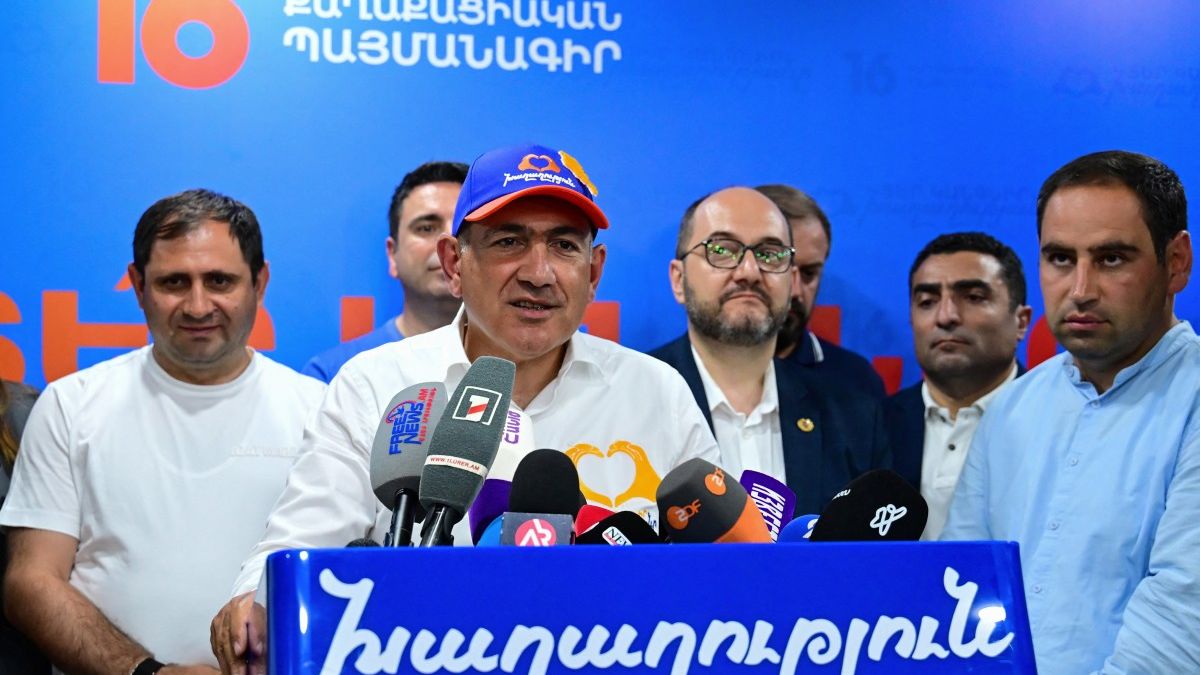
News Screen – The Civil Contract Party led by Armenian Prime Minister Nikol Pashinyan achieved victory in the 2026 Armenian parliamentary elections based on preliminary results announced by the Central Election Commission on Monday, June 8, 2026.
Counting results from all polling stations showed the ruling party obtained 49.8 percent of the vote, significantly ahead of the Strong Armenia alliance led by Russian-Armenian businessman Samvel Karapetyan, who obtained 23.3 percent of the vote.
Two other opposition forces also managed to secure parliamentary seats, namely the Armenian alliance led by former president Robert Kocharyan with 9.9 percent of the vote and the Prosperous Armenia Party which received 4 percent of the vote.
Also Read: Peruvian Election 2026: Keiko Fujimori and Roberto Sanchez Compete Tightly in the Second Round
The Central Election Commission recorded a voter participation rate of 59 percent. Responding to these results, Pashinyan called his party’s victory an important achievement that will become the basis for sustainable national development and the reforms being carried out by the government.
He emphasized his commitment to continuing the policy of approaching Western countries, while maintaining diplomatic relations and cooperation with Russia.
“This victory is the basis for continuing Armenia’s development and strengthening the country’s position amidst global dynamics,” said Pashinyan.
Meanwhile, opposition leader Samvel Karapetyan rejected the election results and accused various violations during the voting process. He also claimed that a number of members of his campaign team were detained before and during the election.
Responding to these reports, the Armenian Investigative Committee stated that it had opened 59 criminal cases related to alleged election violations, including alleged double voting. A total of nine people have reportedly been detained for investigation purposes.
This election is in the international spotlight because it is taking place amidst a change in the direction of Armenia’s foreign policy. In recent years, Pashinyan’s government has sought to reduce dependence on Russia by expanding political and economic ties with the European Union and the United States.
The Armenian government has also taken steps to freeze participation in the Russian-led security alliance and open the door to closer integration with the European Union.
This policy sparked the attention of Moscow, which has been Armenia’s strategic ally in the South Caucasus region. Russia has previously expressed concern over Armenia’s increasingly close ties to Western institutions.
In the midst of the election campaign, a number of analysts noted an increase in political narratives on social media highlighting Armenia’s geopolitical choices. The Armenian government also warned of propaganda and disinformation efforts that could influence public perception ahead of the vote.
Apart from that, Russia’s decision to limit imports of a number of products from Armenia several weeks before the election is also a concern because it is considered to have the potential to put economic pressure on the country.
For some Armenian voters, the results of this election are seen as determining the direction of the country’s future, especially regarding relations with Russia and efforts to strengthen partnerships with Western countries.
With the temporary victory of the Civil Contract Party, Pashinyan’s government is expected to continue its domestic reform agenda and a foreign policy that is more open to cooperation with the European Union and the United States.***