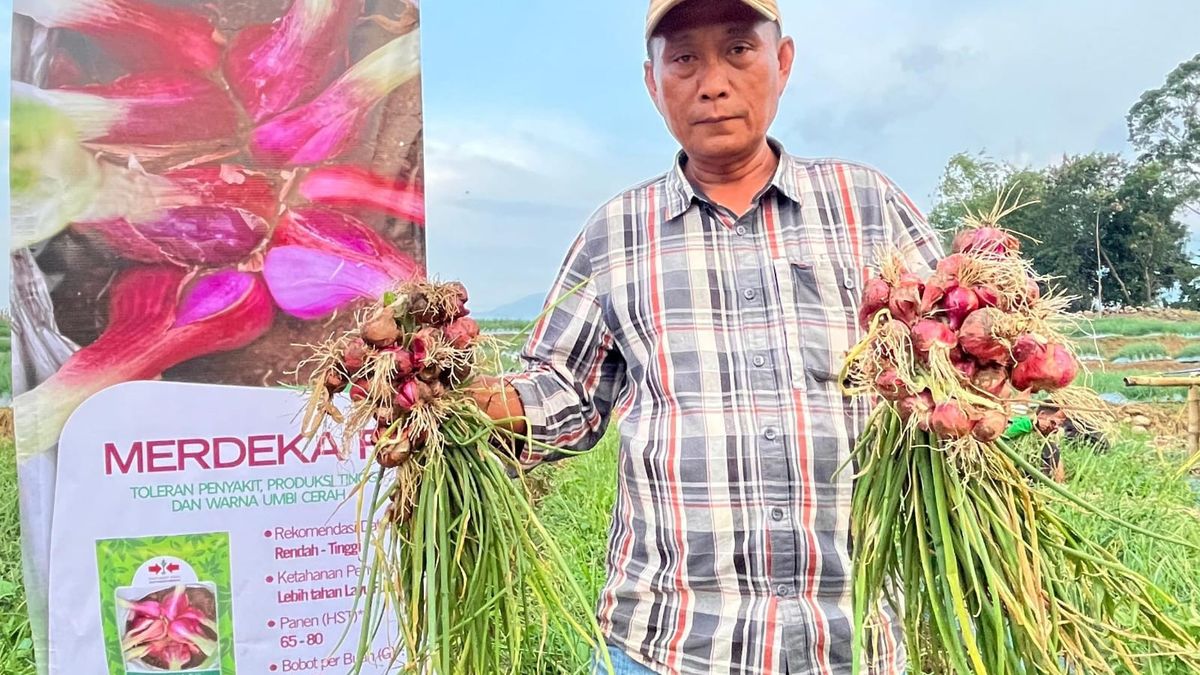
JABAR PR — The decision to leave the profession as a civil servant (PNS) was a turning point for Tono Suwarna. This man from Cimaung, West Java is now known as a shallot farmer who has succeeded in increasing crop yields significantly through innovative cultivation technology.
Instead of using conventional tuber-based methods, Tono chose to develop shallot cultivation from seeds or True Shallot Seed (TSS). This step was doubted by many parties, but it is actually the key to its current success.
“At first many people said I was reckless. But I believe that if you want to progress, you have to have the courage to try new things,” said Tono when met on his farm.
The decision paid off. By implementing TSS, Tono is able to produce harvests of up to dozens of tonnes per hectare with more uniform quality. Apart from increasing productivity, this method also provides production cost efficiency, especially for the seed component which has been quite large.
“This innovation has really changed my life. Costs are lower, results are greater. From here I can send my children to college,” he said.
As a strategic commodity, shallots have an important role in household needs in Indonesia. National consumption is recorded at around 2.8 to 3 kilograms per capita per year. However, high demand has not been fully offset by productivity at the farmer level.
Data from the Central Statistics Agency (BPS) shows that the average national shallot productivity is still around 9-10 tons per hectare. This figure is considered still below optimal potential when compared with the results that can be achieved through technology and the use of superior seeds.
These conditions open up opportunities for innovations such as TSS to increase productivity as well as farmer welfare. One of the varieties developed, MERDEKA F1, has the potential for yields reaching 14-18 tonnes per hectare or an increase of up to 40-80 percent compared to traditional methods.
Apart from that, the use of TSS can also reduce seed costs by up to 30-50 percent. This efficiency is an important factor in increasing farmers’ profit margins and reducing the risk of losses due to high initial production costs.
Managing Director of PT East West Seed Indonesia (Ewindo), Glenn Pardede, emphasized the importance of innovation in facing future challenges in the agricultural sector.
“Innovation is very important for farmers. Without innovation, productivity will stagnate, while challenges continue to increase. Therefore, we are committed to presenting solutions that are relevant and have a direct impact on farmers,” said Glenn.
He added that the development of superior seeds does not only focus on increasing yields, but also the sustainability of farming businesses.
“We want farmers to not only harvest more, but also be more efficient and competitive. TSS is one of the innovations that we are encouraging to achieve this goal,” he said.
At the field level, the impact of this innovation is starting to be seen. More and more farmers are interested in adopting the TSS method, including the emergence of new business models such as providing shallot seedlings.
Tono himself is now actively sharing his experiences with other farmers through “Rumah Bawang”, a TSS-based shallot cultivation learning center initiated by Ewindo. Similar facilities are also available in Wonosobo, Central Java, and Solok, West Sumatra.
Through this program, farmers can learn all stages of cultivation comprehensively, from land preparation, seeding, planting, care, to post-harvest. The training method is carried out practically in small groups to make it more effective and easier to understand.
Apart from improving farmers’ skills, this program also encourages the formation of a new ecosystem in TSS-based shallot cultivation, including the role of seeders as part of the production chain.
Tono’s success is a clear example that innovation can be a solution to agricultural productivity challenges. In the midst of the ever-increasing demand for shallots, the application of more efficient technology is considered a strategic step to strengthen food security while improving the welfare of farmers.***