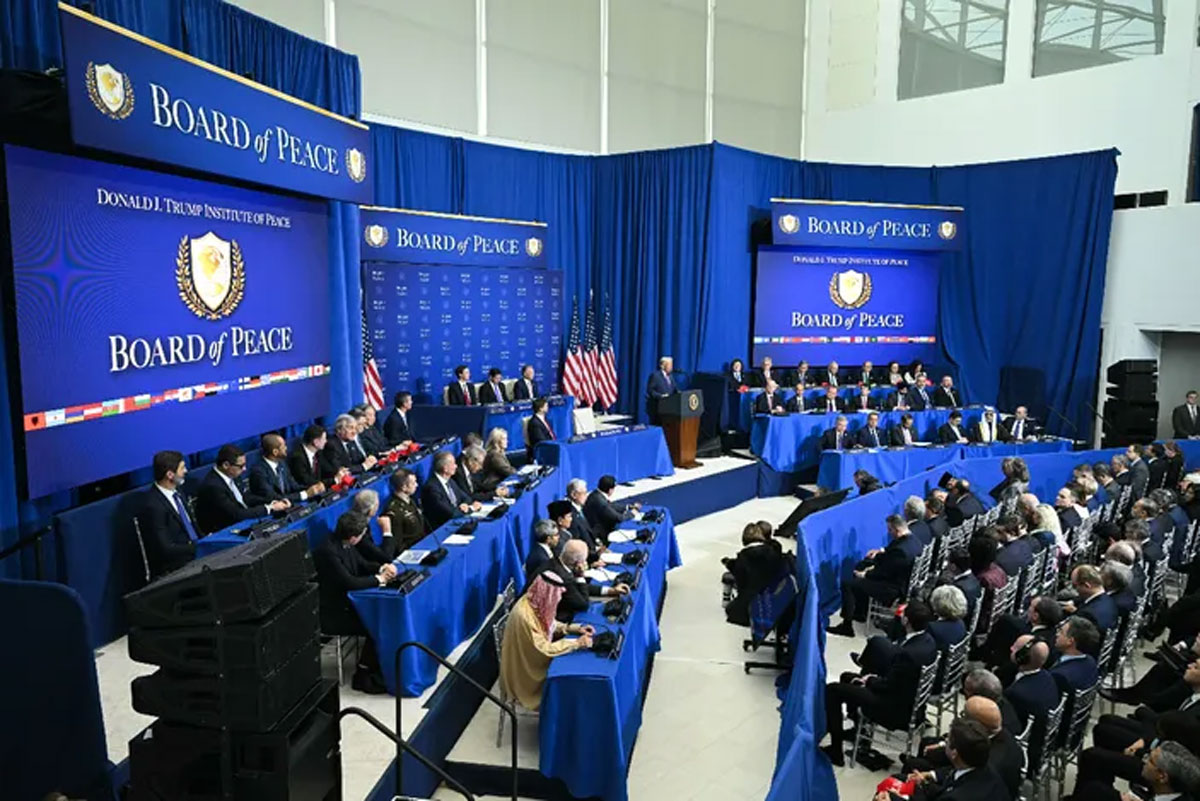
The Gaza recovery plan spearheaded by U.S. President Donald Trump’s Board of Peace has now been dramatically scaled back. What was once envisioned as a comprehensive reconstruction of the entire Gaza Strip has been reduced to a single small pilot project in southern Gaza, near the city of Rafah.
Even that pilot project is not expected to materialize before the end of 2026.
According to The Guardian, the proposed pilot project consists of a temporary camp containing portable cabins to accommodate a small portion of the approximately 2 million displaced residents of Gaza. The camp would also include a Palestinian governing administration, a police force, and a small international security contingent.
The camp is planned for construction within a buffer zone near the ceasefire line around Rafah. However, no preparatory work has begun. Satellite imagery of the area shows only disturbed ground, with no new structures under construction.
Project Delayed by Israeli Elections, International Security Force Still Under Training
Some limited progress has been made in recent weeks.
Several officers from Morocco and Kosovo have arrived in Israel to form the initial core of the international security force that will eventually protect the pilot camp. A logistics base to house the force’s vehicles and equipment is also nearing completion near the Kerem Shalom border crossing between Israel and Gaza.
Nevertheless, no significant progress is expected before Israel holds its general election on October 27, which could potentially bring down Prime Minister Benjamin Netanyahu’s right-wing coalition government.
The planned international security force is expected to consist of approximately 5,000 personnel—only one-quarter of the number originally envisioned—with troops from Morocco, Kosovo, and potentially Albania and Kazakhstan.
Training for the force is expected to continue for several more months, while the legal framework governing its deployment remains under negotiation with the Israeli government.
The situation represents a significant retreat from the project’s original promises.
When the Board of Peace first unveiled its plan at the World Economic Forum in Davos in January 2026, accompanied by an optimistic slide presentation, Trump’s son-in-law Jared Kushner pledged that aid would flow rapidly and that Gaza’s essential infrastructure—including water systems, sewage networks, electricity, hospitals, and bakeries—would be restored across the territory within 100 days.
In reality, only a small fraction of the US$17 billion originally pledged for Trump’s 20-point peace plan for Gaza has materialized.
Sharp Criticism: “Concentration Camp” or “Potemkin Village”?
According to The Guardian, a diplomat in Jerusalem explained why the Board of Peace continues to pursue the much-reduced project.
“The objective is simply to keep something moving, to keep the ball in play, because if it stops, others with far more extreme agendas are waiting to step in and take over, and they are talking about mass population transfers and colonization,” the diplomat said.
The greatest concern at present is the possibility that Netanyahu could launch another major military offensive in Gaza before the October election in an effort to strengthen public support.
Since the ceasefire was announced last October, Israel has carried out repeated attacks that have reportedly killed more than 1,100 Palestinians, while Israeli forces now directly occupy more than 60 percent of the Gaza Strip.
The pilot project has also drawn strong criticism.
Muhammad Shehada of the European Council on Foreign Relations said Israel was effectively attempting to build a “controlled and enclosed Potemkin village” populated by only a symbolic number of residents enjoying conditions slightly better than those experienced by Palestinians in western Gaza.
Former Israeli Prime Minister Ehud Olmert went even further, describing the project as “a concentration camp in the making.”
The Board of Peace rejected those allegations, insisting that residents would enjoy freedom of movement both into and out of the pilot area.
One official involved in planning the project said:
“I think you will see this become a reality by the end of 2026. If it’s completed and in place by December, I will be very pleased.”
On the funding side, the European Union announced that it has secured €883 million (approximately Rp15.8 trillion) to restore Gaza’s basic water and sanitation infrastructure.
The Board of Peace is also negotiating to redirect part of the US$11 billion in Palestinian tax revenues and bank assets that have been seized and withheld by Israel to finance the project.
The proposal has sparked anger from the Palestinian Authority in the West Bank.
“These are not Israeli funds to withhold or use as a bargaining tool,” said Varsen Aghabekian, the Palestinian Authority’s Foreign Minister.***