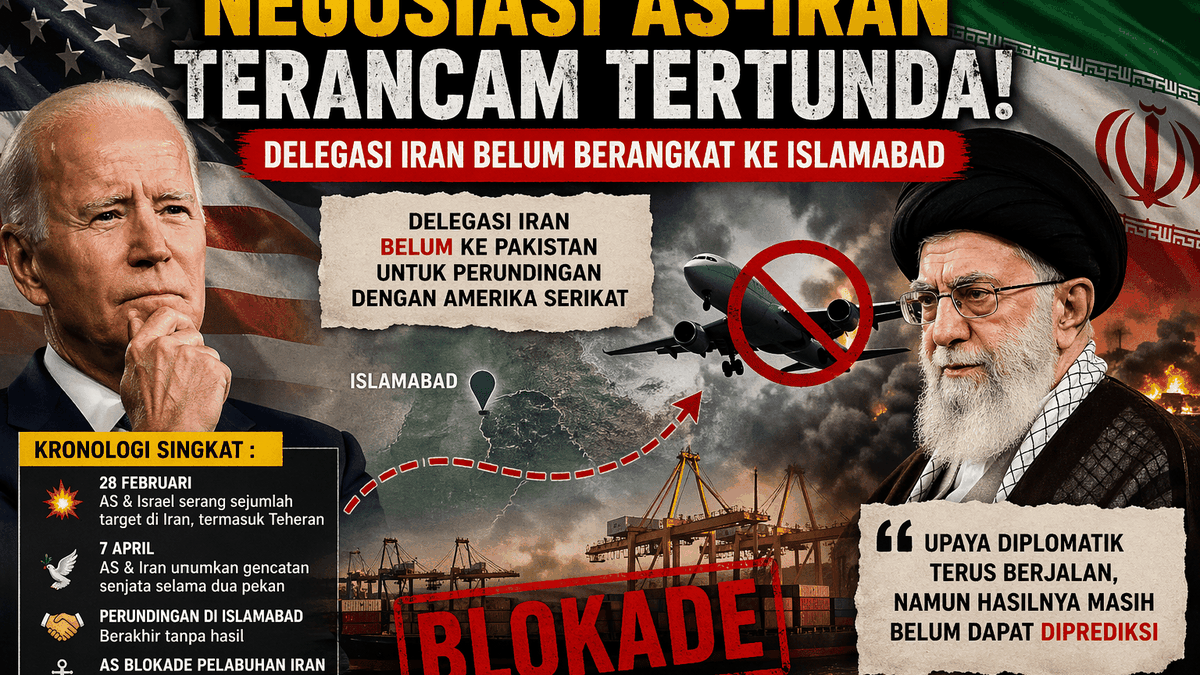
SUKABUMI MANTRA – Iran’s main delegation and its supporting team have reportedly not yet left for Pakistan to take part in the agenda of negotiations with the United States. This information was conveyed by Iran’s state television station, IRIB, on Tuesday.
This report raises a question mark regarding the readiness of both parties to continue the dialogue which was previously planned to take place in the near future in Islamabad as the meeting location.
Previously, international media CNN said that the second round of negotiations between the United States and Iran was scheduled to take place on April 22 in the Pakistani capital.
Also Read: Done Deal! Prabowo Meets Macron, Encourages Cooperation on Defense and Sustainable Energy
However, until the appointed time approached, there were no signs of the Iranian delegation’s departure, which sparked speculation about a possible postponement or change in the diplomatic agenda.
Tensions between the two countries have actually been going on for quite a long time, with their peak occurring at the end of February when the military conflict escalated significantly on Iranian territory.
On February 28, the United States and Israel launched attacks on a number of strategic points in Iran, including the Tehran area which is the center of government.
These attacks caused damage to infrastructure and caused casualties among civilians, thereby worsening the humanitarian situation in the region.
Iran’s strong response also raised world concerns about the potential for wider conflict, especially in the Middle East region which has long been unstable.
However, efforts to reduce tensions began to appear when on April 7 the two parties agreed to temporarily stop the conflict through a ceasefire for two weeks.
This agreement is a new hope for the international community so that diplomacy can again be prioritized over military confrontation which is detrimental to many parties.
Also Read: After Meeting Putin! Prabowo Arrives in Paris Ready to Discuss Global Issues with Macron
However, initial negotiations taking place in Islamabad were previously reported to have not resulted in a concrete agreement that could end the conflict permanently.
This failure made the negotiation process even more complex, with each party still maintaining its own strategic interests.
In the midst of an uncertain situation, the United States actually took additional steps by imposing a blockade on Iranian ports.
This policy is considered to have worsened Iran’s economic conditions while increasing political pressure on the government in Tehran in dealing with the conflict.
This blockade step also drew criticism from a number of international parties who considered that this action could hamper ongoing diplomatic efforts.
Mediators from various countries are now trying hard to bring the two parties back together in the next round of negotiations which are expected to be more productive.
This diplomatic effort is considered important to prevent a larger escalation of conflict, especially considering its impact on global stability.
Also Read: Tragic! Seyed Kamal Kharazi Dies After Air Strike, Middle East Gets Hotter
Until now, there is no certainty regarding when further negotiations will actually be held, considering that political dynamics continue to change rapidly.
This situation makes many parties choose to wait for the latest developments while continuing to encourage dialogue as the main solution in resolving the conflict.
With various uncertainties still surrounding, predictions regarding the future of relations between the United States and Iran have become a major concern internationally. ***