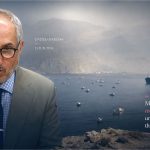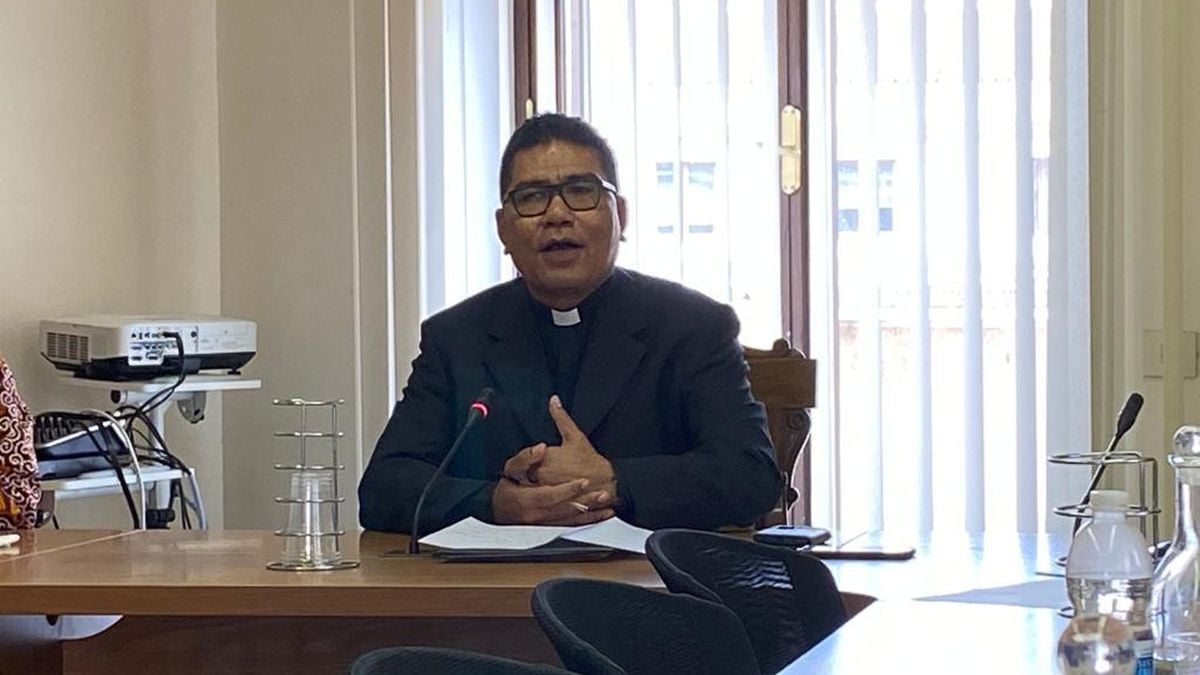
ABOUT CIBUBUR – Pastor Markus Solo Kewuta SVD, Staff of the Dicastery for Interreligious Dialogue of the Holy See of the Vatican said that the Indonesian Government must improve economic prosperity based on the principles of social justice and interfaith dialogue to improve the unstable peace situation in the country.
“I am sure that currently and in the future, Indonesia really needs stability in the economic welfare sector and interfaith dialogue in order to achieve peace,” said Padre Marco, the nickname of the only Holy See official from Indonesia, after attending a briefing on the release of the 2026 Global Peace Index at the Australian Embassy to the Holy See Vatican in Rome, Monday afternoon, 22 June 2026.
Padre Marco explained that the Institute for Economics & Peace (IEP), a non-governmental organizations (NGO) or NGO based in Sydney, Australia, conducts research to determine the fluctuations and movements of the peace situation in countries around the world, based on the economic welfare of these countries.
He added, there are many formulas used in calculations to determine economic welfare, including calculations Gross National Products (GNP), Gross Domestic Products (GDP), the country’s total foreign exchange, and also the mechanism for distributing natural resources (SDA) and state wealth for the welfare of all citizens which is called social justice.
Also Read: Religion and Interreligious Dialogue Contribute to Encouraging a Climate of Peace
” Of course, the level of world peace is not only measured through economic prosperity, but this IEP Organization works on these lines on beliefs as held by the Ancient Romans: Bread and Game (panem et circenses). “That life can only be truly enjoyed if the stomach is full,” he said.
If humans feel hungry, said Padre Marco, there will be a surge of dissatisfaction and a high tendency towards the use of violence against parties outside themselves.
“Economic prosperity is a barometer of a country’s level of peace. That is more or less the synthesis of the briefing from Prof Steve Killelea, founder of IEP, at the meeting yesterday afternoon,” said Padre Marco.
Indonesia’s position
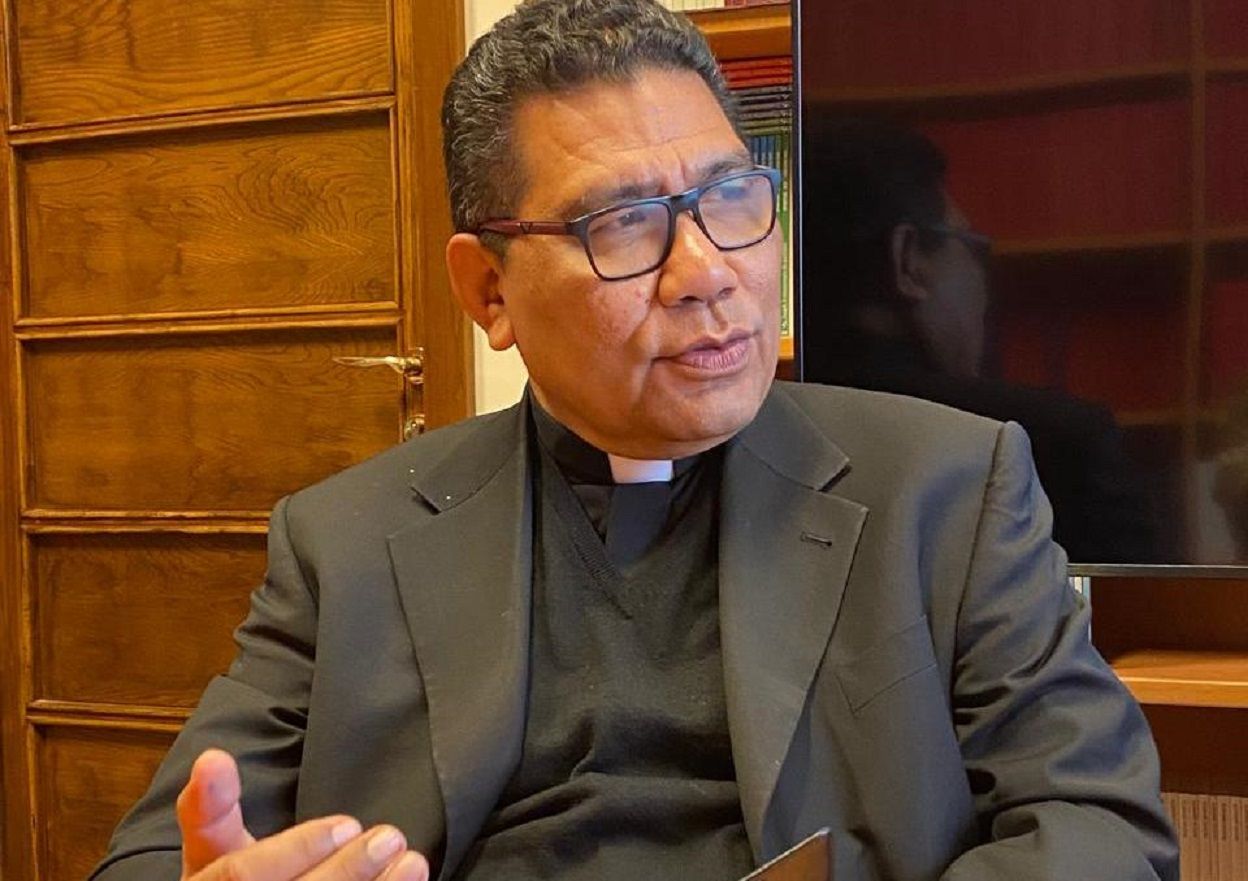
Pastor Markus Solo Kewuta SVD. Source: Lucius GK
Padre Marco revealed that in the 2026 Global Peace Index which was just released last week, Indonesia was ranked 69th, or in the MEDIUM zone category, meaning that the peace situation in Indonesia was unstable. Indonesia is below Sri Lanka and Jordan, above Jamaica and Serbia, and other countries.
Also Read: Indonesia-European Union Inter-Religious and Cross-Cultural Dialogue for Cooperation on Tolerance and Peaceful Coexistence
Compared with Malaysia, Indonesia’s peace situation is worrying. In the 2026 global peace index, Malaysia is ranked 12th, in the HIGH zone category, meaning the country’s peace situation is HIGH. In 2025, Malaysia was ranked 13th, in the same category, namely HIGH.
Thus, continued Padre Marco, this year Malaysia has moved up one step, meaning there is positive development. Meanwhile, Indonesia actually fell so far. Indonesia, which in 2025 is ranked 49th, in the MEDIUM category, is closer to the HIGH category, in 2026 Indonesia’s peace index ranking will fall to 69th.
“This means that Indonesia is free-falling along 20 steps, passing through countries such as Kuwait, Botswana, Armenia, Chile, Greece, Kosovo, Moldova, to Morocco, Turkmenistan, and others. They are still more peaceful than Indonesia, according to the 2026 IEP,” he said.
Furthermore, Padre Marco said that Prof. Killelea confirmed that economic doubts themselves were the single factor that greatly influenced the fluctuations in a country’s peace.
Also Read: Supporting the Jakarta-Vatican Declaration, KWI Awards Interfaith Youth with the Sehati Perjalanan Award
“Interfaith peace, according to him, also has a very high role. This is also the conclusion of those of us who work in the field of interreligious dialogue. Just imagine. We just do a simple calculation. Around 80% of the world’s population is said to follow a religion. So if 80% of the total 8 billion people in the world live peacefully, then religion has a big contribution to the global peace index,” he explained.
Therefore, once again Padre Marco believes that world leaders, including Indonesia, can learn the philosophy or formula for successful leadership from IEP 2026. “It is enough to advance these two sectors significantly. Namely economic prosperity based on the principles of social justice and interfaith dialogue,” he said.
Peace is a Shared Responsibility
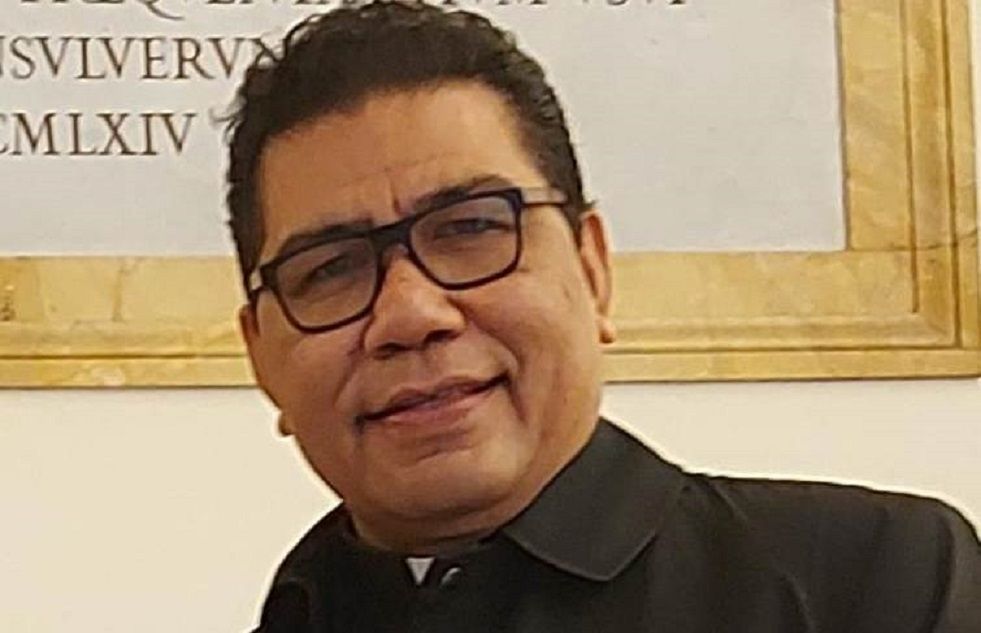
Father Markus Solo Kewuta SVD. Photo: doc. Personal
Padre Marco further stated that the Holy See of the Vatican has always reminded the international community that peace is not just the absence of war, but a comprehensive effort. This means that peace requires justice, dialogue, respect for human dignity, social responsibility, fair access for all people to the earth’s resources and just and equitable development.
According to Padre Marco, the Global Peace Index of the Institute for Economics & Peace (IEP) is an important tool in this context because it reveals developments that are often hidden behind the daily news. This index shows how closely related security, social cohesion, level of conflict, militarization, and economic and social conditions are.
Also Read: Pope Leo XIV Receives 200 Indonesian Citizens in Special Audience at the Vatican Palace
“Peace is never just a political situation. Peace is always a culture that must be cultivated. If one day Indonesia can improve its position and be claimed to be in a high zone, that does not mean that the country and all its people can forget their responsibility to maintain peace. Real peace is not something that is just given or falls from the sky like rain. It must be maintained, built, protected and reshaped every day,” he said.
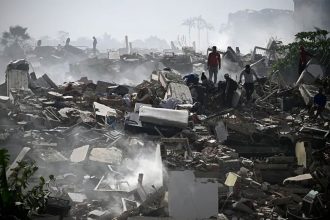
Padre Marco emphasized that what is very worrying is the general picture of the 2026 IEP. Of the 195 total countries in the world, only 66 countries are at the VERY HIGH and HIGH levels. That means that 129 countries in the world are experiencing a peace crisis. This phenomenon speaks of increasing multidimensional conflicts, increasingly entrenched violence, and new and even prolonged forms of warfare, which are also triggered by the manipulation of modern technology which brings additional dangers to humanity on this earth.
As a result, on the one hand, people feel fatigue and boredom which leads people to an indifferent attitude or feel that it is permissible to justify violence because of the world’s habitus. On the other hand, religious people and people of good will want the presence of protagonists and prophets of peace, both individuals and institutions who dare to oppose the logic of power, oppose all forms of violence and antagonism, and who keep alive the language of reconciliation, justice and shared responsibility.
From a Christian perspective, continued Padre Marco, peace always begins in the human heart and with each individual. Peace grows where truth is spoken, where justice is not only demanded but also lived, where the poor and vulnerable are not forgotten, and where the gifts of creation are best used to serve the common good.
“Therefore, peace is never just a statistical measure. Statistics are present as a compass and a siren for danger. Peace is a spiritual and moral responsibility,” he concluded.