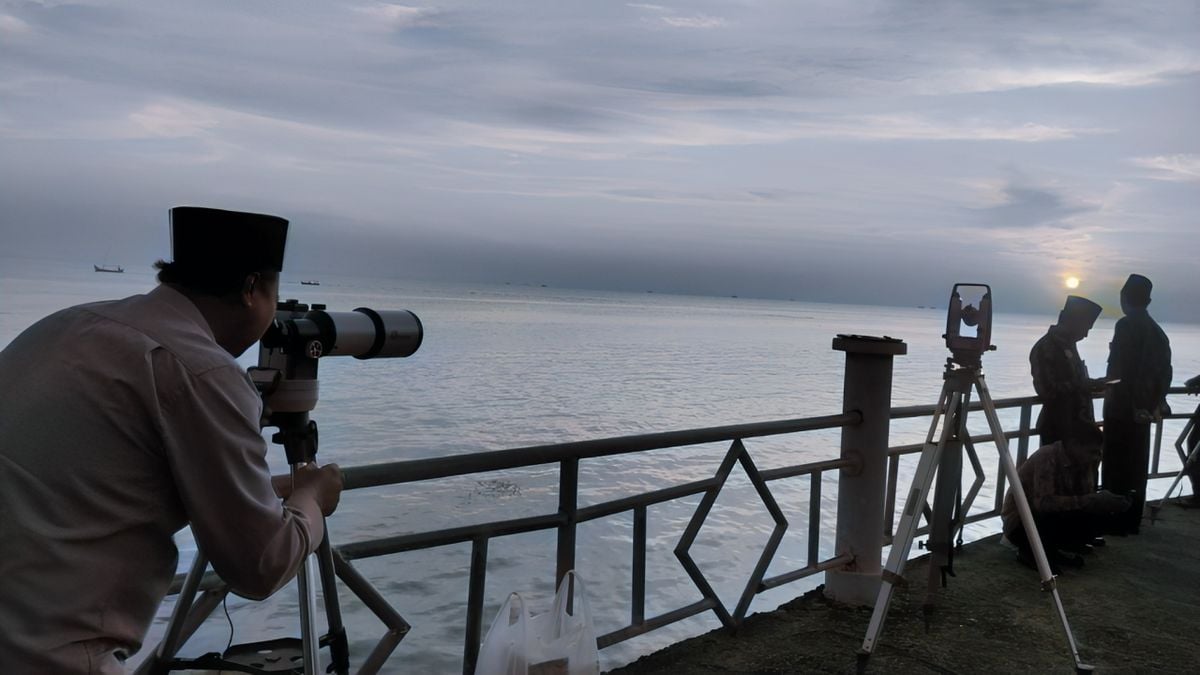
Bulukumba News – Riyadh’s sky had not yet completely darkened when a number of residents began to crowd the moon-watching area on the edge of the city. Binoculars are installed facing the western horizon. The desert wind moved slowly, bringing up light dust that occasionally slapped the observers in the face. Amidst the quiet conversations and the sound of passing vehicles, one question kept repeating itself: is Dzulhijjah’s crescent moon visible tonight?
The Supreme Court of the Kingdom of Saudi Arabia on Sunday, May 17 2026, appealed to Muslims throughout the kingdom to monitor the appearance of the crescent moon marking the beginning of Dzulhijjah. This appeal is not an ordinary administrative routine. The results of the rukyat will determine when Eid al-Adha 2026 will be held, as well as marking the peak of the Hajj pilgrimage at Arafah.
At a number of observation points, officers and residents brought different equipment. Some rely on modern telescopes, others prefer to look at the sky with the naked eye. The court asked anyone who saw the crescent moon to immediately report to the nearest court to record official testimony.
Also Read: Egyptian President Assassinated During Military Parade, Peace with ‘Israel’ Becomes Trigger
Also Read: UFO Case Heats Up: Key Witness Dies Suddenly Before Testifying in US Congress
Hilal Dzulhijjah and the determination of Eid al-Adha 2026
Tension always arises every time we enter the initial determination of Dzulhijjah in Saudi Arabia. Not only because it concerns the worship calendar, but also the impact on millions of Muslims in various countries who are waiting for confirmation of the holiday of sacrifice.
In the Sudair observation area, one of the famous rukyat locations in Saudi Arabia, the atmosphere before sunset was solemn and tense. Several people were seen repeatedly checking the direction of the telescope. Children ran behind the observation fence, while parents were busy taking photos of the slowly fading orange sky.
The Grand Mufti of Saudi Arabia, Sheikh Saleh Al-Fawzan, also reminded Muslims to increase their worship during the first 10 days of Dzulhijjah. In his statement quoted ArabNewshe highlighted the virtues of the Arafat fast for non-hajj pilgrims which is believed to wash away two years of sins.
“The deeds in the early days of Dzulhijjah were very loved by Allah,” said Al-Fawzan.
The call came when millions of prospective Hajj pilgrims from various countries began to flock to Mecca. Hotels were full, shuttle buses operated almost without interruption, and security forces increased surveillance around the Grand Mosque.
Also Read: Iran Changes Strait of Hormuz Rules: World Oil Route Now Under Tight Control
Also Read: Iran Proposes 14 Points of Peace: From Compensation to the Strait of Hormuz, the World Waits for the US Answer
Differences in the Islamic calendar
The initial determination of Dzulhijjah in Saudi Arabia has almost always attracted the attention of other Muslim countries, including Indonesia. The differences in the methods of reckoning and rukyat often give rise to the possibility of different days of Eid al-Adha.
For many Muslim families, fixing a date is not just a matter of the calendar. Sacrificial animal traders start counting down the days of the last sale. Airlines are adjusting to the surge in domestic flights. In various cities, sacrificial committees have already prepared meat distribution even before the official decision is announced.
In Riyadh that night, the observers’ eyes had not yet left the western horizon even though the light was starting to disappear. Some people looked down at their cellphone screens, waiting for official news from the Supreme Court. Others continued to stare at the empty sky which was slowly turning dark.
In an increasingly digital world, determining the beginning of the Hijri month still depends on one silent moment: someone who first saw the thin line of the crescent moon in the sky.
The night of observing the new moon always leaves a strange gap for Muslims: between astronomical beliefs, human testimony, and the hope that the big day will come at what is believed to be the most appropriate time. In many places, the decision was announced in just a few minutes. However, the social and spiritual reverberations can be felt much longer than the sound of an official announcement.***