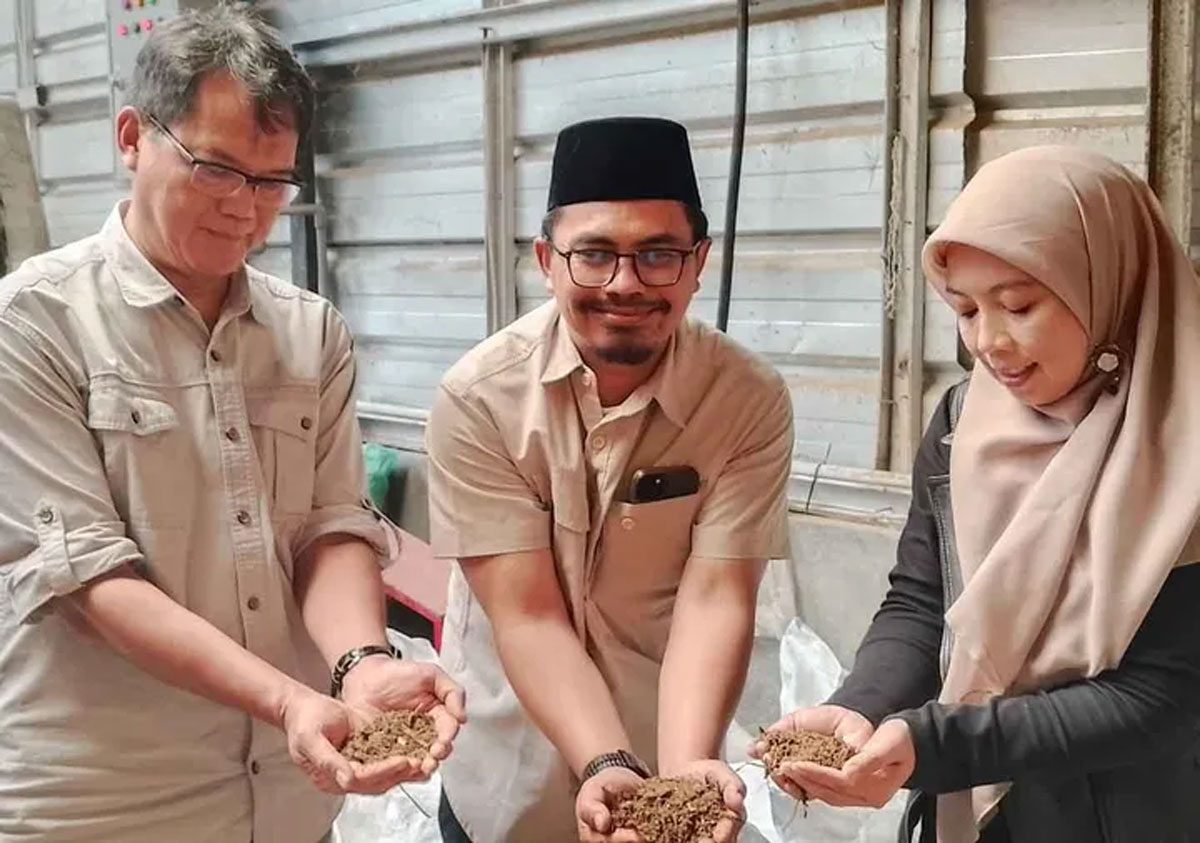
The continuous rise in livestock feed prices has sparked innovation in Garut Regency. Motivated by the concerns of a resident from Leles District over soaring livestock production costs, an initiative was launched to develop an alternative feed that is more affordable, easy to use, and maintains high quality through collaboration with academic experts.
The innovation was developed by Unit Pakan Mandiri Leles Lestari, which recently organized a livestock feed development and educational program in Leles District. The initiative aims to improve livestock productivity, animal health, and the welfare of local farmers.
The event was attended by Yosep Purnama, Founder of Unit Pakan Mandiri Leles Lestari; Professor Luki Abdullah of the Faculty of Animal Science at IPB University; Dyah Savitri, Head of the Garut Regency Fisheries and Livestock Service; and livestock farmers from various parts of Garut Regency.
Professor Luki Abdullah explained that the feed innovation is the result of research that began in 2019. The study was initiated in response to the steadily increasing cost of livestock feed and farmers’ heavy reliance on commercial concentrate feed.
According to him, the research team sought alternative fiber sources that would not depend primarily on grass as the main feed ingredient. The effort has continued to evolve, eventually producing a variety of complete feed products that are now ready for use by livestock farmers.
“These alternative fiber sources are what we have continued to develop over the years, enabling us to produce various types of complete livestock feed,” Luki said during a product introduction event in Leles on Friday, June 26, 2026.
He explained that the innovation is called Fermented Complete Feed. The product has completed its development phase and is now ready to be used and tested by livestock farmers.
Luki said that approximately 80 percent of the feed’s raw materials come from locally available resources, including rice bran, oilseed meal, and nutritional supplements produced from regional raw materials. Besides being easier to obtain, these ingredients also improve the nutritional quality of livestock feed.
In addition, the fermented complete feed utilizes various agricultural by-products, including corn, sorghum, and rice straw. According to Luki, fiber derived from corn plants has a higher digestibility level than either grass or rice straw.
He added that the innovation also offers a practical solution during the dry season, when fresh forage becomes increasingly difficult to obtain.
At the same time, his team continues to develop drought-resistant grass varieties to further support the long-term availability of livestock feed.***