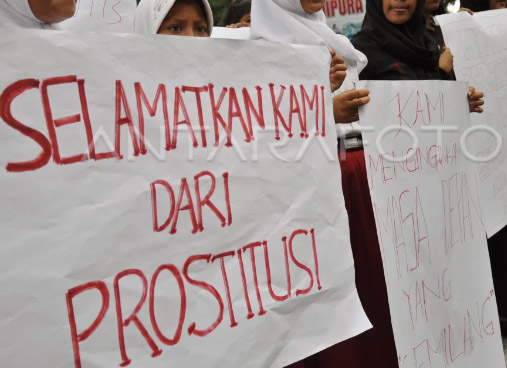
A child prostitution operation has been uncovered in Bekasi Regency. The case also revealed the involvement of a foreign worker network from Japan operating in Bekasi.
The case began after Japanese-language media content reported on child prostitution in Indonesia, particularly in Jakarta and Bekasi. The report included photos showing the backs of several girls who were allegedly being exploited as sex slaves. The report stated that all of the victims were minors.
The news report became the basis for the Jakarta Metropolitan Police (Polda Metro Jaya) to conduct operations at several locations. Authorities eventually discovered that the prostitution network was operating in Cibitung, Bekasi Regency. The area, known locally as a prostitution district, is referred to as “Tenda Biru” (Blue Tent).
“The operation was carried out very discreetly. Even the local police stations and precincts were not informed. It was conducted directly by the regional police. Afterwards, the regional police contacted us and requested assistance because several of the victims were minors,” said Fahrul Fauzi, Head of the Regional Technical Implementation Unit (UPTD) of the Bekasi Regency Women’s Empowerment and Child Protection Agency, on Friday, July 10, 2026.
According to Fahrul, 36 people were detained during the operation. Of that number, 24 were women.
“Among those 24 people, eight were children. These are the victims who are now receiving assistance from us,” he said.
Fahrul explained that the Bekasi Women’s Empowerment and Child Protection Agency provided assistance starting from medical examinations to transferring the victims to a safe house managed by the UPTD.
“That night, medical examinations were immediately conducted at the Kramat Jati Police Hospital. They were then placed in a safe house for around three to four nights,” he said.
Based on the identification process, the children did not originate from Bekasi Regency. Some of them came from outside West Java, including Lampung and Central Java. One victim from West Java came from Cirebon.
Based on their statements, the victims had been working at the Blue Tent area for several months. Before being recruited, they were reportedly aware of the type of work they would be involved in.
“That was their statement. They were initially recruited to work as singers or entertainers, but they were also asked to provide additional services to customers,” Fahrul explained.
Fahrul said the victims claimed they received payments of up to Rp250,000 for each customer served. However, the amount was reduced by rental fees and commissions paid to intermediaries.
“In the end, they received around Rp100,000 to Rp150,000 for each customer,” he said.
Fahrul stated that the handling of the case had been taken over by the Ministry of Women’s Empowerment and Child Protection. However, his office continues to coordinate in the ongoing response.
“It is being handled directly by the ministry because this case involves multiple provinces. Based on the information we received, all of the victims have been returned to their respective families. However, the legal process will continue, especially because this case falls under the crime of human trafficking,” he said.
Recovery Efforts
Meanwhile, West Java Child Protection Commission (Komnas PA) Commissioner Wawan Wartawan praised the efforts of the PPA-PPO Directorate of Polda Metro Jaya for uncovering the alleged sexual exploitation of children.
“We appreciate the success of the PPA-PPO Directorate of Polda Metro Jaya in uncovering child exploitation practices at the Blue Tent area. This is clear evidence of law enforcement’s commitment to protecting children from human trafficking crimes,” Wawan said.
He emphasized that Komnas PA West Java would continue monitoring the legal process until completion and encourage comprehensive recovery programs for the victims through psychological assistance, trauma healing, and fulfillment of their educational rights.***