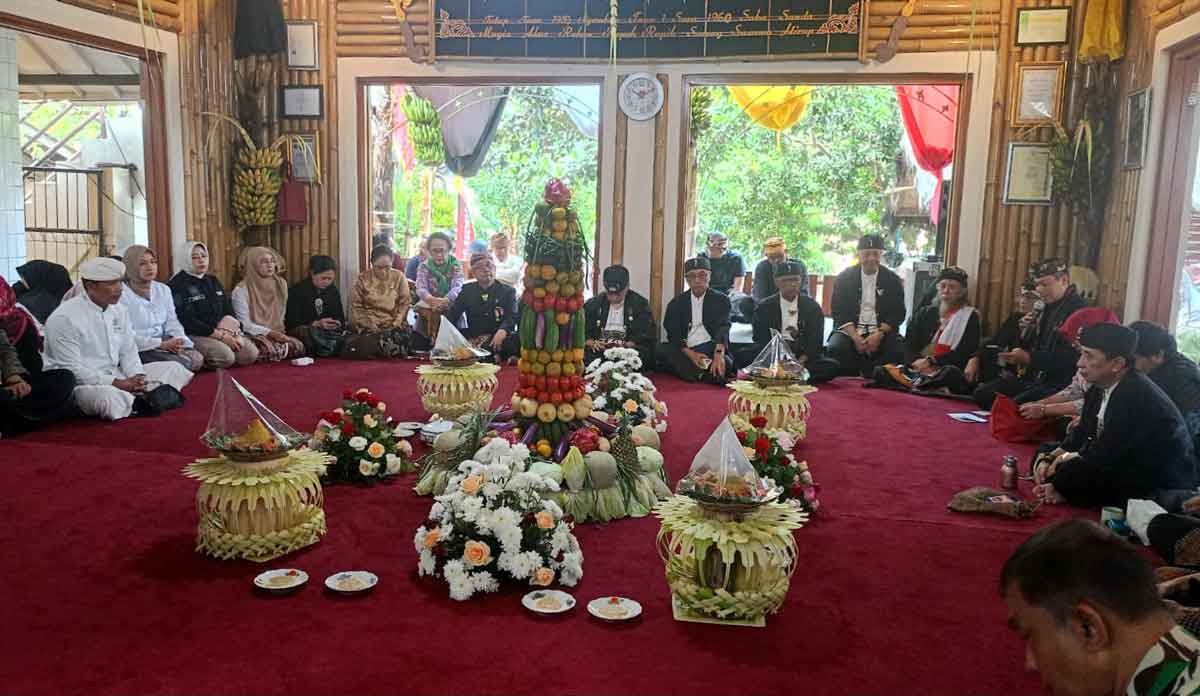
The peak procession of Tutup Taun 1959 and Ngemban Taun 1 Sura 1960 of the Sundanese Saka calendar was solemnly observed in the Cireundeu Traditional Village, Leuwigajah, South Cimahi, Cimahi City, on Saturday, July 11, 2026. Far from a mere ritual, this event serves as a time to reflect on the past year’s journey and to express deep gratitude for bountiful harvests, good health, and the harmonious relationship between humanity, the Creator, fellow human beings, and the natural world.
The festival commenced with the symbolic “Meupeus Kendi” (breaking of the earthen jar) ritual, followed by the Ngajayak—a colorful parade showcasing the earth’s bounty and rasi (cassava rice), the staple carbohydrate of the Cireundeu community. The celebration continued with traditional children’s games, angklung buncis musical performances, and various other cultural showcases. The gathering also featured interfaith prayers, an exhibition of Cireundeu’s indigenous food products, and a cultural discourse themed “Local Food, Culture, and Food Security.”
Abah Widi, the Ais Pangampih (traditional leader) of Cireundeu Traditional Village, explained that these ceremonies are how the community keeps track of time. “This calendar is not just a static set of numbers; it is a living entity. Every single date reminds us to practice gratitude and mindfulness. Being in good health, having a livelihood, and a nature that still sustains us are the primary reasons we gather here to pray,” he noted.
In an era dominated by modern pressures, indigenous traditions provide a vital anchor. “Modern society tends to forget easily. This ritual serves as a reminder that we are merely guests on this planet, not its owners. The core philosophy here is a mindset of living simply, being content with what we have, and avoiding greed. The younger generation shouldn’t dismiss these traditions as outdated; through these rituals, our community actually learns how to endure in times of global crisis,” he added.
Cassava remains the primary source of carbohydrates for the village to this day, as they have sustained themselves without consuming rice for decades. “Everything is harvested from our immediate surroundings without causing destruction. Our principle is straightforward: take only what you need and safeguard sustainability. Cireundeu splits its woodlands into three zones: the Untouchable Forest (Hutan Tutupan), the strictly guarded Forbidden Forest (Hutan Larangan), and the Cultivated Forest (Hutan Baladahan), which can be used responsibly. This is our daily reality, not a tourist show; it is a way of life. While the rest of the world faces a food crisis, we have held the answer for generations: protect the soil, protect the water, and protect the trees,” he explained.
An Educational Icon
Dani Bastian, Head of the Cimahi City Culture, Tourism, Youth, and Sports Department, affirmed that the Cimahi City Government remains fully committed to preserving, maintaining, and promoting Cireundeu Traditional Village’s unique cultural heritage and localized food systems.
“Cireundeu Traditional Village stands as an icon for both cultural education and food security for the wider public. One of Cireundeu’s core heritage elements, which has officially been designated as an Intangible Cultural Heritage, is rasi. This status serves as official state recognition of our indigenous food wisdom,” he stated.
Retno Raswati, Head of the West Java Cultural Preservation Office, who attended the event, praised the Cireundeu community for their dedication. She commended the residents for their steadfast consistency in protecting, nurturing, and passing down ancestral customs, keeping them vibrant to this day.
Echoing this sentiment, Anton Charliyan, General Chairman of the West Java Sundanese Traditional Council (MASDA Jabar), remarked, “Amid the waves of globalization that frequently erode ancestral values, Cireundeu stands out as living proof that a traditional village can not only survive but thrive. Their reliance on rasi proves that a diet and lifestyle rooted in local wisdom can effectively maintain physical health. This is precisely where their time-tested wisdom lies.”