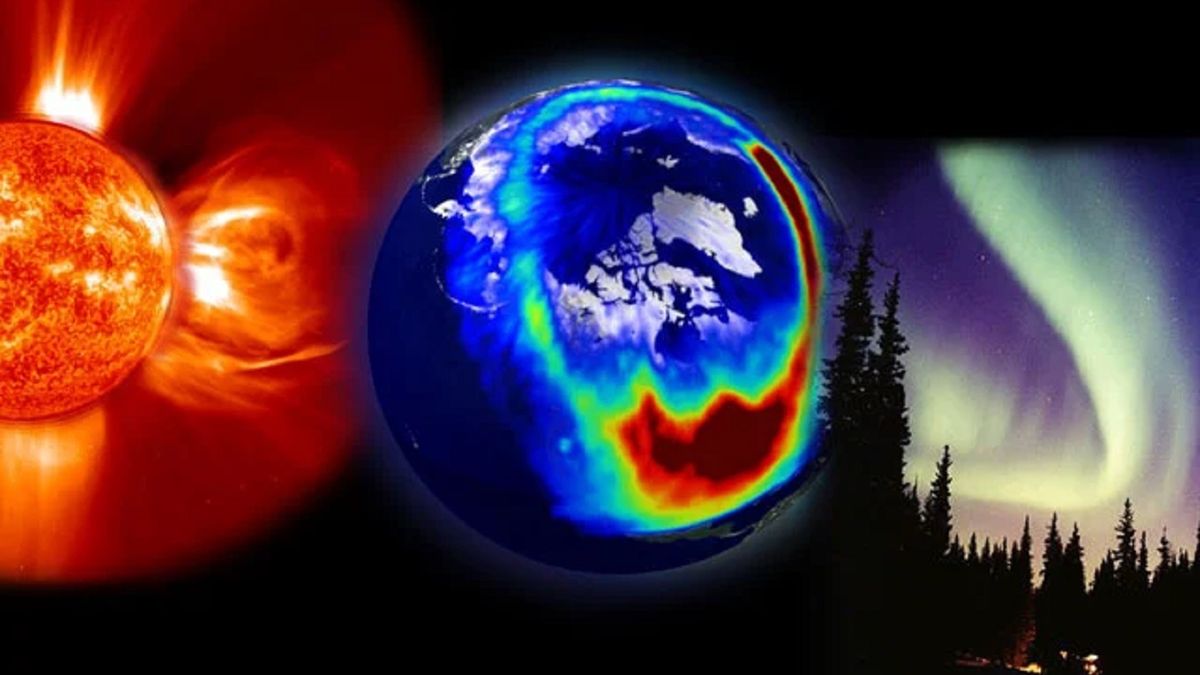
NAIL MEDIA, TECHNOLOGY – A recent study from Japanese scientists gave rise to a theory that shocked the world of science. For the first time, solar storms are said to have the potential to play a role in triggering earthquakes on Earth.
This controversial hypothesis was developed by a research team from Kyoto University and published in the ‘International Journal of Plasma Environmental Science and Technology’ in February 2026.
In the study, scientists explain the possibility of a hidden connection between space weather and seismic activity in the Earth’s crust, something that until now was almost unthinkable.
Solar Storms Allegedly Send “Invisible Pressure” to Earth
According to the theoretical model developed by the research team, very strong solar activity can disrupt the ionosphere, namely the layer of the Earth’s upper atmosphere at an altitude of around 60 to 1,000 kilometers.
When a large solar storm occurs, the density of electrons in the ionosphere increases sharply and forms a negatively charged layer. This is where the process called *capacitive coupling* starts to work.
Also read: Is it true that the mystery of Mount Padang Cianjur has been solved? Astronomical and Ritual Functions: If you’re curious, check out this article
This phenomenon is believed to be capable of producing an electric field that penetrates deep into the Earth’s crust, especially in areas of geological faults that have cracked and are in critical condition.
The researchers estimate that the resulting electrostatic pressure could reach several megapascals, a figure close to the natural pressure caused by gravity and tides which is known to influence fault stability.
It is said that the Earth’s crust can act like a “giant capacitor”
In their explanation, the team of scientists described the fault zone inside the Earth as a system filled with water with extreme temperature and pressure, perhaps even in a supercritical condition.
Electrically, this area is said to function like a giant capacitor that connects the Earth’s surface with the ionosphere in the upper atmosphere.
This means that not only is the Earth affecting the ionosphere, but disturbances in the upper atmosphere may also be sending back effects to the Earth’s crust.
Even though it sounds dramatic, the researchers emphasize that this study does not conclude that solar storms are a direct cause of earthquakes.
They simply offer a new framework for understanding possible interactions between extraterrestrial phenomena and seismic activity.
2024 Japan Earthquake Also Highlighted
Researchers also mentioned the Noto Peninsula earthquake in Japan in 2024 which occurred not long after a period of intense solar flare activity.
Also read: 7 unique facts about South Africa that are rarely known, home to the largest astronomical project in the world
However, they emphasize that the occurrence of two events close together cannot be considered evidence of a cause-and-effect relationship.
However, this new theory is considered interesting because it is in line with various previous observations of ionospheric anomalies that often appear before large earthquakes, such as spikes in electron density and changes in ionospheric height.
So far, this anomaly is believed to only be the result of pressure from within the Earth’s crust. Now, scientists are starting to consider the opposite possibility: the upper atmosphere may also have an influence.
Research Still Continuing
In the future, the Kyoto University team plans to combine high-resolution GNSS-based ionospheric data with more detailed space weather data.
The goal is to find out when ionospheric disturbances are actually capable of creating significant electrostatic effects on geological faults.
If this theory is proven stronger through further research, the world of science may enter a new chapter in understanding the mysteries of earthquakes.***