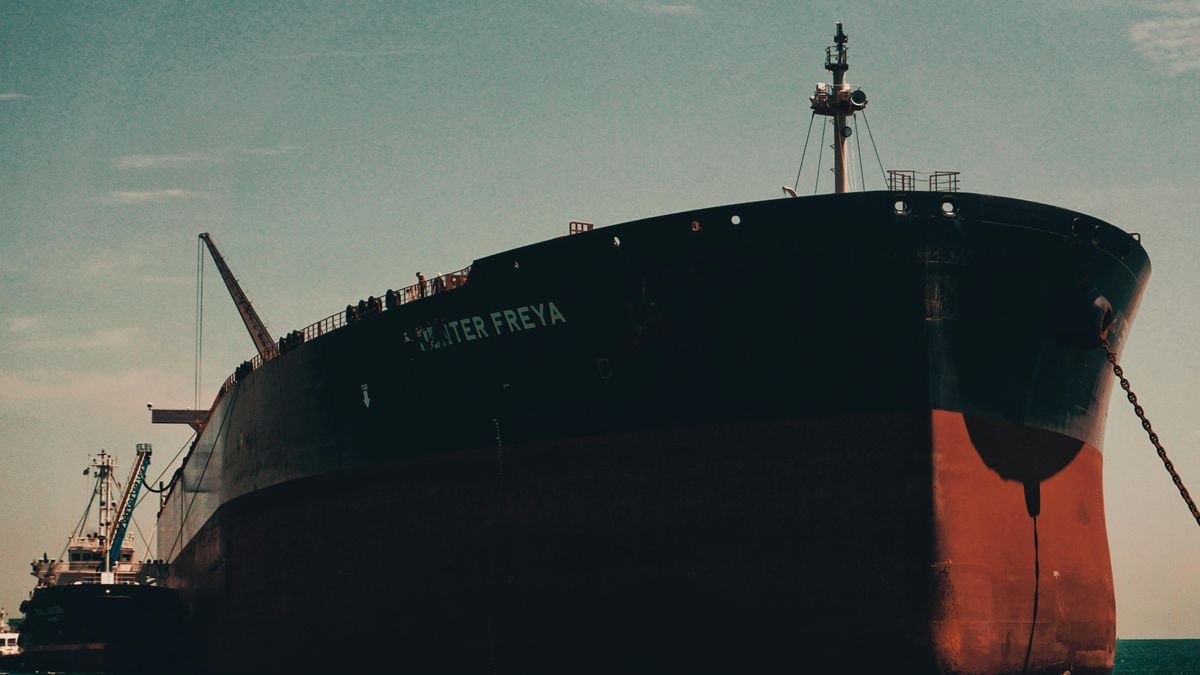
Bulukumba News – A light mist hangs over the waters of the Strait of Hormuz on a calm morning. A giant tanker slowed, its engines humming lowly, as if holding its breath. On the bridge, the captain stared at the navigation screen—not only monitoring the currents and weather, but also waiting for the one thing that now couldn’t be ignored: clearance.
There were no sirens, no loud warnings. Only an email will determine whether the ship can continue its journey.
Starting this week, Iran implemented a new mechanism. Every ship wishing to cross the Strait of Hormuz must obtain approval from local authorities. The pathway that has long been known as the world’s energy artery is now under tighter supervision.
“This is not a normal procedure. This is a signal,” said a maritime analyst in the Gulf region, quoted in the report PressTV, Tuesday, May 6, 2026.
The Strait of Hormuz is not just a narrow body of water. About 20 percent of the world’s oil supply passes through this route every day, according to Energy Information Administration (EIA) data. Any rule change here immediately shakes global markets.
Also Read: Stock Doesn’t Run Out? Iranian Drone Production Never Stops
Iranian vessel clearance and control mechanisms in the Strait of Hormuz
In the latest policy, ships wishing to pass will receive guidance via email from the Persian Gulf Strait Authority (PGSA). After that, they are required to apply for official permission before being allowed to enter the transit route.
This step was reinforced by a statement by the Islamic Revolutionary Guard Corps (IRGC), which emphasized that all movements of civil and commercial vessels must follow established routes and coordinate with the Iranian government.
Technically, this policy changes the old, looser pattern. The Strait of Hormuz has long been governed by the principle of international freedom of navigation, although it has always been in the shadow of geopolitical conflict.
“Administrative controls like this could slow down ship traffic and increase logistics costs,” said an energy trade expert quoted in the report RIA Novosti.
For shipping companies, time is money. Delays of just a few hours can have a big impact, especially for tankers carrying millions of dollars worth of crude oil—equivalent to tens of billions of rupiah per load.
Also read: It’s not about winning, this is Iran’s strategy to face the US and Israel.
Geopolitical impacts and concerns of regional countries
This step by Iran does not stand alone. It comes amid broader dynamics, including the decision by the President of the United States, Donald Trump, to temporarily suspend operations related to freedom of navigation in the region.
Pakistan’s Prime Minister, Shehbaz Sharif, welcomed the decision as a step that could promote stability. In a statement on the X platform, he called the temporary suspension a “timely announcement” amid a sensitive situation.
However, not all parties felt calm. Gulf countries reportedly expressed concern over the potential for new escalation. The Strait of Hormuz has been a hot spot for conflict between Iran and Western countries.
History records that every tension in this region is almost always followed by a spike in world oil prices. In 2019, for example, a series of tanker incidents in the same area pushed oil prices up significantly in a matter of days.
Also Read: Failure of Nuclear Negotiations in Islamabad: Trump Cancels Meeting and Challenges Tehran
Now, with new rules giving Iran more control, the question is again emerging: is this a security measure, or part of a geopolitical pressure strategy?
On a map, the Strait of Hormuz looks like a thin line connecting two large bodies of water. But in reality, it is a meeting point of global interests—energy, politics, and military power.
Iran’s new policy is changing the way the world views this path. It’s no longer just a matter of who passes, but who allows it.
For ships now waiting for emails in the middle of the sea, the change feels real. And for the world, the consequences may only become apparent when the flow of energy begins to stagnate—slowly, but surely.***