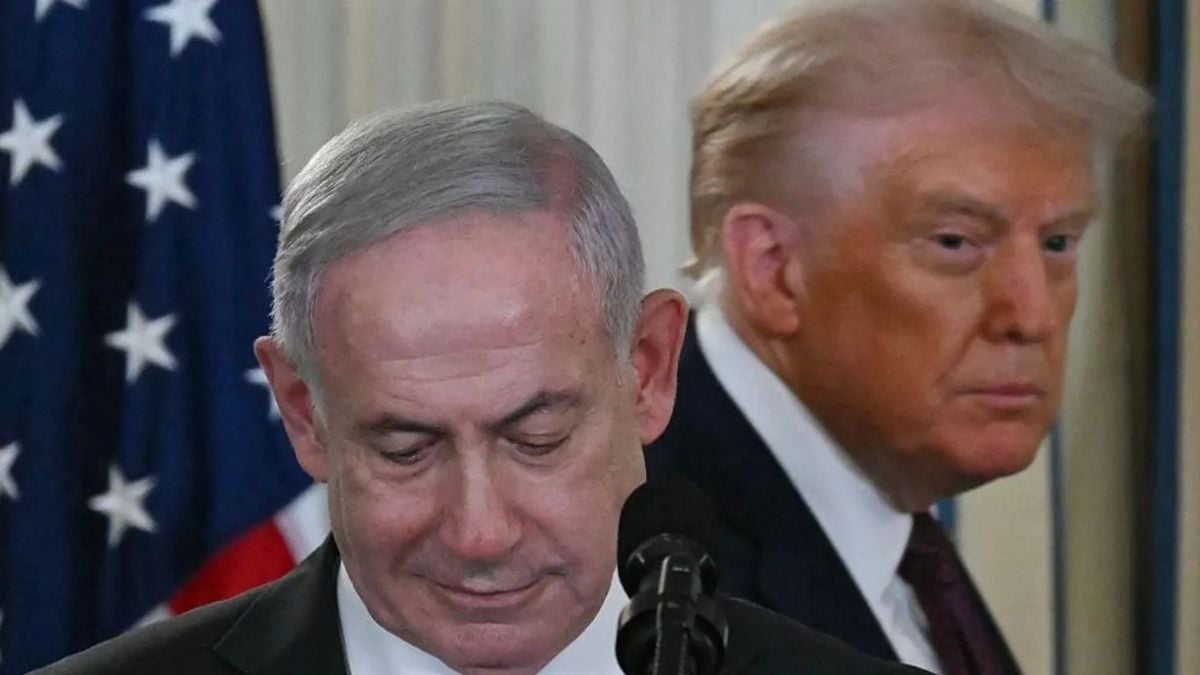
JATIM PR – The US ceasefire agreement with Iran has presented a political nightmare for the Israeli prime minister, destroying three cornerstones of Benjamin Netanyahu’s political career and leaving him trapped in a new security dilemma.
How can a man who calls himself Washington’s political whisperer, who has real influence over American politicians, be so comprehensively sidelined and openly insulted by his main ally, the US?
How can someone who has made Iran the centerpiece of Israel’s security policy end the war with the Iranian regime on a stronger footing?
And how will his long-standing and tarnished political image as Israel’s “Security Master” survive Washington and Tehran’s demands that Israel stop attacking Hezbollah in Lebanon, months before Israeli elections?
The choice Netanyahu faces now is not a good one. It was summarized by the opposition leader, Yair Lapid, in the Knesset on Monday as “a direct and destructive confrontation with our greatest ally, or a submissive surrender of Israel’s interests.”
US President Donald Trump’s expletive-laden assessment that Netanyahu showed no judgment when ordering the attack in Beirut on Sunday has been seized on by his political rivals and media commentators, who are already focused on elections that must be held before the end of October.
But comments from members of Netanyahu’s supportive Likud party, and right-wing cabinet ministers in his governing coalition, also show the pressure he faces from his own side – the most pointed of which was a demand from Tehran that the ceasefire cover “military operations on all fronts, including Lebanon”.
“Trump’s agreement does not bind us,” Israel’s right-wing Minister of National Security, Itamar Ben-Gvir, wrote on social media on Monday. “We are not partners in this agreement that does not guarantee our security.”
“Israel will continue to protect itself,” Likud lawmaker Ariel Kallner told me, although he did not say whether that meant Israel would continue its attacks.
“We will do what we need to do. And we hope our friends understand us,” he said. “Sometimes there are differences of opinion between allies, and allies must also understand their allies when they are in danger.”
Sima Shine, a former Mossad official and Iran expert, said: “It’s hard to understand why America accepted it.
“By letting Iran decide what will happen in Lebanon, the US gives Iran the possibility to continue supporting Hezbollah, and ensures that Hezbollah becomes a major political actor in the Lebanese arena.
“Israel is not happy about it – neither the security side nor the political side,” he said.
Amid a flurry of criticism and anger from across the political spectrum, Israel’s prime minister bristled at suggestions from journalists late Monday that he had failed.
“I devoted most of my adult life to one goal — preventing Iran from obtaining nuclear weapons,” he said at a news conference in Jerusalem.
“We will do what is necessary. I am not limiting myself in any way to this goal: Iran will not have nuclear weapons.”
But he also acknowledged there were cases where he and Trump saw things differently.
“I have expressed my views in the discussions, but we have our own interests: first, no nuclear threat; second, Lebanon – we created a buffer zone and will remain there as long as necessary,” he said.
“Iran wanted us to withdraw – but that didn’t happen. You know why? Because I was very firm. Our American allies respected that resolve. We also insisted on maintaining our operational freedom – if we were attacked or threatened, we would respond.”
Often quick to claim victory, Israel’s prime minister now faces the difficult task of deciding his next steps.
Security has been a cornerstone of Netanyahu’s pitch to voters for decades. It’s a message that’s becoming increasingly difficult to convey.
Its response to the devastating Hamas-led attack on October 7, 2023 was to shift Israel’s security policy to a more aggressive approach – preventing threats rather than containing them.
Transforming the Middle East by eliminating the threats Israel faces is the solution to the crisis.
But even though Israeli forces have destroyed large parts of Gaza and killed more than 73,000 people, according to the Hamas-run health ministry, Hamas still controls half the territory and is reasserting its rule there, while a US-brokered peace plan and a US-appointed government for Gaza remains stuck in limbo, eight months after Israel and Hamas agreed to a ceasefire.
Netanyahu’s new approach to security has seen Israeli forces occupy large parts of Gaza, Lebanon and Syria. This is popular with many Israelis and will likely not end before the elections, but will also stretch Israel’s military resources and reserves to breaking point, without a clear diplomatic path.
Recurring conflicts with Hezbollah and the Iranian regime have not eliminated Israel’s main enemies, but have left Tehran in the hands of more hardline leaders, with less fear of US-Israeli power, and more influence through the Strait of Hormuz.
Now Israel’s archenemy seems to be the party that has influence over Israel’s main ally.
“Israel’s failure requires a new assessment of its strategy towards Tehran. [Israel] must formulate more realistic and controlled priorities,” according to Danny Citrinowicz, senior Iran researcher at Israel’s Institute for National Security Studies (INSS).
“Any Israeli military action perceived by Washington as an attempt to sabotage the agreement is expected to be met with a strong response from the US, he said in an article for the daily newspaper Israel Hayom.
“Unlike during the Obama administration, when Benjamin Netanyahu tried to bypass the White House by mobilizing support in Congress and US public opinion, those options are almost non-existent today.”
Netanyahu’s statement to voters in Israel has long been that his policies and political skills are the best protection against regional threats; that promise seemed to be increasingly eclipsed by events.
Regime change in Iran may be able to save its political image and election narrative. Instead, his new security approach has left him facing the choice of confrontation or surrender, not with enemies, but with allies.***