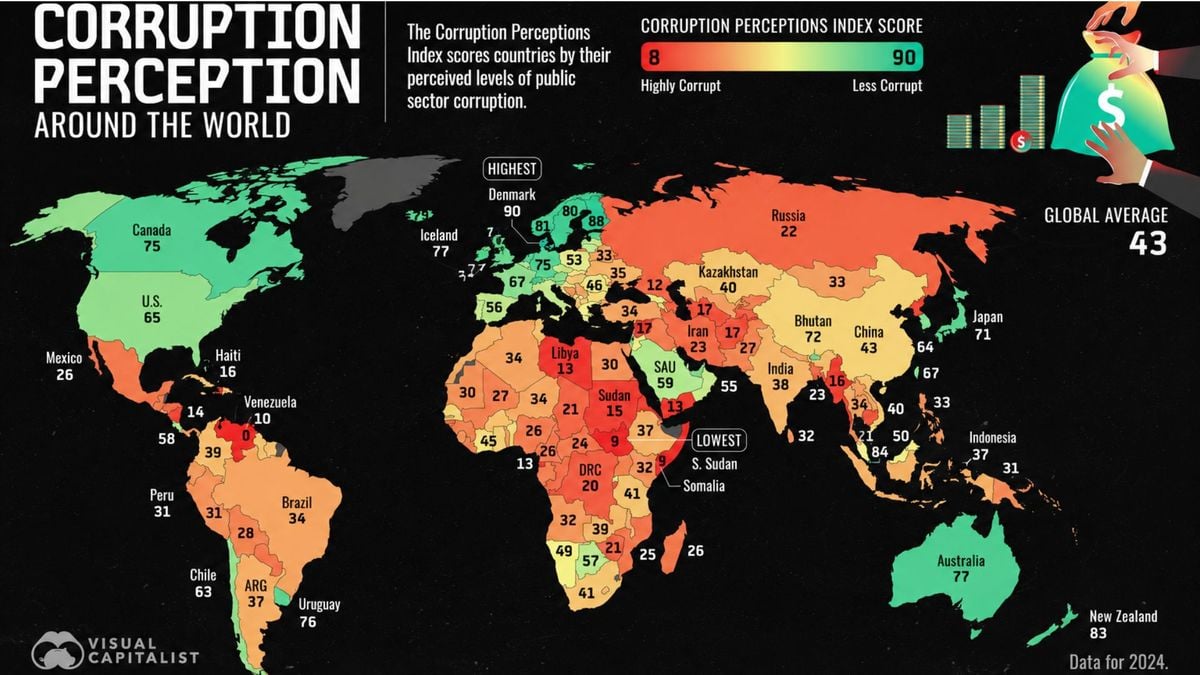
THE THOUGHTS OF THE PEOPLE OF SULTENG – The issue of corruption in government bureaucracy remains the world’s main barometer in measuring economic stability, legal certainty and a portrait of a nation’s prosperity.
Through the latest data released by the global corruption monitoring agency, the international integrity map shows a fairly wide gap between countries that have succeeded in building strong corruption prevention systems and regions that are still struggling to escape the trap of abuse of power.
In general, the performance of countries highlighted in this global index can be mapped contrastingly into three large clusters, namely countries with super clean governments, groups of countries with stable regional performance, to groups that recorded the lowest scores due to conflict or weak law enforcement.
Also read: Steel Symphony, Story of Courage, Controversy and Immortality of the Eiffel Tower, Paris, France
This analysis sheet presents this comparative portrait as a picture of world governance today.
- A Country with a Very Clean Government
In the highest caste of the global governance architecture, there are a number of countries that consistently maintain the title of regions with the lowest levels of corruption. These countries are characterized by absolute budget transparency, independence of the judiciary, and indiscriminate law enforcement.
- Denmark (Score: 89) & Finland (Score: 88). These two Nordic countries continue to lead at the top of the world. This high score is not without reason, a transparent social welfare system, fully guaranteed press freedom, and a culture of public accountability that has been inherent since the beginning are the main shields that close the loopholes in the practice of bribery and gratification.
- Singapore (Score: 84). As the sole representative of the Southeast Asian region in the ranks of the global elite, Singapore proves that territorial limitations are not an obstacle to building a clean government system. Singapore’s success formula relies on aggressive law enforcement, a strict meritocracy system, and providing very adequate compensation for state civil servants to reduce incentives to commit corruption.
- New Zealand (Score: 81) & Norway (Score: 81). Closing the top ranks, these two countries recorded twin scores. Their success is rooted in strong public participation in monitoring the running of government as well as the digitalization of the bureaucracy which minimizes illegal transactional interactions.
- Measuring the Balance of Serumpun Neighbor Governance
To get a fair perspective on the dynamics of regional development, the global index also highlights countries in the Southeast Asia region and beyond that have succeeded in maintaining internal stability and recording varying levels of legal compliance at the middle to upper levels.
- Brunei Darussalam (Score: 63). This sultanate is in a fairly safe position at the regional level. Political stability supported by state-centered welfare governance contributes greatly to keeping corruption rates low in the public sector.
- Malaysia (Score: 52). Even though it has been hit by various major political challenges in the last decade, Malaysia has managed to show resilience. A score above the threshold of 50 reflects that institutional reform, strengthening anti-corruption institutions (MACC), and public awareness are starting to produce positive results in reducing fraudulent practices.
- Timor-Leste (Score: 44). As one of the youngest countries in the region, Timor-Leste’s achievements are considered progressive. Even though they still face challenges in developing economic infrastructure, their political commitment in building legal foundations is slowly placing this country in a competitive position among other developing countries in the Asia Pacific region.
- Countries with Chronic Corruption Levels
At the other end of the spectrum of this index, there are a number of countries that have suffered due to structured, systemic corruption, which has even become rooted in the very fabric of power. The majority of countries in this category are experiencing multidimensional crises, ranging from authoritarianism, armed conflict, to economic collapse.
- Russia (Score: 22). Centralized bureaucracy and weak control over the oligarchy mean this country is trapped in a low score. Here, public institutions are often considered vulnerable to intervention by the interests of certain political and economic elites.
- Myanmar (Score: 16). Political instability following the military coup and prolonged domestic conflict have paralyzed the functions of enforcing constitutional law. As a result, corruption is rampant in almost all lines of bureaucracy and natural resource management.
- North Korea (Score: 15). Extreme international isolation and a government system that is hermetically sealed from the outside world make transparency impossible to measure, placing the country in a chronic red zone.
- Venezuela (Score: 10) & Somalia (Score: 9). Being in the lowest global position, these two countries are clear examples of how corruption is directly correlated with state failure (failed state). The collapse of public institutions, extreme hyperinflation in Venezuela, and the never-ending horizontal conflict in Somalia have made the law completely lose its strength.
Also Read: Uncovering the Classic Charm in the Heart of the Modern Metropolis of Sapporo, Japan
Looking at the comparative data above, the world map clearly shows that the level of cleanliness of a government is directly proportional to the prosperity and stability of the country. On the other hand, regions that allow their legal institutions to consistently weaken will decline to the bottom of the index, having a direct negative impact on the economy of their people.
This global data is an objective mirror for any country in the world that without a radical commitment to maintaining the independence of law enforcement agencies and cutting the chains of corrupt bureaucracy, development progress will always be held hostage by budget leaks. The figures above are a reminder that transparency is not an option, but a necessity for the future of the nation. ***