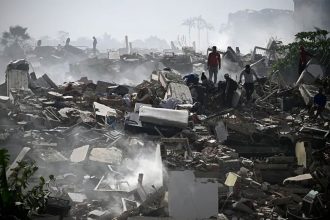
THE MIND OF THE PEOPLE — The attack on an all-girls elementary school in the Iranian city of Minab was one of the deadliest bombings of civilians carried out by the United States military in decades. But nearly four months on, the Pentagon has yet to provide an answer as to why the military fired a Tomahawk cruise missile at a school on the first day of the war, killing at least 175 people, most of them children.
Quoting The Guardian, a number of critics doubt the Pentagon will ever reveal the results of the investigation, or will bury the results under a secret classification to hide the worst mistakes from the public. As the US signs a fragile ceasefire memorandum of understanding with Iran, the secretive investigation into the attack is also a test of Defense Secretary Pete Hegseth’s new approach to what he calls “warfighting.”
Also Read: Iran Threatens to Close the Strait of Hormuz Again, Accuses Israel of Violating the Ceasefire After Attacking Lebanon
Shortly after the attack occurred at the end of February, President Donald Trump accused Iran of being the perpetrator. When it was revealed that the attack used US-made Tomahawk missiles, Trump then claimed that Iran also had access to the cruise missiles, even though in fact it did not. While celebrating a ceasefire agreement to open the Strait of Hormuz last week, Trump signaled his readiness to dismiss the attack as a mistake. “It’s a strange question to ask on this date, because you’re talking about quite a long time that has passed. But no one did that on purpose,” Trump said when asked about the investigation at a press conference at the G7 summit in Évian-les-Bains, France.
The series of attacks or “double taps” on school buildings came at the start of what Trump called a “little excursion” to Iran, killing most of the children under the age of 12. US officials anonymously told the media that the location is believed to be a base for Iran’s Islamic Revolutionary Guard Corps or IRGC.
Also Read: Make History! Tori Penso Becomes First US Female Referee to Lead 2026 World Cup Match
US Responsibility in Doubt
Mohammadreza Ahmadi Tifakani lost two of his children in the school bombing. Her seven-year-old daughter, Hanieh, was killed along with her entire class in the all-girls section of the school when the first missile hit. According to eyewitnesses, his 10-year-old son, Sobhan, survived the first blast and ran back to look for his younger sibling. He died in the second explosion. “I went to the morgue myself and identified the two,” Tifakani told The Guardian in an interview shortly after the attack.
Several former Pentagon and national security officials expressed doubts to The Guardian that the US government would take responsibility for the deaths of schoolchildren in Minab or even release a full report of the investigation. “It’s rare for a military operation to go without an incident in which a mistaken target causes civilians to be injured or killed, but then there are systems in place to investigate, assess accountability, and take responsibility,” said a former senior Pentagon official.
As part of Hegseth’s “anti-woke” campaign at the Pentagon, the military has closed or reduced units tasked with reviewing civilian casualty incidents, and has more broadly indicated that decisions made in combat by “warfighters” will not be subject to such strict scrutiny. The incident is comparable to some of the worst mass casualty incidents in previous US wars, including the 2017 Mosul airstrike that killed at least 105 people, the 2015 Kunduz hospital airstrike that killed 42 people, and the 1991 Amiriyah air shelter bombing that killed more than 400 Iraqi civilians.
Media reports indicate the investigation has been completed. Initial results suggest the attack occurred because the US used seven-year-old targeting data that failed to show that the building next to the IRGC base was actually a girls’ school. The New York Times reported last week that at least one analyst had warned colleagues several years ago that the US appeared to be targeting what is now a school in Minab, but the targeting data was not updated and military officials continued to revalidate the location as a legitimate bombing target.
Tifakani said he had little hope of accountability from US or global investigations. “They witnessed everything themselves. We saw what happened in Gaza and Palestine. Now the same tragedy is happening to our own children,” he said.
Congressional investigations into this incident also ran into obstacles. Iranian-American Congressman Yassamin Ansari who represents Arizona’s third district stated, “The US attack on Minab is one of the most horrific episodes of Trump’s entire illegal war on Iran.” He said he had written to the Trump administration demanding answers but had “received little to no response.”
Wes Bryant, a former US Air Force special operations targeting expert and former head of civil hazard assessment at the Pentagon, said his remaining colleagues overseeing civilian harm reduction at the Pentagon had been barred from seeing the initial results of the investigation. “I believe Hegseth and Trump will both do everything they can to suppress this investigation,” he said.
A report released last May by the Department of Defense inspector general concluded the U.S. military no longer has the personnel, tools or infrastructure needed to comply with two federal laws that require maintaining a functioning civilian casualty policy.***